Enterprise AI in 2026: Why Infrastructure Matters More Than Generative AI
 Vansh Banthia,
4 months ago
6 min read
Vansh Banthia,
4 months ago
6 min read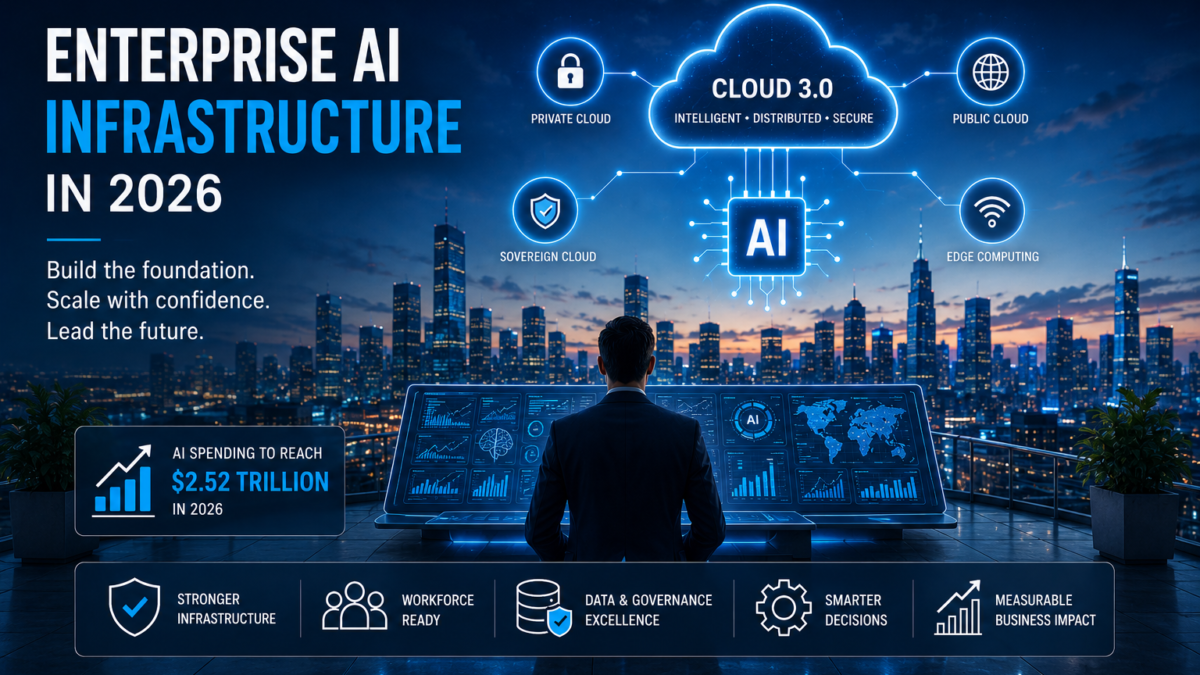
For the past few years, Enterprise AI has been defined by experimentation. Mid-sized businesses and global enterprises alike rushed to launch generative AI pilots, internal copilots, intelligent chatbots, and automated content creation tools. Innovation was the priority, and simply proving that AI could work was often considered success.
As we move through 2026, however, the conversation has fundamentally changed.
Welcome to what many industry analysts are calling the “Year of Truth for AI.”
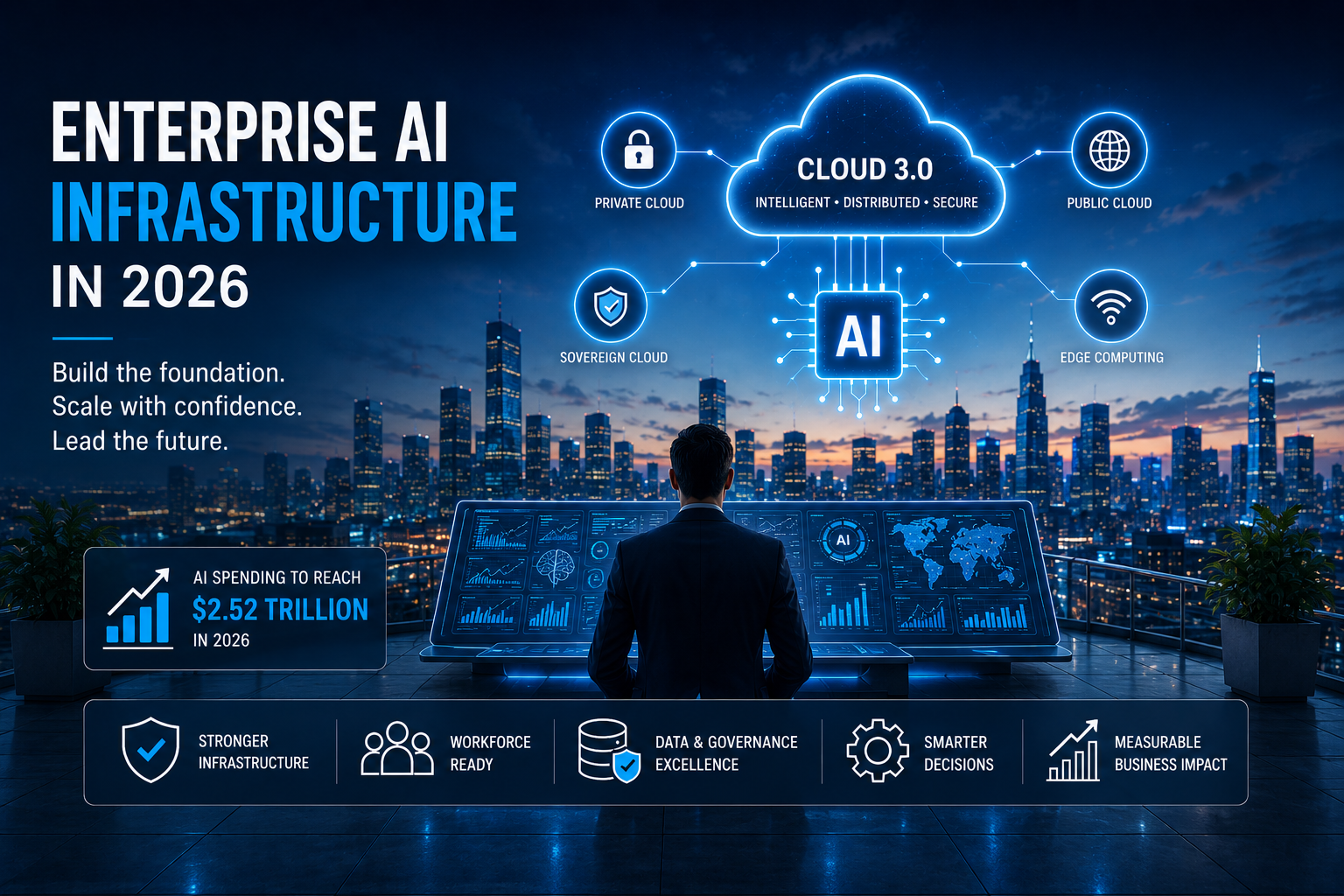
According to Gartner, worldwide spending on artificial intelligence is expected to reach an astonishing $2.52 trillion in 2026, representing a 44% year-over-year increase. Yet behind these impressive investment figures lies a more complex reality: organizations are discovering that moving AI from successful proof-of-concepts to enterprise-wide deployment requires far more than choosing the right language model. It demands a complete rethink of IT infrastructure, governance, data management, and workforce readiness.
The organizations succeeding today aren’t necessarily those deploying the most AI applications—they’re the ones building the strongest digital foundations beneath them.
The AI Infrastructure Reckoning
Understanding the Impact of Enterprise AI on Business
The initial wave of enterprise AI adoption was fueled by rapidly declining costs of large language models. Over the past two years, token pricing has dropped dramatically, making AI more accessible than ever before.
Logically, one might expect cloud costs to decrease as well.
Instead, many enterprises have watched their cloud bills surge.
The reason is simple: AI usage has grown exponentially faster than infrastructure efficiencies. Continuous inference, real-time analytics, vector databases, GPU workloads, and AI-powered business applications consume significantly more computing resources than traditional enterprise software. Legacy cloud architectures simply weren’t designed to support this new operational reality at scale.
As a result, businesses are entering what many technology leaders describe as the next evolution of cloud computing.
The Rise of Cloud 3.0
The traditional “cloud-first” strategy is evolving into something much more sophisticated.
Rather than relying exclusively on public cloud environments, organizations are building distributed ecosystems that combine multiple deployment models, including:
- Hybrid cloud
- Private cloud
- Sovereign cloud
- Edge computing
Each environment serves a different purpose. Sensitive intellectual property remains within private infrastructure, customer-facing AI applications leverage public cloud scalability, while edge computing reduces latency for real-time operations.
Instead of functioning merely as a storage platform, cloud infrastructure has become an intelligent orchestration layer that determines where AI workloads should run for optimal performance, compliance, and cost efficiency.
For enterprise leaders, the question is no longer “Should we move to the cloud?”
It’s “How do we architect the right cloud strategy for AI?”
From AI Assistants to Autonomous Agents
Infrastructure isn’t the only area evolving.
Enterprise automation itself is entering a new phase.
Rather than relying solely on prompt-and-response applications, organizations are beginning to deploy autonomous AI agents capable of planning tasks, coordinating workflows, monitoring systems, retrieving information, and making routine operational decisions with minimal human intervention.
This emerging agentic AI model promises enormous productivity gains—but it also introduces entirely new governance and operational challenges.
An autonomous system is only as reliable as the processes and data supporting it.
The Workforce Readiness Challenge
Technology, however, is only half of the equation.
According to Kyndryl’s 2026 People Readiness Report, which surveyed more than 1,100 global business and technology leaders, only 23% of executives believe their workforce is fully prepared to work alongside advanced AI systems.
This highlights one of the biggest misconceptions surrounding digital transformation.
Many organizations attempt to automate outdated processes instead of redesigning them.
Unfortunately, automating inefficient workflows doesn’t eliminate problems—it simply allows them to happen faster.
Successful enterprise AI initiatives require organizations to rethink business processes, redefine employee roles, establish governance policies, and invest heavily in AI literacy across departments.
Without that preparation, even the most sophisticated AI platform will struggle to deliver meaningful business value.
A Practical Example: Infrastructure Before Intelligence
Consider a multinational manufacturing company implementing AI-powered predictive maintenance across hundreds of production facilities.
Running every AI inference through a centralized public cloud could increase operational costs while introducing unnecessary latency.
Instead, the organization processes equipment data locally using edge computing, securely synchronizes critical insights with its private cloud, and leverages public cloud resources only for large-scale analytics and model training.
The result is faster decision-making, lower operational costs, improved data security, and significantly greater system resilience.
This illustrates an important lesson: successful enterprise AI isn’t determined by the sophistication of the model alone—it’s determined by the strength of the infrastructure supporting it.
Building the Modern Enterprise Core
Organizations preparing for long-term AI success are focusing less on individual software deployments and more on creating an integrated digital ecosystem where people, data, infrastructure, and intelligent systems work together seamlessly.
This transformation typically revolves around two strategic priorities.
1. Strengthening Core Infrastructure
Before deploying advanced AI applications, businesses need a resilient technological foundation.
Networks must be secure.
Data pipelines must be accurate.
Hybrid environments require continuous monitoring.
Cybersecurity must extend across every connected workload.
Organizations looking to modernize their infrastructure often partner with providers offering Managed IT Services to improve cloud performance, strengthen cybersecurity, simplify infrastructure management, and ensure enterprise systems remain scalable as AI adoption accelerates.
2. Making Smarter Technology Decisions
The enterprise software landscape continues to expand at an unprecedented pace.
New AI platforms, automation tools, security solutions, and productivity applications enter the market almost every week.
Choosing technology based solely on marketing promises is becoming increasingly risky.
Instead, organizations are relying on independent enterprise software research, detailed software comparisons, and comprehensive B2B technology reports to evaluate scalability, security, integrations, compliance, and long-term return on investment before making purchasing decisions.
A disciplined evaluation process reduces implementation risk while helping businesses invest in technology that aligns with their long-term strategy rather than short-term trends.
The New KPI for Enterprise AI Success
Just a few years ago, success meant building an AI prototype.
Then it became deploying AI into production.
In 2026, the benchmark has changed again.
Today’s enterprise leaders are asking more strategic questions:
- Can our infrastructure scale with increasing AI demand?
- Is our data accurate, secure, and governance-ready?
- Are employees prepared to collaborate effectively with AI systems?
- Can our technology ecosystem evolve without accumulating technical debt?
Organizations answering “yes” to these questions are positioning themselves for sustainable competitive advantage—not because they adopted AI first, but because they built the operational maturity to support it.
The Future Belongs to Organizations That Build to Last
Enterprise AI is no longer an innovation experiment—it has become a long-term business capability.
The organizations pulling ahead aren’t necessarily those launching the most attention-grabbing AI pilots. They’re the ones investing in resilient infrastructure, disciplined governance, workforce development, and thoughtful technology adoption.
By embracing hybrid cloud architectures, strengthening operational resilience, continuously upskilling employees, and making informed software investment decisions, businesses can transform AI from an exciting possibility into a dependable competitive advantage.
The era of chasing every new AI trend is fading.
The era of building durable digital foundations has arrived.
For organizations preparing for the next wave of transformation, understanding broader technology shifts is equally important. Explore our analysis of the Top 5 Enterprise Tech Trends for 2026 to discover how digital twins, agentic platforms, quantum-ready cybersecurity, and emerging enterprise technologies are reshaping business strategy for the years ahead.