If AI Isn’t Recommending You, It’s Time to Rethink Your Enterprise SEO Services
 Vansh Banthia,
3 months ago
6 min read
Vansh Banthia,
3 months ago
6 min read
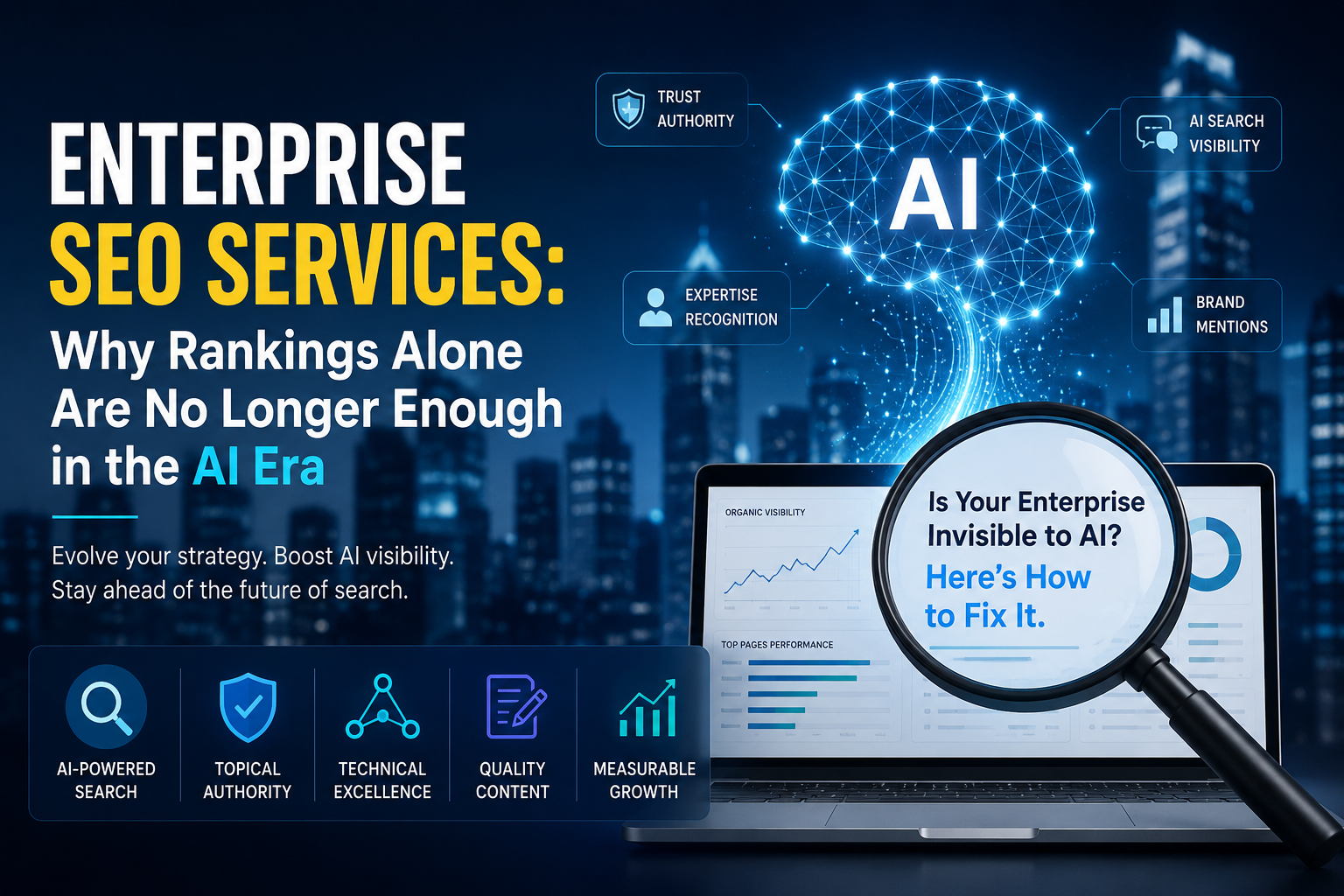
Traditional search rankings are no longer the only measure of online visibility. As AI-powered search transforms how B2B buyers discover information, enterprises must rethink their SEO strategies to remain relevant. Here’s why Enterprise SEO Services are evolving, and what decision-makers should do next.
The Rules of Enterprise Visibility Have Changed
Transforming Digital Strategies with Enterprise SEO Services
For years, the success of Enterprise SEO Services was measured by keyword rankings, organic traffic, and click-through rates. If your website ranked on the first page of Google, you were considered visible.
Today, that definition is changing.
With AI-powered search experiences becoming part of how people research solutions, discover vendors, and compare products, visibility is no longer limited to search engine results pages. Buyers are increasingly turning to AI-driven platforms that summarize information, recommend vendors, and answer questions directly, often without users clicking through to multiple websites.
For B2B enterprises, this means one thing: your brand needs to be visible not only to search engines but also to AI systems that influence purchasing decisions.
The question is no longer, “Are we ranking?” It’s, “Does AI recognize our brand as a trusted source?”
Why Enterprise SEO Services Need to Evolve
Enterprise websites are unlike typical business websites. They often include thousands of pages, multiple product lines, regional websites, extensive documentation, and content managed by different teams.
While traditional SEO ensures these websites are discoverable, modern Enterprise SEO Services must also help AI systems understand the business behind the website.
AI platforms evaluate more than keywords. They look for signals such as topical expertise, content quality and originality, brand authority across the web, consistent messaging, structured and machine-readable content, and up-to-date information. In other words, enterprise SEO is shifting from optimizing pages to building digital authority.
The Rise of AI Visibility
One of the biggest shifts in digital marketing is the concept of AI visibility.
Unlike traditional search engines that rank individual pages, AI systems generate answers by combining information from multiple trusted sources. If your enterprise isn’t among those sources, your brand may never appear in the buyer’s research journey, even if your website ranks well in search results.
This presents a new challenge for enterprise leaders.
Organizations can invest heavily in SEO, publish thousands of pages, and still have limited presence in AI-generated responses if their content lacks authority, consistency, or unique value.
That is why forward-looking Enterprise SEO Services are beginning to focus on helping brands become recognizable, trustworthy, and easy for AI systems to understand.
Why Many Enterprises Remain Invisible
Large organizations often struggle with challenges that impact both traditional search and AI visibility.
Different departments often create content independently, leading to fragmented messaging and duplicate information across multiple pages. Legacy content, outdated product pages, and obsolete documentation can reduce overall content quality and weaken topical authority over time. At the same time, as AI-generated content becomes increasingly common, publishing large volumes of generic articles is no longer enough. Enterprises need original insights that demonstrate genuine expertise and deliver value that cannot easily be replicated.
Technical complexity also remains a significant challenge. Enterprise websites frequently encounter issues such as inefficient crawl paths, duplicate URLs, poor internal linking, and inconsistent structured data, making it harder for both search engines and AI systems to interpret their content accurately.
What Modern Enterprise SEO Services Should Focus On
The role of enterprise SEO is expanding beyond rankings. To stay competitive, organizations should prioritize strategies that strengthen both search performance and AI discoverability.
Rather than publishing isolated blog posts around individual keywords, businesses should build comprehensive content hubs that address every aspect of their industry. For example, a cybersecurity company could create interconnected resources covering cloud security, compliance, threat intelligence, ransomware prevention, and risk management. This approach signals greater depth of expertise while improving content discoverability.
Organizations should also invest in original, experience-driven content because AI systems are more likely to reference content that offers something unique. Publishing industry research, benchmark reports, customer success stories, proprietary data, expert interviews, and executive insights helps establish credibility while differentiating the brand in an increasingly AI-driven search landscape.
Technical excellence remains the backbone of effective Enterprise SEO Services. Maintaining a well-structured site architecture, improving crawl efficiency, implementing structured data, strengthening internal linking, optimizing page performance, managing indexation effectively, and regularly refreshing content all make it easier for both search engines and AI systems to understand and interpret a website accurately.
At the same time, enterprises should focus on establishing consistent brand authority across the web. AI does not evaluate a website in isolation. It also considers signals from industry publications, customer reviews, executive thought leadership, conference presentations, documentation, and other trusted sources. A consistent digital presence reinforces brand authority and increases the likelihood of being recognized as a credible source.
Measuring Success Beyond Rankings
Enterprise marketing leaders should expand how they evaluate SEO performance.
Alongside traditional metrics like keyword rankings and organic traffic, organizations should also measure brand visibility across AI-powered search experiences, share of voice within their industry, growth in branded search demand, engagement with thought leadership content, high-quality backlinks from authoritative publications, organic contribution to qualified leads and pipeline, and content performance across the buyer journey. Together, these indicators provide a more complete picture of how a brand is being discovered, trusted, and influencing potential customers.
Preparing for the Future of Enterprise Search
Search is no longer just about ranking pages; it is about becoming the most credible answer.
As AI continues to reshape digital discovery, enterprises that invest in authoritative content, technical excellence, and consistent brand messaging will be better positioned to earn visibility across both traditional search engines and AI-powered platforms.
This doesn’t mean abandoning the fundamentals of SEO. Instead, it means evolving them to meet new expectations.
The future belongs to organizations that combine strong technical foundations with meaningful, experience-driven content that answers real business questions.
Final Thoughts
The evolution of AI search is changing how B2B buyers evaluate vendors, compare solutions, and make purchasing decisions. For enterprise organizations, this shift presents both a challenge and an opportunity.
Modern Enterprise SEO Services are no longer limited to improving search rankings. They help enterprises build digital authority, strengthen topical expertise, and ensure their content is discoverable in an AI-first search landscape.
For decision-makers, the key takeaway is clear: visibility is no longer just about being found on a search engine results page. It’s about being recognized as a trusted source wherever your audience is searching, whether that’s on a traditional search engine or through the next generation of AI-powered discovery.
In the AI era, the enterprises that win won’t necessarily be the ones publishing the most content. They’ll be the ones creating the most credible, connected, and authoritative digital presence.