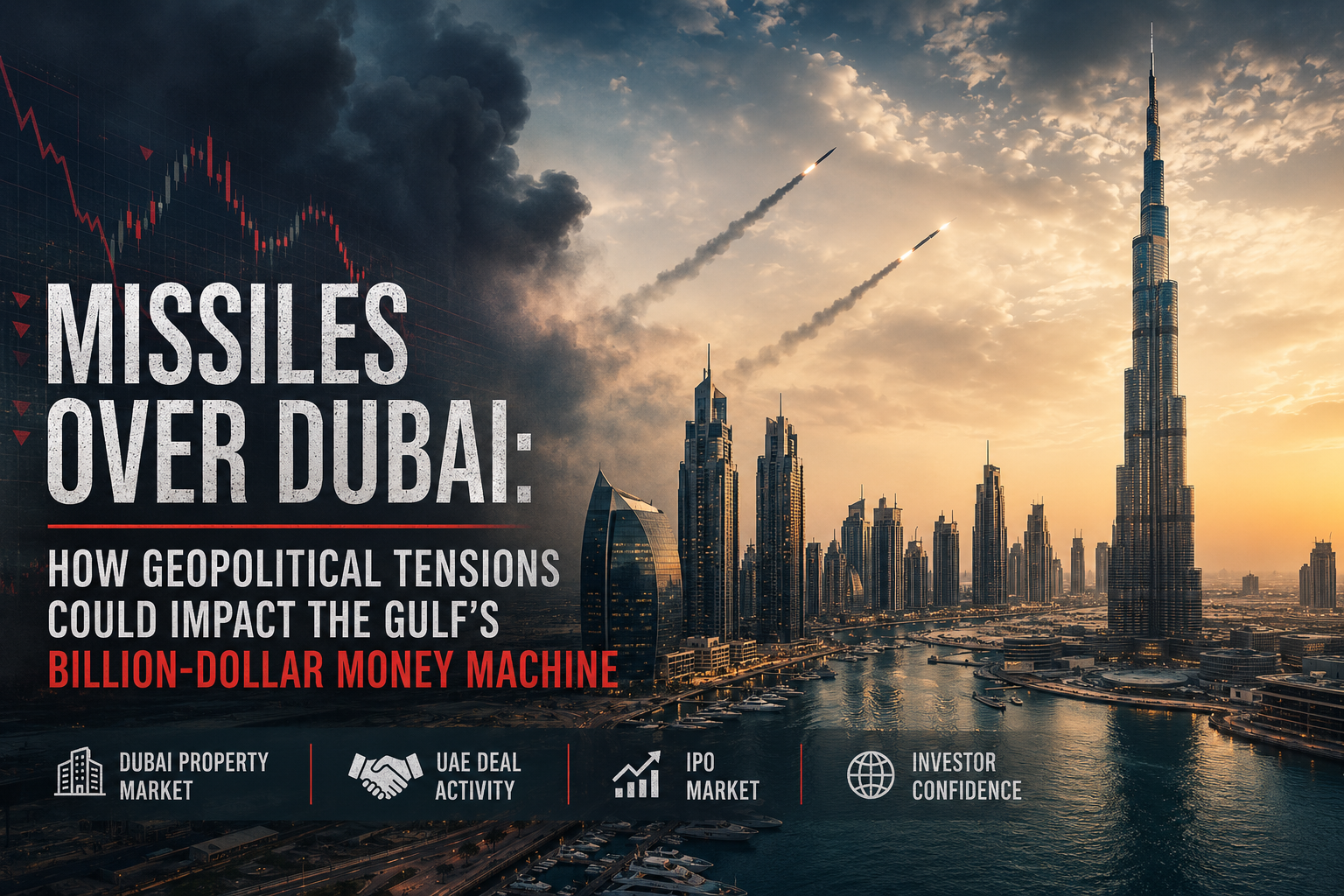
Missiles Over Dubai: Why Global Investors Are Suddenly Watching the Gulf More Carefully
 Vansh Banthia,
5 months ago
4 min read
Vansh Banthia,
5 months ago
4 min read
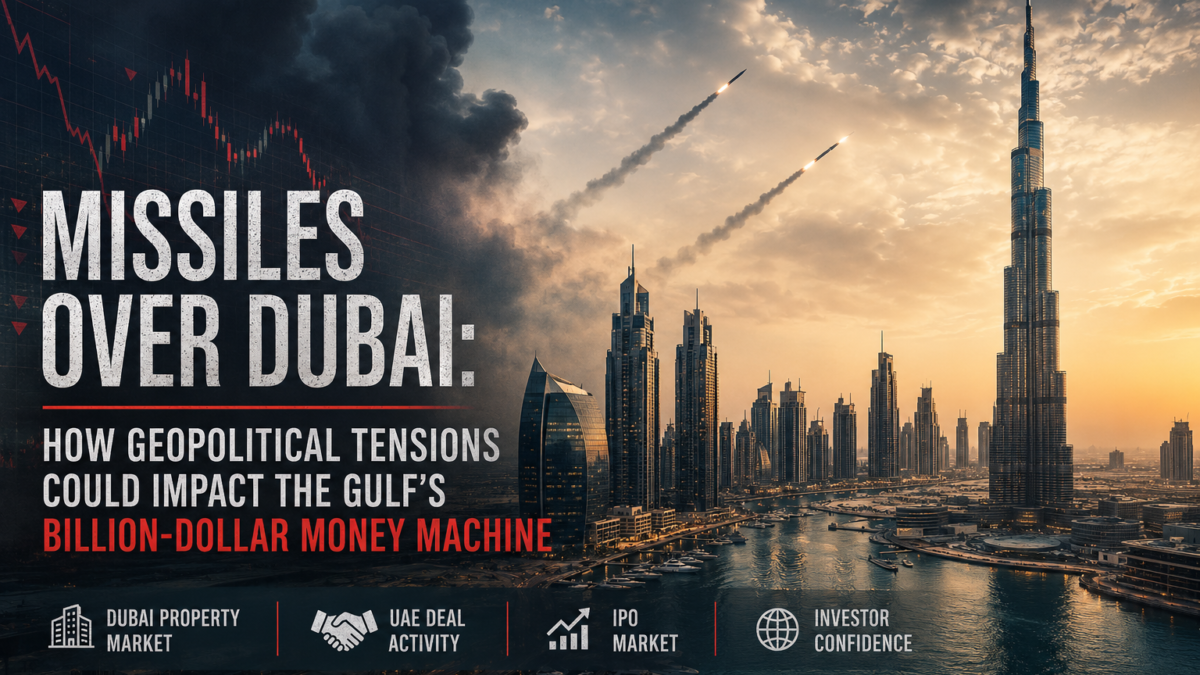
For years, Dubai positioned itself as something rare in the modern world — a city built on stability, ambition, luxury, and relentless economic momentum.
While many regions struggled with uncertainty, Dubai successfully became a global business hub where money, talent, startups, real estate investors, and multinational companies all converged rapidly. The city transformed itself into one of the world’s most attractive destinations for capital movement, high-value real estate, tourism, and international business expansion.
But recent geopolitical tensions across the Middle East are beginning to create a different kind of conversation.
The recent reports around missile activity impacting regional sentiment have once again reminded investors of an uncomfortable reality:
even the world’s strongest economic growth stories are never fully isolated from geopolitical risk.
And for Dubai — a city deeply connected to global finance, international confidence, and luxury investment flows — perception matters enormously.
Why Dubai Became a Global Financial Magnet
Dubai’s rise over the past decade has been extraordinary.
The city evolved far beyond tourism and luxury branding. It became:
- A global startup destination
- A wealth migration hub
- A real estate investment hotspot
- A financial services center
- A strategic base for multinational companies
Part of Dubai’s success came from offering something investors increasingly struggled to find elsewhere:
speed, safety, tax efficiency, and business-friendly infrastructure.
As uncertainty grew across many parts of the world after the pandemic, Dubai attracted even more global capital. High-net-worth individuals, founders, crypto entrepreneurs, investors, and international businesses increasingly moved operations or assets into the UAE.
This rapid growth fueled:
- Record property demand
- Rising luxury housing prices
- Massive tourism growth
- Strong IPO activity
- Expanding foreign investment flows
Dubai became one of the strongest symbols of economic optimism globally.
Why Geopolitical Signals Matter So Much
Financial markets react not only to actual disruptions, but also to perceived instability.
That distinction is extremely important.
Even limited geopolitical escalations can trigger broader investor caution because global capital tends to prioritize predictability above everything else.
For a region like the Gulf, where economic growth is deeply connected to international confidence, geopolitical headlines can quickly influence:
- Investor sentiment
- Real estate momentum
- Tourism confidence
- Market liquidity
- Business expansion decisions
This does not necessarily mean economic collapse or long-term decline.
But it does mean perception becomes highly sensitive.
And in globally connected financial ecosystems, perception itself can influence market behavior.
Dubai’s Real Estate Boom Faces a New Question
One of the biggest areas investors are now watching closely is Dubai’s real estate sector.
Over the past few years, Dubai experienced one of the strongest luxury property booms in the world. Demand surged from international buyers seeking:
- Asset diversification
- Tax advantages
- Lifestyle migration
- Political stability
- Long-term wealth preservation
Ultra-luxury developments expanded rapidly, and property prices climbed sharply across prime locations.
However, real estate markets are often highly psychological.
When uncertainty enters the narrative — even temporarily — buyer behavior can slow. International investors may delay decisions, adopt a wait-and-watch approach, or become more cautious about large capital commitments.
For Dubai, maintaining investor confidence becomes critical because confidence itself has been one of the city’s strongest economic drivers.
The Gulf’s Economic Transformation Is Still Massive
Despite rising geopolitical concerns, the broader Gulf growth story remains extremely significant.
Countries across the region are investing heavily into:
- Technology
- Tourism
- Infrastructure
- Artificial intelligence
- Financial services
- Renewable energy
- Global business ecosystems
The UAE, Saudi Arabia, and other Gulf nations continue positioning themselves as long-term global economic players rather than oil-dependent economies alone.
Dubai especially retains several structural advantages:
- Strategic global location
- Strong infrastructure
- Business-friendly regulations
- Global connectivity
- International talent attraction
These fundamentals do not disappear overnight because of geopolitical headlines.
However, periods of uncertainty can test how resilient investor confidence truly is.
Why Global Businesses Are Watching Closely
The modern global economy is highly interconnected.
A geopolitical event in one region can quickly influence:
- Commodity markets
- Currency movement
- Tourism flows
- Foreign investment behavior
- International business sentiment
That’s why multinational companies, institutional investors, venture capital firms, and financial markets are watching Gulf developments carefully right now.
Not necessarily because panic is immediate.
But because uncertainty changes decision-making behavior.
And in finance, hesitation itself can sometimes reshape momentum.
The Bigger Lesson for Global Markets
One of the most important takeaways from this situation is how deeply modern economies depend on confidence.
Economic growth today is not driven only by infrastructure or capital.
It is also driven by narrative.
Cities like Dubai grew rapidly because they successfully built a global perception of opportunity, ambition, and stability. That perception attracted businesses, investors, founders, and wealth from around the world.
When geopolitical tensions rise, markets begin reassessing risk.
The challenge for fast-growing global hubs is maintaining trust during uncertain periods.
Because in modern financial systems, confidence is often one of the most valuable economic assets a city can have.