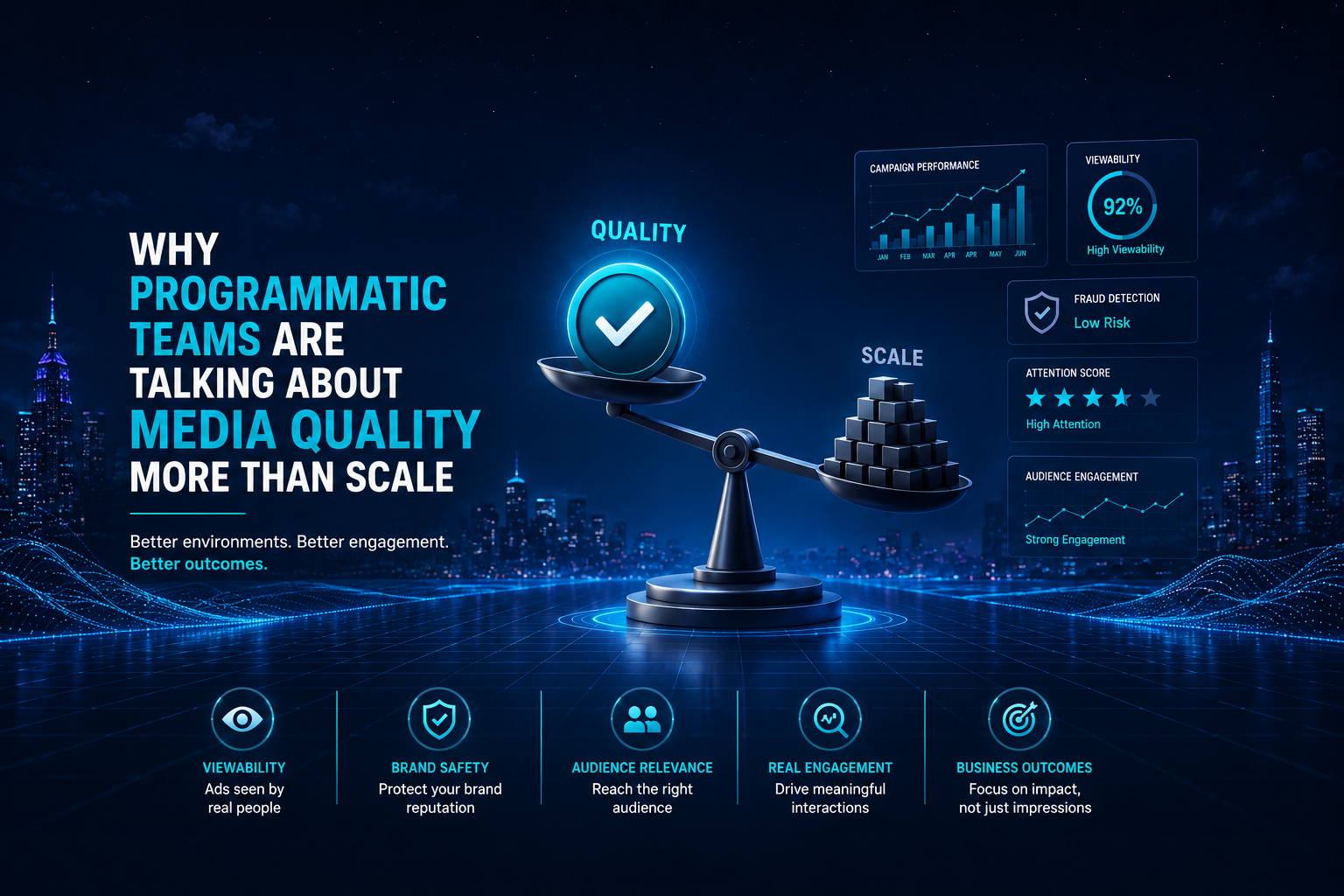
Why Programmatic Teams Are Talking About Media Quality More Than Scale
 Purva Wankhade,
3 months ago
5 min read
Purva Wankhade,
3 months ago
5 min read
For much of the past decade, programmatic advertising was defined by one dominant objective: scale. The ability to reach millions of users across thousands of websites in real time transformed digital advertising, allowing marketers to automate media buying with unprecedented efficiency. Success was often measured through impressions, reach, and the sheer volume of inventory available.
In 2026, however, the conversation has shifted. As artificial intelligence becomes more sophisticated and privacy regulations continue reshaping digital advertising, marketers are asking a different question. Instead of wondering how many impressions they can buy, they are asking whether those impressions appear in environments that genuinely influence buying decisions.
This shift is redefining Programmatic advertising. Media quality, contextual relevance, brand safety, and attention metrics are becoming stronger indicators of campaign success than inventory scale alone. Recent developments across the advertising industry show brands placing greater emphasis on trusted publisher environments, premium inventory, and measurable engagement rather than maximizing exposure at the lowest possible cost.
For B2B decision makers, this represents a significant evolution. Programmatic advertising is no longer simply about buying audiences more efficiently. It is becoming a strategy focused on buying higher-quality opportunities to influence business outcomes.
Quality Inventory Is Becoming More Valuable Than Unlimited Reach
The early promise of programmatic advertising centered on automation. Algorithms could purchase advertising inventory across countless digital properties within milliseconds, optimizing campaigns based on bids, audience targeting, and historical performance.
While automation remains essential, the digital advertising ecosystem has become significantly more complex. The decline of third-party cookies, increasing privacy regulations, AI-powered search experiences, and greater scrutiny around invalid traffic have encouraged marketers to reconsider how campaign success should be measured.
As a result, Programmatic advertising strategies are placing greater emphasis on media quality rather than inventory quantity. Premium publisher networks, curated private marketplaces, contextual targeting, and verified inventory are becoming increasingly attractive because they provide greater transparency and reduce wasted advertising spend.
Recent industry developments also reflect growing investment in supply path optimization. Advertisers are streamlining relationships with trusted supply partners to improve efficiency, reduce hidden fees, and gain better visibility into where advertisements appear. Instead of purchasing inventory through unnecessarily complex supply chains, businesses are prioritizing direct access to high-quality media environments.
For enterprise organizations, this shift delivers more than operational efficiency. It improves brand reputation by ensuring advertising appears alongside credible, professionally produced content that aligns with business values.
AI Is Redefining How Programmatic Advertising Measures Performance
Artificial intelligence is changing more than campaign automation. It is transforming how advertising platforms evaluate media quality itself.
Modern AI systems analyze contextual relevance, audience engagement, attention signals, viewability, fraud detection, user behavior, and AI crawling patterns simultaneously. Rather than optimizing campaigns exclusively for clicks or impressions, intelligent algorithms increasingly identify placements that contribute to meaningful business outcomes while also considering how content is discovered and interpreted by AI-powered search and crawling systems.
This evolution is particularly important for Programmatic advertising targeting enterprise buyers. Business purchasing decisions rarely occur after a single advertisement. Instead, decision makers interact with multiple content sources over extended buying cycles before engaging with vendors.
AI-powered optimization helps marketers understand which media environments consistently support these journeys. Campaigns appearing alongside trusted business publications, industry analysis, educational resources, and professional content often generate stronger engagement than campaigns relying solely on broad audience scale.
Another significant trend shaping the market is contextual intelligence. As advertisers adapt to privacy-first marketing environments, contextual targeting is experiencing renewed growth. Instead of depending exclusively on personal identifiers, campaigns increasingly evaluate page meaning, content themes, and audience intent to determine where advertisements should appear.
This creates more relevant customer experiences while supporting compliance with evolving privacy expectations. For B2B organizations, contextual alignment often delivers stronger performance because advertisements reach decision makers while they are actively researching business challenges.
The Future of Programmatic Advertising Will Reward Smarter Buying
The next phase of Programmatic advertising will be driven less by automation alone and more by intelligent media selection.
Advertisers are increasingly investing in attention measurement, publisher quality scores, sustainability metrics, and transparent media supply chains to ensure advertising budgets generate meaningful business impact. The industry is moving beyond simply counting impressions toward understanding whether those impressions create genuine opportunities for engagement.
Generative AI is also beginning to influence creative optimization. Advertising platforms can now analyze creative performance across multiple environments, recommend messaging improvements, and adapt campaigns based on audience behavior. However, even the most advanced creative performs better when placed within trusted, high-quality media environments.
Another emerging trend is the growing importance of first-party data. As organizations strengthen their customer data strategies, they are combining proprietary insights with contextual targeting and AI-powered optimization to create more resilient advertising programs. This reduces dependence on third-party identifiers while improving long-term campaign effectiveness.
Brand trust is becoming equally important. Advertisements appearing within respected industry publications, authoritative news platforms, and premium digital ecosystems contribute not only to campaign performance but also to broader brand perception. Buyers increasingly associate advertising quality with company credibility, making media selection a strategic business decision rather than simply a buying tactic.
For B2B decision makers, the implications are clear. The future of Programmatic advertising will not belong to organizations that purchase the most impressions. It will belong to those that consistently invest in trusted environments, meaningful audience engagement, and intelligent optimization.
Scale will always matter, but scale without quality is becoming an increasingly expensive strategy. As artificial intelligence, privacy-first advertising, and premium media ecosystems continue reshaping the digital landscape, businesses that prioritize media quality over sheer reach will build stronger brands, create more valuable customer relationships, and generate more sustainable marketing performance in the years ahead.