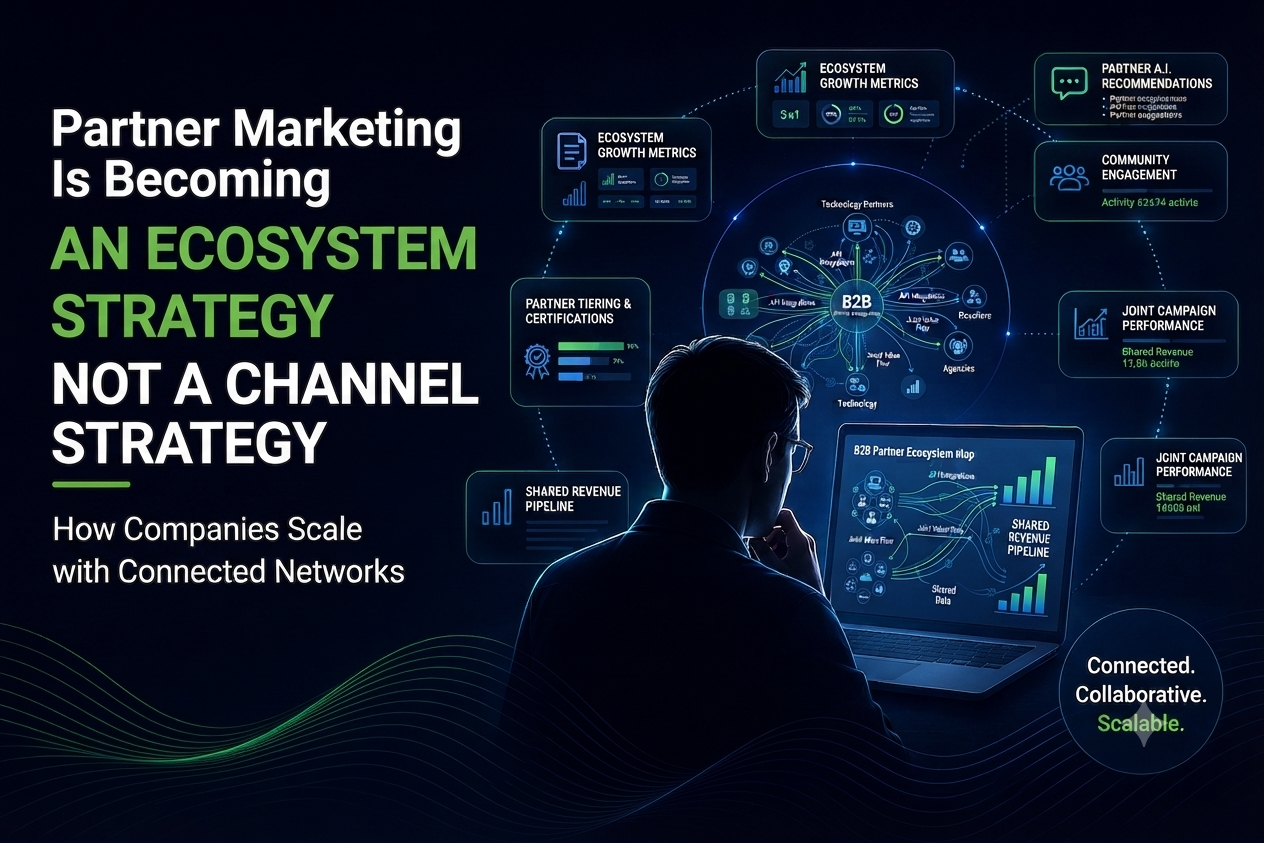
Partner Marketing Is Becoming an Ecosystem Strategy, Not a Channel Strategy
 Purva Wankhade,
3 months ago
5 min read
Purva Wankhade,
3 months ago
5 min read
For years, businesses approached partnerships much like any other marketing channel. Technology alliances generated referrals, resellers expanded geographic reach, affiliates drove leads, and co-marketing campaigns increased brand awareness. While these initiatives often delivered value, they were frequently managed as isolated programs with limited strategic integration.
That approach is rapidly becoming outdated. In 2026, Partner Marketing is evolving into something much larger: a business ecosystem strategy. Instead of viewing partners as external channels that simply generate revenue, organizations are building interconnected networks where technology providers, solution integrators, consultants, cloud platforms, distributors, and strategic alliances collectively create customer value.
This transformation is being accelerated by artificial intelligence, API-driven integrations, cloud marketplaces, and the growing complexity of enterprise buying decisions. As businesses increasingly purchase complete solutions instead of standalone products, success depends less on individual capabilities and more on the strength of the ecosystem surrounding them.
For B2B decision makers, the question is no longer whether partnerships matter. It is whether their organization is building an ecosystem capable of supporting long-term growth.
Modern Buyers Choose Ecosystems, Not Individual Vendors
Enterprise purchasing has become significantly more collaborative. A single software platform rarely solves every business challenge. Organizations increasingly combine CRM systems, ERP platforms, cybersecurity solutions, collaboration tools, analytics platforms, and AI applications into unified technology environments.
As a result, buyers evaluate not only individual products but also how effectively those products integrate with the broader business ecosystem.
Recent developments across the enterprise software industry illustrate this shift. Major technology companies continue expanding partner marketplaces, strategic alliances, and integration ecosystems to help customers deploy connected solutions more efficiently and eliminate the inefficiencies caused by disconnected platforms. AI partnerships between cloud providers, enterprise software vendors, and infrastructure companies are also accelerating innovation by combining specialized expertise rather than operating independently.
This changing landscape is reshaping Partner Marketing. Instead of focusing exclusively on lead sharing or joint campaigns, organizations are collaborating on customer success, product innovation, industry education, and solution development.
Businesses that participate in strong ecosystems gain credibility because customers view partnerships as indicators of compatibility, reliability, and long-term stability. A trusted network of partners reduces implementation complexity while giving buyers greater confidence in their investment decisions.
For enterprise organizations navigating increasingly sophisticated technology stacks, ecosystems have become powerful competitive differentiators.
Partner Marketing Is Becoming a Growth Engine
One of the biggest changes in Partner Marketing is the expanding role partners play throughout the customer lifecycle.
Historically, partnerships often centered on customer acquisition. Today, they influence implementation, onboarding, product adoption, technical support, innovation, and long-term customer retention.
Artificial intelligence is strengthening these relationships even further. AI-powered analytics help organizations identify high-performing partnerships, uncover new collaboration opportunities, predict customer needs, and optimize joint go-to-market initiatives. Instead of relying on historical performance alone, businesses can continuously refine partner strategies using real-time insights.
Cloud marketplaces are contributing to this evolution as well. Enterprise buyers increasingly discover, evaluate, and purchase business software through trusted marketplace ecosystems where complementary vendors work together rather than compete independently. This creates new opportunities for organizations to expand visibility while reducing customer acquisition friction.
The shift toward ecosystem thinking also reflects changing customer expectations. Businesses no longer want fragmented vendor relationships that require multiple disconnected implementations. They expect integrated experiences where products, services, and expertise work together seamlessly.
As a result, organizations investing in collaborative partner networks are creating value that extends far beyond marketing campaigns. They are simplifying purchasing decisions while strengthening customer outcomes.
The Future of Partner Marketing Belongs to Connected Ecosystems
The next generation of Partner Marketing will be defined less by individual campaigns and more by shared business value.
Artificial intelligence, intelligent automation, and API-first architectures are making collaboration between organizations easier than ever before. Partners can securely exchange insights, coordinate customer engagement, automate workflows, and develop integrated solutions that address increasingly complex enterprise challenges.
Another important trend shaping this evolution is the rise of co-innovation. Businesses are no longer partnering solely to promote each other’s products. They are building new services together, sharing research, integrating AI capabilities, and creating industry-specific solutions that neither organization could deliver independently.
This collaborative approach aligns closely with how enterprise buyers now make purchasing decisions. Buying committees evaluate long-term compatibility, implementation support, ecosystem maturity, and strategic alignment alongside traditional product capabilities. Organizations supported by strong partner networks often demonstrate greater resilience, broader expertise, and stronger customer success potential.
Trust is also becoming an increasingly valuable asset. Partnerships between respected organizations reinforce market credibility while expanding opportunities to reach new audiences through shared expertise. In an era where AI-powered search engines and digital platforms increasingly recognize entity relationships and authoritative collaborations, ecosystem visibility contributes to both brand reputation and long-term discoverability.
The future of Partner Marketing is no longer about managing another acquisition channel. It is about building interconnected business ecosystems where every partnership strengthens innovation, customer experience, and sustainable growth.
For B2B decision makers, this represents a strategic opportunity. Organizations that invest in collaborative ecosystems today will be better positioned to respond to changing market demands, accelerate innovation, and deliver greater value than businesses operating in isolation. They can leverage shared expertise, co-develop solutions, access new customer segments, and improve resilience through stronger strategic partnerships. As technology continues to connect businesses more closely, ecosystem-driven collaboration will become a critical driver of sustainable growth and long-term competitive success. In a connected digital economy, competitive advantage will increasingly belong to companies that build the strongest ecosystems, not simply the largest customer lists.