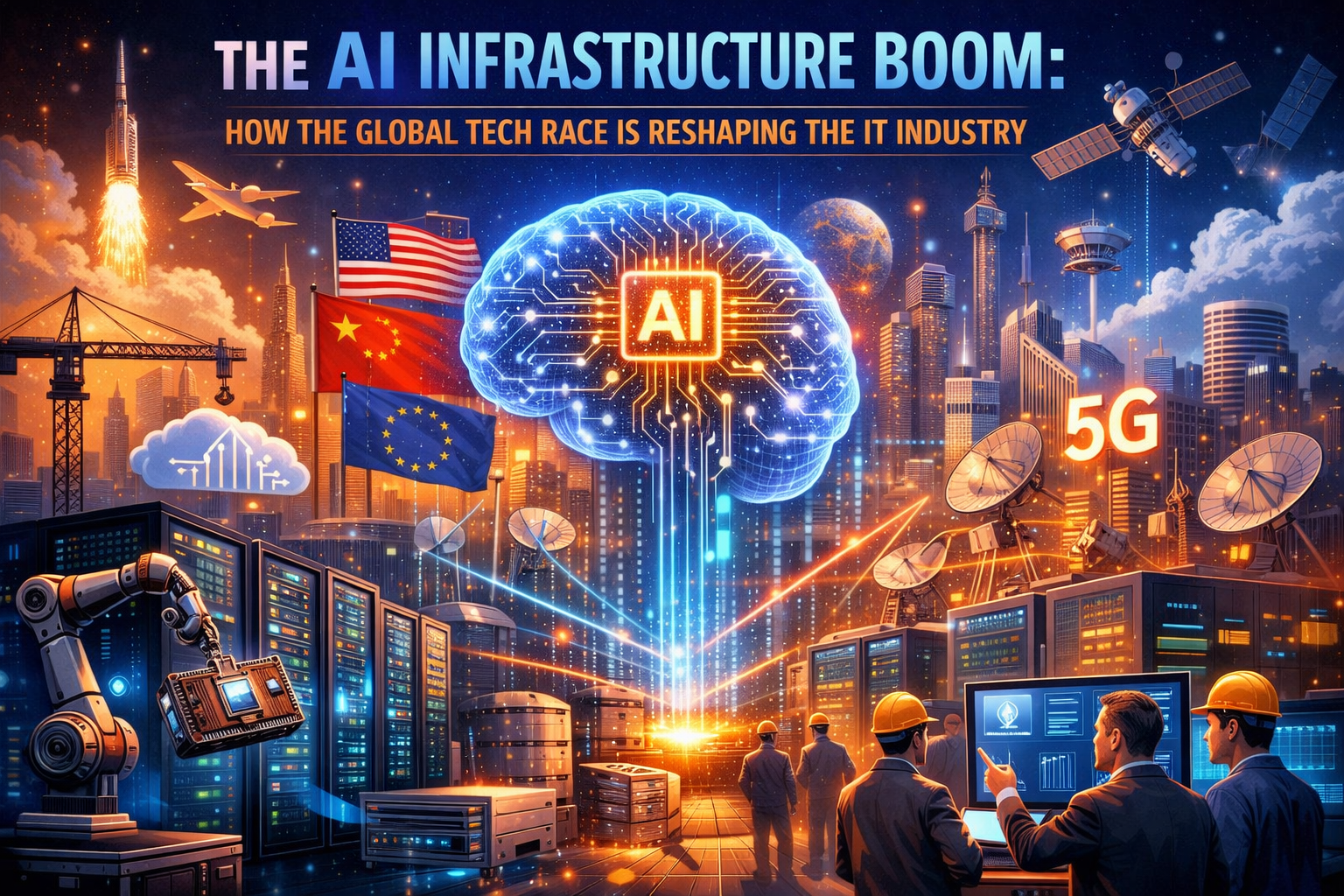
The AI Infrastructure Boom: How the Global Tech Race is Reshaping the IT Industry
 Vansh Banthia,
3 weeks ago
4 min read
Vansh Banthia,
3 weeks ago
4 min read
The global technology landscape is undergoing one of its most significant transformations in decades. Artificial intelligence has moved beyond experimentation and is now driving massive investments, infrastructure expansion, and industry restructuring.
From semiconductor partnerships to multi-billion-dollar data center investments, companies across the technology ecosystem are racing to build the infrastructure needed to power the next generation of AI applications. This surge is not only reshaping the tech industry but also influencing hiring trends, investment strategies, and enterprise technology adoption.
For businesses operating in the IT ecosystem, understanding these shifts is essential to staying competitive.
The Massive Investment in AI Infrastructure
Technology companies are pouring billions of dollars into building AI infrastructure, including advanced chips, data centers, and cloud computing capacity. Industry giants such as OpenAI, Microsoft, and Google are aggressively expanding their computing capabilities to support increasingly complex AI models.
The demand for AI computing power is so high that semiconductor companies and equipment manufacturers are forming strategic partnerships to accelerate innovation. Recently, Applied Materials partnered with major memory chip manufacturers Micron and SK Hynix to develop next-generation memory technologies designed specifically for AI workloads.
These collaborations highlight a broader industry trend: AI development now depends heavily on hardware innovation and large-scale computing infrastructure.
The Global AI Chip Race
At the heart of the AI boom lies an intense competition among semiconductor companies.
AI models require enormous computing resources for both training and inference. As a result, demand for high-performance chips has skyrocketed.
Companies are developing specialized processors designed specifically for AI applications. New generations of AI chips promise faster processing speeds and significantly improved efficiency, enabling organizations to deploy advanced AI models at scale.
The semiconductor race has become so critical that governments are also becoming involved, with regulatory discussions and policies aimed at controlling AI chip exports and strengthening domestic manufacturing capabilities.
AI Investment vs Workforce Restructuring
While AI investment is increasing rapidly, the industry is simultaneously experiencing workforce restructuring.
Many technology companies are reallocating resources toward AI development and automation, leading to significant job cuts in other areas. Reports indicate that more than 45,000 tech jobs have already been cut globally in early 2026, with a portion of those layoffs linked to AI-driven restructuring.
Companies are prioritizing AI research, data infrastructure, and automation capabilities, which often require different skill sets than traditional software or support roles.
This shift signals a long-term transformation of the technology workforce.
Why AI Infrastructure is Becoming the New Tech Battleground
The rapid expansion of AI capabilities is creating an entirely new competitive landscape.
Organizations that control AI infrastructure—such as advanced chips, data centers, and large-scale computing clusters—will likely dominate the next generation of technology platforms.
This is why major technology companies are investing heavily in:
- AI supercomputing clusters
- Advanced semiconductor manufacturing
- High-performance memory chips
- Global data center networks
- AI-optimized cloud platforms
These investments are shaping what many analysts describe as the “AI infrastructure race.”
The Impact on the Global IT Ecosystem
The ripple effects of this transformation extend across the entire technology industry.
Enterprise Software
Businesses are integrating AI into enterprise tools, automation platforms, and analytics systems to increase productivity and reduce operational costs.
Cloud Computing
Cloud providers are expanding AI capabilities within their platforms, offering organizations easier access to high-performance computing resources.
Semiconductor Industry
Chip manufacturers are experiencing unprecedented demand due to the computing requirements of modern AI models.
IT Services
Consulting firms and IT service providers are seeing increased demand for AI implementation, integration, and data strategy services.
What This Means for Businesses
For companies operating in the IT and B2B technology space, these developments present both challenges and opportunities.
Organizations that adopt AI-driven technologies early can gain competitive advantages in automation, analytics, and decision-making.
At the same time, companies must adapt their strategies to align with the new AI-focused technology ecosystem.
Key areas businesses should focus on include:
- AI adoption and integration
- data infrastructure modernization
- cloud and computing scalability
- AI talent development
- strategic technology partnerships
The Future of the AI-Driven Tech Economy
The AI boom is still in its early stages. As technology companies continue investing heavily in infrastructure, the global IT landscape will evolve rapidly over the next decade.
Industry experts believe that AI will become as foundational to modern business as cloud computing and the internet itself.
The organizations that successfully navigate this shift will be those that combine innovation, infrastructure, and strategic partnerships.
In the race for AI dominance, the real winners may not just be the companies building the smartest algorithms—but those building the infrastructure that powers them.