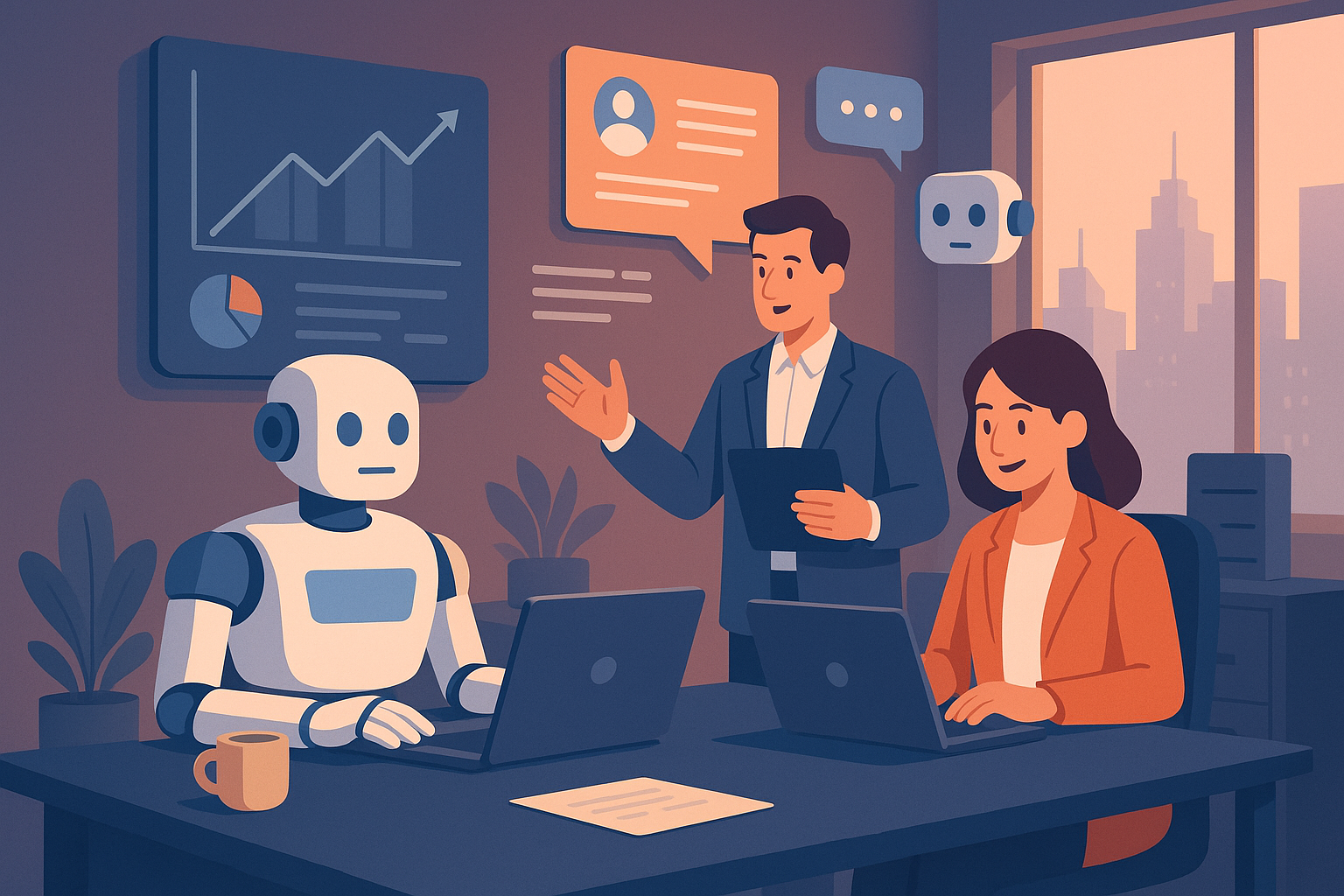
AI Agents in 2025: How Autonomous Systems Are Transforming Business
 Gaurav Uttamchandani,
4 months ago
5 min read
Gaurav Uttamchandani,
4 months ago
5 min read
Table of Contents: AI Agents in 2025 – Overview & Quick Links
Artificial intelligence has entered a new phase—one where AI agents can work autonomously, make decisions, and execute complex tasks without constant human oversight. From customer service and marketing automation to cybersecurity and DevOps, AI agents are becoming the backbone of modern digital transformation.
For businesses aiming to scale efficiently, AI agents offer the perfect mix of speed, intelligence, and automation. In this blog, we break down what AI agents are, how they work, real-world use cases, and how companies can deploy them to unlock exponential growth.
What Are AI Agents?
AI agents are autonomous systems capable of understanding goals, analyzing context, and taking actions to achieve desired outcomes. Unlike traditional automation, which follows rigid rules, AI agents can:
- Interpret natural language
- Make real-time decisions
- Access tools, APIs, and databases
- Learn from data and adapt
- Execute multi-step workflows automatically
These agents operate similarly to human digital workers—handling tasks, monitoring environments, and proactively solving problems.
How AI Agents Work: The Core Framework
Modern AI agents are powered by a blend of AI models, reasoning engines, memory, and tool integrations. Here’s a simplified breakdown:
1. Input Processing
Agents take instructions through text, voice, or system triggers.
2. Goal Interpretation
Using LLMs, the agent understands the objective and breaks it down into actionable subtasks.
3. Tool & Knowledge Access
Agents access real-time data, applications, and APIs such as:
- CRM platforms
- Email systems
- Code repositories
- Knowledge bases
4. Workflow Execution
The agent executes tasks autonomously—sending emails, analyzing data, generating reports, or updating databases.
5. Learning & Optimization
Some agents continuously learn from results, improving accuracy and efficiency.
Top Business Use Cases of AI Agents in 2025
AI agents are reshaping industries across the board. Here are the most impactful real-world applications:
1. Customer Support Automation
Modern support teams use AI agents to handle:
- Ticket resolution
- FAQs
- Order tracking
- Refund processing
- Conversational support
These systems reduce wait times, cut operational costs, and offer 24/7 global coverage.
2. Sales & Marketing Automation
AI agents can act as digital SDRs (Sales Development Representatives), managing:
- Lead qualification
- Outreach sequencing
- Email personalization
- CRM updates
- Competitor research
They also analyze campaign performance and recommend optimization strategies.
3. AI Agents in Software Development (DevOps Agents)
DevOps teams use AI agents to:
- Run diagnostics
- Deploy code
- Monitor system health
- Predict failures
- Auto-remediate issues
This dramatically reduces downtime and accelerates release cycles.
4. Finance & Risk Management
AI agents help finance teams by:
- Automating reconciliation
- Detecting fraud
- Generating financial reports
- Monitoring credit risks
- Ensuring compliance
Their ability to analyze large datasets in seconds makes them indispensable.
5. HR & Talent Management
HR teams deploy AI agents for:
- Resume screening
- Employee onboarding
- Payroll processing
- Policy management
- Skill gap analysis
They improve efficiency and eliminate repetitive manual workloads.
Benefits of AI Agents for Modern Businesses
1. Massive Productivity Gains
AI agents handle repetitive workloads, freeing employees for strategic tasks.
2. Cost Reduction
Businesses save on labor costs and operational inefficiencies.
3. Better Decision Making
Agents analyze data at scale and provide instant recommendations.
4. 24/7 Operations
AI agents never sleep, ensuring continuous business performance.
5. Error Reduction
Automation minimizes human errors and ensures consistency.
How to Implement AI Agents in Your Organization: A Step-by-Step Guide
Step 1: Identify High-Impact Workflows
Look for repetitive, time-consuming, or data-heavy tasks.
Examples:
- Customer emails
- Database updates
- Reporting
- Lead follow-ups
Step 2: Choose the Right AI Agent Framework
Options include custom LLM agents, no-code platforms, and enterprise AI tools.
Step 3: Integrate Your Tools & Data Sources
Connect CRMs, ERP systems, cloud platforms, and APIs.
Step 4: Define Guardrails & Compliance Policies
Ensure your AI agent follows security protocols and governance rules.
Step 5: Test, Deploy & Optimize
Start with small tasks and gradually scale to mission-critical workflows.
Real-World Example: How AI Agents Are Reshaping B2B Workflows
Many B2B enterprises now rely on agent-based systems for:
- Automated prospecting
- Multi-channel content distribution
- AI-led data enrichment
- Predictive analytics
- Intelligent routing
This shift enables teams to operate at speeds previously impossible with manual work.
Future of AI Agents: What’s Next?
By 2026 and beyond, expect AI agents to become:
- More autonomous
- More reliable through memory systems
- More deeply integrated with enterprise tools
- Capable of collaborating like human teams
Businesses that adopt early will gain a major competitive edge.
Conclusion
AI agents are no longer futuristic—they’re an operational necessity. Organizations that leverage them can automate mission-critical workflows, improve scalability, and unlock higher profits with fewer resources.
If your business is exploring how AI can streamline operations, 2025 is the perfect time to begin.
CTA: Ready to Scale Your Business with AI Automation?
iTMunch helps businesses stay ahead of the technology curve with insights, strategies, and expert coverage on AI, automation, and digital transformation.
Ready to scale your B2B content reach and generate high-quality leads?
Partner with iTMunch to unlock smarter, data-driven content syndication strategies today.
You May Also Like: How Content Syndication Maximizes Whitepaper ROI: A Complete Guide for B2B Marketers