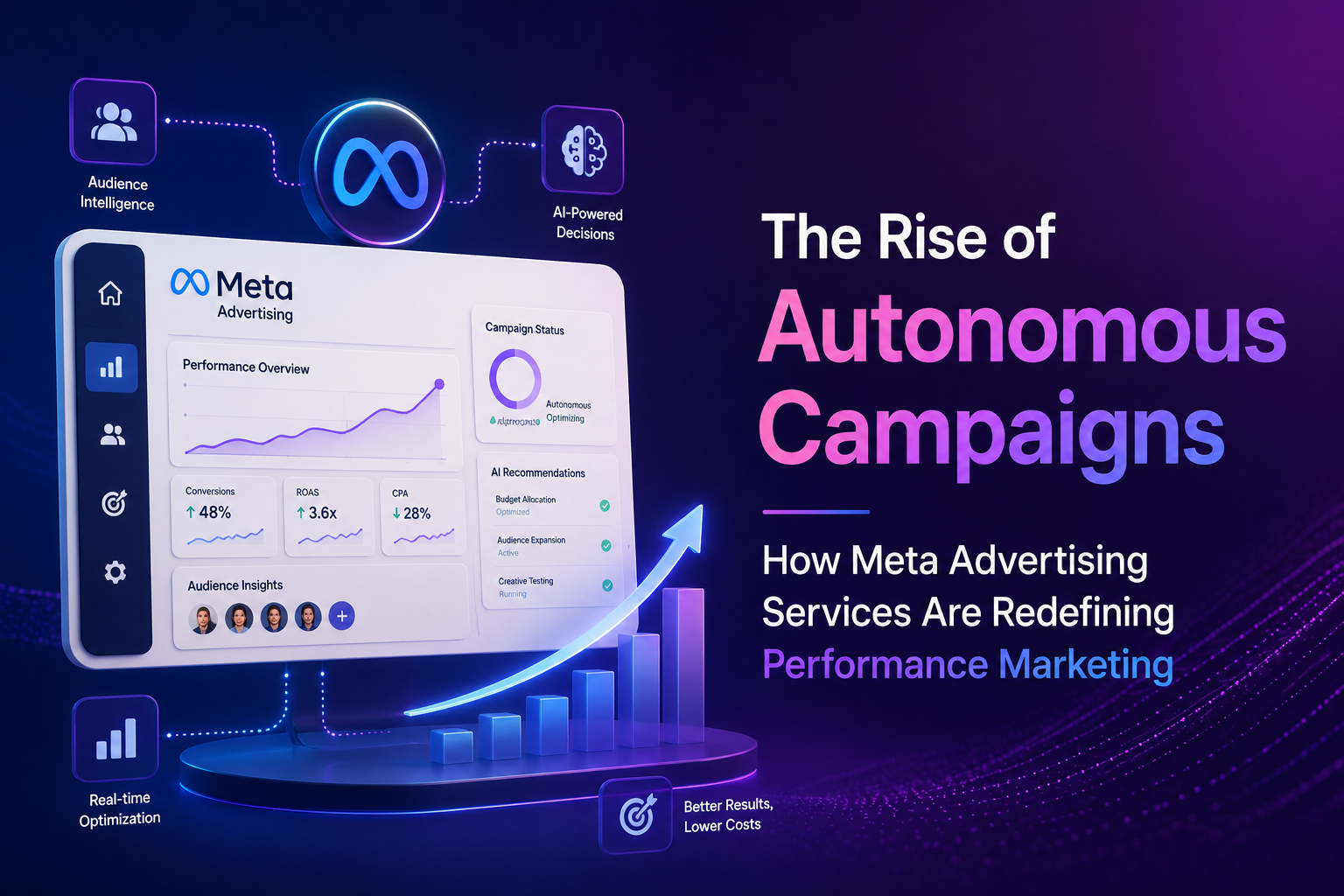
The Rise of Autonomous Campaigns: How Meta Advertising Services Are Redefining Performance Marketing
 Purva Wankhade,
2 months ago
5 min read
Purva Wankhade,
2 months ago
5 min read
Performance marketing has entered a new era. For years, campaign success depended heavily on manual audience segmentation, bid adjustments, creative testing, and constant optimization by marketing teams. While human expertise remains essential, artificial intelligence is fundamentally changing how campaigns are planned, executed, and optimized. Today, Meta Advertising is evolving beyond campaign management into an autonomous system capable of making millions of optimization decisions in real time.
This transformation is reshaping the relationship between marketers and advertising platforms. Instead of manually controlling every campaign variable, businesses are increasingly defining objectives, providing high-quality creative assets, and allowing AI to determine the most effective combinations of audiences, placements, bidding strategies, and delivery timing. The result is a marketing environment where automation is not replacing strategy but amplifying it.
For B2B decision-makers, this shift represents far more than another platform update. It reflects a broader movement toward AI-driven marketing ecosystems where intelligent systems continuously learn, adapt, and improve campaign performance with minimal manual intervention. As enterprise organizations pursue greater efficiency and measurable business outcomes, autonomous advertising is becoming a defining characteristic of modern digital marketing.
AI Is Transforming Campaign Management Into Continuous Optimization
Artificial intelligence has steadily become the foundation of digital advertising, but recent advancements have accelerated its role dramatically. Modern Meta Advertising platforms now analyze vast volumes of behavioral signals, contextual information, engagement history, and conversion patterns to optimize campaigns continuously throughout their lifecycle.
Instead of relying solely on predefined audience targeting, AI models evaluate thousands of variables simultaneously to determine where advertisements should appear, which creative assets perform best, and how budgets should be allocated to maximize campaign objectives.
Recent innovations across Meta’s advertising ecosystem continue reinforcing this trend. AI-powered campaign automation, creative generation capabilities, predictive audience expansion, and intelligent performance optimization are reducing the need for constant manual adjustments while enabling campaigns to respond dynamically to changing user behavior.
This evolution changes how marketing teams approach campaign management. Rather than spending significant time adjusting bids or refining audience segments, marketers are focusing more on strategic planning, creative quality, messaging, and business outcomes. Success increasingly depends on providing AI with strong creative inputs, reliable conversion data, and clearly defined objectives instead of managing every operational detail.
The shift also highlights the growing importance of first-party data. As privacy regulations evolve and digital tracking methods continue changing, organizations are investing more heavily in customer-owned data sources that improve AI optimization while maintaining regulatory compliance. High-quality data has become one of the most valuable competitive advantages in AI-driven advertising.
Creative Intelligence Is Becoming the New Competitive Advantage
As automation increasingly manages campaign delivery, creative quality is emerging as one of the most significant differentiators in digital advertising.
AI can determine where and when advertisements appear, but the creative experience remains central to customer engagement. Businesses are therefore investing in diverse creative assets, personalized messaging, dynamic formats, and data-informed storytelling that allow AI systems to identify the combinations most likely to resonate with different audiences.
This evolution is changing the strategic role of Meta Advertising within enterprise organizations. Campaign success is becoming less dependent on manual optimization expertise and more dependent on the organization’s ability to continuously produce relevant, high-quality creative experiences supported by meaningful customer insights.
Another important trend is the growing use of AI-assisted creative production. Marketing teams are leveraging intelligent tools to generate image variations, refine copy, localize messaging, and accelerate creative testing while maintaining brand consistency. These capabilities allow organizations to experiment at a scale that would have been difficult using traditional production methods alone.
At the same time, measurement is becoming increasingly sophisticated. Instead of evaluating isolated campaign metrics, enterprises are connecting advertising performance with CRM systems, customer data platforms, revenue analytics, and business intelligence environments. This provides greater visibility into how advertising contributes to long-term customer relationships rather than short-term engagement alone.
For B2B organizations managing complex buying journeys, this integrated view helps marketing leaders better understand which campaigns influence pipeline growth, account engagement, and revenue generation across multiple customer touchpoints.
The Future of Meta Advertising Is Autonomous, Connected, and Intelligent
The next generation of digital advertising will likely involve far greater collaboration between artificial intelligence and human decision-makers. Autonomous campaigns will continue expanding their ability to optimize performance, but strategic direction will remain firmly rooted in human expertise.
Forward-looking organizations are already adapting to this reality. Rather than evaluating advertising platforms solely on campaign management capabilities, they are prioritizing AI transparency, data quality, governance, cross-platform integration, and measurable business impact. These considerations are becoming essential as marketing automation grows increasingly intelligent.
Another emerging trend is the integration of advertising with broader enterprise ecosystems. Meta Advertising is becoming more closely connected with customer relationship management platforms, marketing automation systems, analytics tools, commerce environments, and AI-powered business intelligence solutions. This interconnected approach enables organizations to transform advertising from an isolated marketing activity into a continuous source of customer intelligence.
Trust is also becoming a defining factor. As AI assumes greater responsibility for campaign optimization, organizations are placing increased emphasis on responsible data usage, privacy compliance, transparent reporting, and explainable automation. Building confidence in AI-driven decision-making will be just as important as improving campaign efficiency.
Ultimately, autonomous campaigns represent a significant milestone in the evolution of performance marketing. They allow businesses to respond faster to changing customer behavior, optimize campaigns at unprecedented scale, and unlock efficiencies that manual processes cannot easily achieve.
The future of Meta Advertising is therefore not simply about automation, it is about intelligent collaboration between technology, creativity, and strategic decision-making. Organizations that embrace this balance will be better positioned to build stronger customer relationships, adapt to rapidly evolving digital ecosystems, and achieve sustainable growth in an increasingly AI-driven advertising landscape.