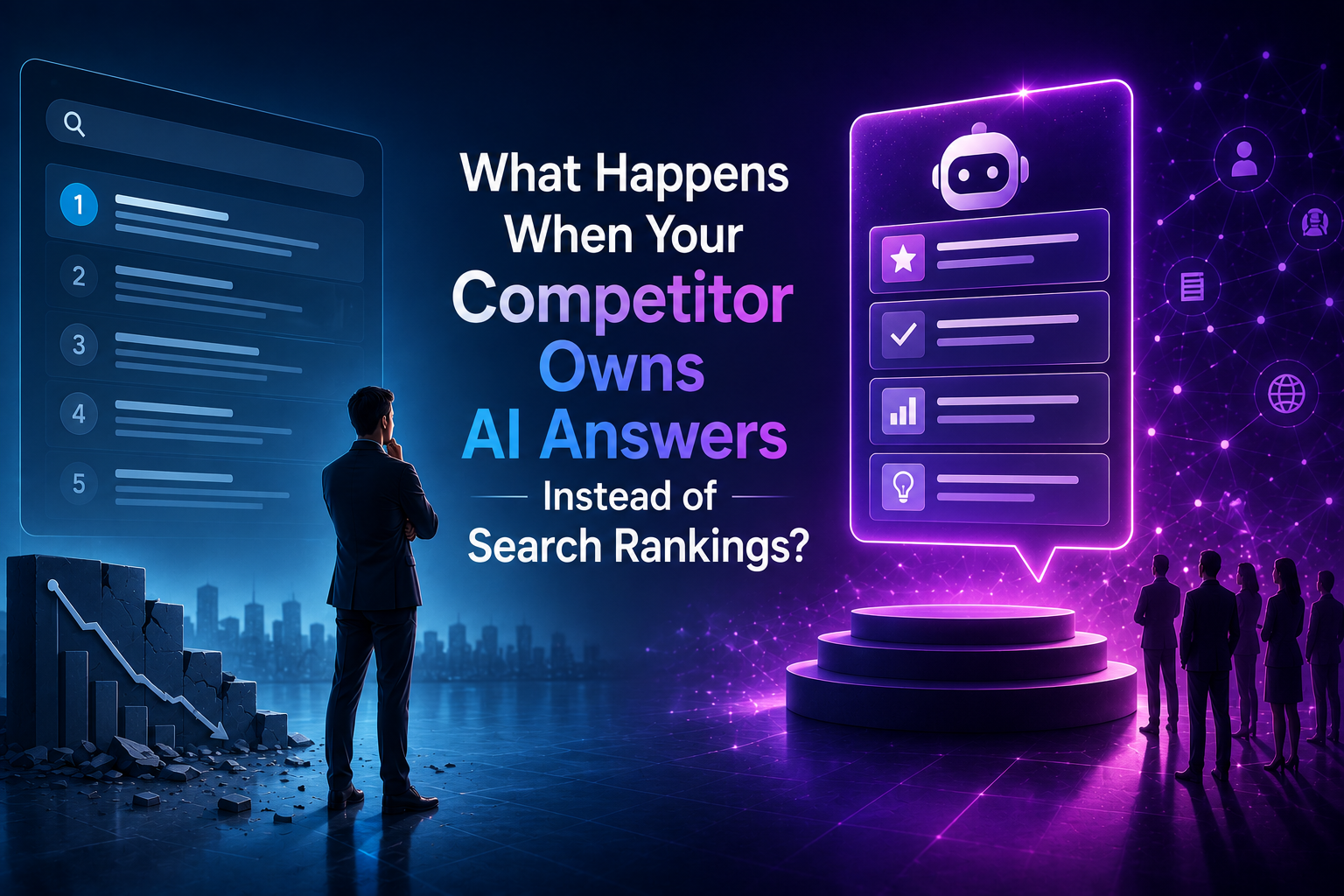
What Happens When Your Competitor Owns AI Answers Instead of Search Rankings?
 Purva Wankhade,
2 months ago
4 min read
Purva Wankhade,
2 months ago
4 min read
For decades, businesses have competed for one thing: the top position on search engine results pages. As enterprise SEO strategies have become more sophisticated, organizations have invested heavily in improving visibility, authority, and long-term organic growth.
Ranking first on Google was considered the ultimate measure of digital visibility. Companies invested in keyword strategies, technical optimization, content creation, and link building to secure valuable search real estate.
But search is entering a new era.
The rise of AI-powered search experiences is changing how buyers discover information, evaluate solutions, and make decisions. Instead of scrolling through multiple search results, users are increasingly receiving direct answers generated by artificial intelligence systems.
This creates a new competitive challenge.
What happens when your competitor is no longer just ranking higher than you, but becoming the brand that AI systems recommend, summarize, and reference?
In this evolving landscape, visibility is moving beyond traditional rankings. Businesses now need to understand how their digital presence is interpreted by AI-driven platforms, search engines, and intelligent assistants.
This is where Enterprise SEO is becoming more strategic than ever. It is no longer only about improving rankings at scale. It is about building digital authority that allows organizations to remain visible in an AI-first search environment.
AI Search Is Changing the Definition of Digital Visibility
The relationship between users and search engines has fundamentally changed.
Traditional search required users to enter a query, review multiple links, and decide which sources appeared trustworthy. AI-powered search experiences are designed to simplify this process by understanding intent, analyzing information, and providing summarized responses.
Google’s expansion of AI Overviews and the growth of AI-powered discovery tools reflect this broader shift. Search engines are increasingly focused on delivering helpful answers rather than simply displaying websites.
For businesses, this means being ranked on page one may no longer guarantee visibility.
A company can have strong traditional rankings but still lose attention if AI systems consistently highlight competitors in generated answers. The brands appearing in AI responses are often those with strong topical authority, clear information structures, trustworthy content, and recognized expertise.
This creates a new competitive battlefield.
Businesses are no longer competing only for clicks. They are competing to become the source that AI systems trust.
Enterprise SEO is evolving around this reality by focusing on how large organizations can create consistent, authoritative, and technically optimized digital ecosystems that support visibility across traditional and AI-driven search platforms.
Why Enterprise SEO Is Becoming a Business Strategy, Not Just a Marketing Function
For large organizations, search visibility has always been complex. Multiple websites, thousands of pages, different product categories, global audiences, and constantly changing customer needs make enterprise-level optimization challenging.
AI search adds another layer of complexity.
Search systems are becoming better at understanding relationships between topics, entities, brands, and expertise. This means businesses need more than individual pages optimized around keywords. They need connected content ecosystems that clearly communicate their knowledge and authority.
A competitor owning AI answers may not necessarily have more content. They may simply have a stronger digital footprint that helps AI systems understand their relevance.
This is why Enterprise SEO is moving closer to business strategy.
Organizations need to think about how their content represents their expertise, how their technical infrastructure supports discovery, and how consistently their brand information appears across digital channels.
Structured data, high-quality content, strong internal linking, authoritative resources, and accurate brand information are becoming increasingly important because they help search systems interpret and trust online information.
The future of SEO is not just about being found. It is about being understood.
The Next Competitive Advantage Will Be AI Visibility
The shift toward AI-powered search does not mean traditional SEO is disappearing. Search rankings, technical performance, and content optimization remain important.
However, the definition of success is expanding.
Forward-thinking businesses are beginning to measure visibility across multiple environments, including traditional search results, AI-generated answers, conversational search platforms, and emerging discovery experiences.
This requires a different mindset.
Instead of asking, “How do we rank for this keyword?” organizations need to ask, “How do we become the most trusted answer for this topic?”
This shift will influence how companies create content, organize information, and build authority.
The brands that succeed in AI search will likely be those that integrate enterprise SEO with genuine expertise rather than relying on short-term optimization tactics. They will create resources that answer complex customer questions, demonstrate industry knowledge, and provide meaningful value throughout the buyer journey.
For B2B decision-makers, this represents a major change in how digital competition works. A competitor appearing consistently in AI answers has a significant advantage because they are influencing customer decisions before traditional website visits even happen.
The next generation of search competition will not only be about who ranks first.
It will be about who gets recognized first.
As AI continues to reshape discovery, Enterprise SEO will play a critical role in helping businesses build the authority, structure, and trust needed to remain visible in an increasingly intelligent search ecosystem.