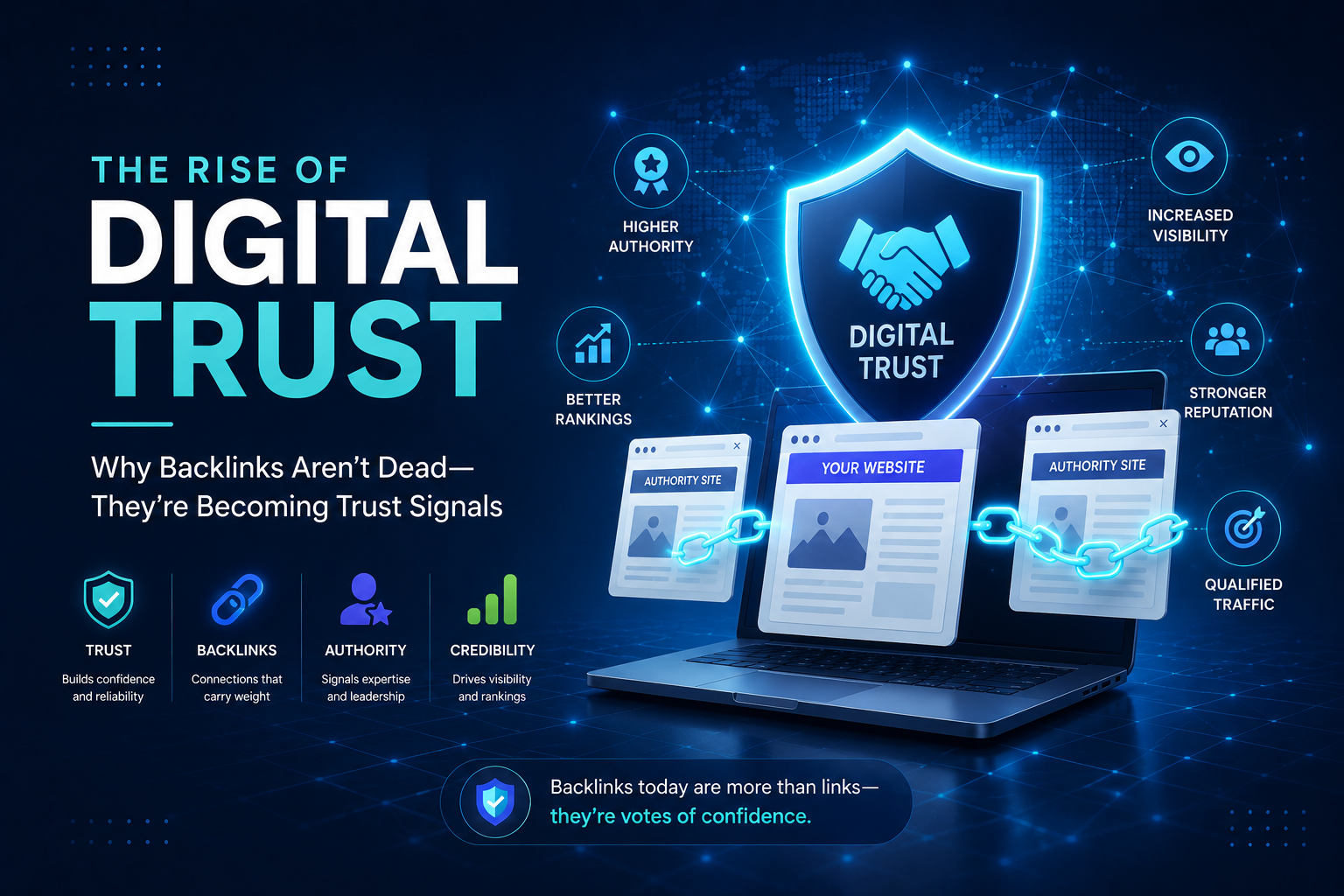
The Rise of Digital Trust: Why Backlinks Aren’t Dead-They’re Becoming Trust Signals
 Purva Wankhade,
2 months ago
5 min read
Purva Wankhade,
2 months ago
5 min read
For years, every time Google released a major algorithm update, a familiar prediction resurfaced: backlinks are dead. Yet every year, the opposite proved true. What has changed isn’t the importance of a backlink—it’s the role it plays in modern search.
In 2026, search has evolved beyond blue links. AI-powered search experiences, answer engines, and generative search results are changing how people discover information. Enterprise buyers are increasingly finding vendors through AI-generated summaries instead of scrolling through pages of results. This shift has prompted many B2B leaders to question whether traditional SEO signals still matter.
The answer is yes—but not in the way they once did.
A backlink is no longer just a ranking factor. It’s becoming a digital trust signal that helps search engines and AI systems determine whether a brand deserves visibility, credibility, and authority in an increasingly crowded information landscape.
For decision-makers responsible for growth, this distinction matters. Winning organic visibility today isn’t about accumulating the highest number of links. It’s about earning recognition from the right sources.
The AI Search Era Has Changed the Meaning of a Backlink
Search engines have spent years improving their ability to understand content quality, context, and expertise. The rise of generative AI has accelerated that evolution.
Modern AI-powered search experiences don’t simply retrieve webpages. They synthesize information from multiple trusted sources before presenting answers to users. That means the web’s trust ecosystem has become more important than ever.
When respected industry publications, research organizations, business journals, universities, and authoritative websites reference a company, they’re doing more than passing SEO value. They’re creating a network of credibility that algorithms can interpret.
A high-quality backlink increasingly functions like a professional recommendation in the digital world.
Imagine evaluating two technology vendors. Both claim to be market leaders, but one is regularly cited by respected industry publications, featured in independent research, and referenced by authoritative business websites. The other exists largely within its own marketing ecosystem.
The decision becomes easier because trust is being reinforced by third parties.
Search engines and AI systems operate similarly. They don’t just analyze what companies say about themselves—they evaluate what the broader web says about them.
This is one reason why recent discussions around Google’s evolving search ecosystem and AI-driven search experiences continue to emphasize authority, expertise, and content quality. While ranking systems have become significantly more sophisticated, independent validation remains one of the strongest indicators of credibility.
Digital Authority Is Becoming a Competitive Advantage
One of the biggest misconceptions in B2B marketing is that backlinks are purely an SEO metric.
In reality, they’re increasingly becoming a business credibility metric.
Enterprise purchasing decisions involve long buying cycles, multiple stakeholders, and significant financial commitments. Before contacting a vendor, decision-makers often encounter the brand across numerous digital touchpoints.
They might discover a research report, read an industry publication, listen to a podcast, explore thought leadership content, or see the company mentioned in a market analysis.
Each independent mention reinforces trust.
Every quality backlink contributes to this broader reputation ecosystem.
This explains why many enterprise organizations are shifting their content strategies away from producing large volumes of keyword-focused articles and toward creating original research, executive insights, benchmark reports, proprietary data, and opinion-led content that naturally attracts citations. High-value assets like these also perform well across a B2B lead generation marketplace, helping organizations engage decision-makers with credible, insight-driven content while generating qualified demand.
The objective isn’t simply to earn links.
It’s to become a reference point within an industry.
As AI increasingly summarizes information from trusted sources, brands that consistently appear across authoritative publications are likely to enjoy stronger visibility—not only in traditional search results but also in AI-generated responses.
For B2B companies, this creates a compelling opportunity. Instead of chasing rankings directly, they can focus on becoming organizations that others naturally reference.
The resulting backlinks become evidence of market trust rather than isolated SEO achievements.
The Future Belongs to Brands That Earn Recognition
The conversation around backlinks is shifting from quantity to reputation.
Years ago, SEO strategies often focused on acquiring as many links as possible. Today, one meaningful citation from an influential industry publication can deliver greater long-term value than dozens of low-quality links.
This reflects a broader shift happening across digital marketing.
AI has dramatically lowered the barrier to producing content. Businesses can generate articles, landing pages, and marketing copy faster than ever before. As content volume increases, trust becomes the scarce resource.
Search engines know this.
AI systems know this.
Customers know this.
That’s why signals of independent validation are becoming increasingly valuable.
A backlink from a trusted source tells algorithms that a company has contributed something worth referencing. It suggests expertise that extends beyond self-promotion.
Looking ahead, this dynamic is likely to become even more influential as AI search experiences continue to evolve. Large language models thrive on trustworthy, well-cited information. Brands that consistently publish original ideas, unique research, practical frameworks, and valuable industry insights are more likely to become part of those trusted knowledge networks.
For B2B leaders, this changes the strategic question.
Instead of asking, “How do we build more backlinks?” organizations should ask, “What can we create that others genuinely want to reference?”
That shift transforms backlink acquisition from an SEO tactic into a brand-building strategy.
The companies that succeed in the next era of search won’t necessarily be those producing the most content. They’ll be the ones producing the most trusted content.
As AI reshapes how information is discovered, evaluated, and recommended, trust is emerging as the new currency of digital visibility. In that environment, a backlink is no longer just a technical SEO signal—it’s evidence that a brand has earned recognition from the wider web.
And in a marketplace where credibility influences every stage of the buyer journey, that may be more valuable than ever before.