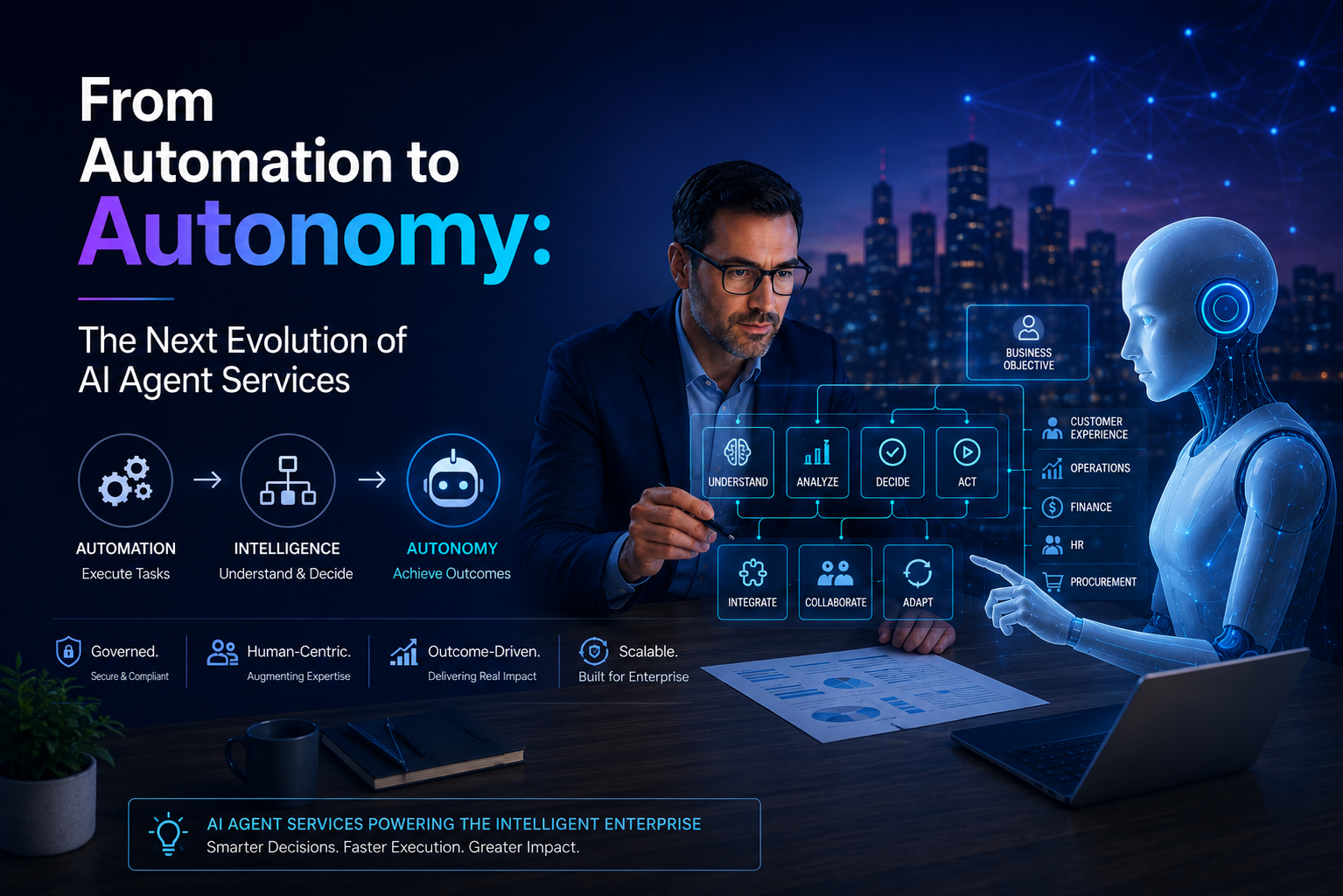
From Automation to Autonomy: The Next Evolution of AI Agent Services
 Vansh Banthia,
2 months ago
5 min read
Vansh Banthia,
2 months ago
5 min read
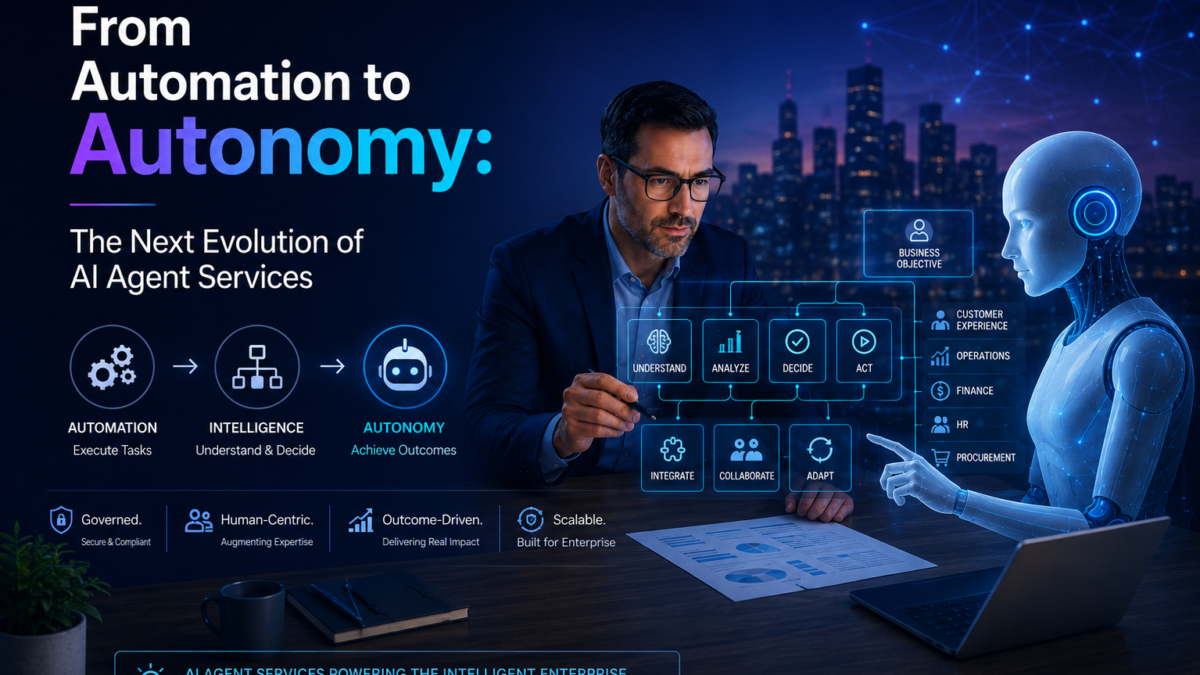
For decades, automation has been at the heart of digital transformation. Businesses invested in technologies that could streamline repetitive tasks, reduce manual effort, and improve operational efficiency. From workflow automation and robotic process automation (RPA) to AI-powered chatbots, the goal was clear: execute predefined tasks faster and more accurately.
Today, enterprise AI is entering a fundamentally different era.
Rather than simply automating individual processes, organizations are beginning to adopt systems capable of understanding objectives, making contextual decisions, coordinating multiple actions, and adapting in real time. This shift marks the emergence of autonomous AI, and at its center are AI Agent services.
For B2B decision-makers, this isn’t just another technology trend. It represents a new operating model where intelligent agents become active participants in business processes, helping organizations move beyond efficiency toward greater agility, scalability, and innovation.
The Difference Between Automation and Autonomy
Traditional automation follows a predictable path. It executes rules, completes repetitive tasks, and performs actions based on predefined workflows. While these systems have delivered measurable productivity gains, they remain dependent on structured inputs and human-defined processes.
Autonomous AI introduces a different approach.
Powered by advances in large language models, reasoning capabilities, memory, and orchestration frameworks, AI agents can interpret goals rather than simply execute commands. They can analyze information from multiple sources, decide on the next best action, collaborate with other systems, and continuously refine their responses based on changing conditions.
This distinction is becoming increasingly important for enterprises. Instead of asking software to perform one isolated task, businesses are beginning to delegate entire workflows to intelligent agents capable of managing complex processes with minimal supervision.
That evolution is reshaping expectations around what enterprise AI can accomplish.
Why AI Agent Services Are Gaining Enterprise Momentum
The rapid acceleration of agentic AI has become one of the defining trends in enterprise technology. Major technology providers have introduced platforms designed to support autonomous AI agents, enabling organizations to build systems that interact across applications, retrieve enterprise knowledge, automate decision-making, and execute multi-step workflows.
This momentum is being driven by a simple business reality. Modern organizations operate across hundreds of software applications, generating vast amounts of data that often remain disconnected. Employees spend significant time switching between systems, gathering information, and coordinating routine activities before meaningful work can even begin.
AI Agent services help bridge these operational gaps by acting as intelligent connectors between people, data, and business applications. Instead of replacing existing technology investments, they enhance them by enabling software to work together more intelligently and with greater context.
For enterprise leaders, the value lies not only in reducing operational complexity but also in enabling faster and more informed decision-making across the organization.
From Task Automation to Outcome-Oriented Execution
One of the most significant changes introduced by AI agents is the shift from task-based automation to outcome-based execution.
Traditional automation focuses on completing individual activities. An autonomous agent, however, works toward achieving a defined business objective.
Consider a customer support operation. Instead of routing tickets through predefined workflows, an AI agent can analyze the customer’s issue, retrieve relevant documentation, coordinate with internal knowledge systems, recommend solutions, escalate when necessary, and provide continuous updates throughout the resolution process.
The emphasis moves from executing isolated actions to successfully delivering outcomes.
This approach is equally relevant across sales, marketing, finance, human resources, procurement, and operations, where multiple systems and stakeholders are involved in achieving business goals.
Human Expertise Remains Central
Despite growing enthusiasm around autonomous AI, successful implementation is not about removing humans from the equation.
Enterprise leaders increasingly recognize that AI performs best when it augments human expertise rather than replacing it. Strategic judgment, relationship building, creativity, ethical decision-making, and complex problem-solving remain uniquely human capabilities.
The role of AI agents is to reduce administrative burden, surface relevant insights, accelerate execution, and support employees in making better decisions.
This collaborative model – often referred to as human-in-the-loop AI , is becoming the preferred approach for organizations seeking to balance innovation with accountability. As AI systems become more capable, governance, transparency, and human oversight will remain essential components of enterprise adoption.
Governance Is Becoming as Important as Innovation
As organizations expand the use of autonomous AI, governance has emerged as one of the most important considerations.
AI agents frequently interact with sensitive business data, customer information, financial systems, and critical enterprise applications. Ensuring these systems operate securely, ethically, and within clearly defined permissions is becoming a strategic priority.
Businesses are increasingly establishing governance frameworks that address data privacy, regulatory compliance, auditability, access controls, and responsible AI practices. Rather than slowing innovation, these measures create the trust necessary for organizations to deploy AI agents at scale.
For decision-makers, the conversation is shifting from whether autonomous AI should be adopted to how it can be implemented responsibly while maintaining operational resilience.
The Future Belongs to Intelligent Enterprise Systems
The next phase of digital transformation will not be defined solely by software automation. It will be shaped by intelligent systems capable of reasoning, adapting, collaborating, and executing complex business objectives with increasing autonomy.
As enterprise platforms continue integrating agentic AI capabilities, organizations will move beyond isolated AI assistants toward interconnected networks of specialized agents working together across departments. Marketing teams may rely on AI agents to personalize campaigns, analyze market signals, and optimize whitepaper performance metrics by identifying high-intent audiences and improving content engagement, while finance teams use them to monitor risks, procurement departments optimize supplier decisions, and customer service organizations deliver faster, more contextual support.
This evolution reflects a broader shift in enterprise technology. Businesses are no longer looking for tools that simply complete tasks ,they are investing in systems that contribute directly to business outcomes.
For organizations evaluating their long-term AI strategy, AI Agent services represent more than the next generation of automation. They signal a transition toward intelligent operations where technology becomes an active collaborator rather than a passive tool.
The companies that embrace this evolution thoughtfully ,combining autonomous capabilities with strong governance and human expertise will be better positioned to improve efficiency, respond to changing market conditions, and create sustainable competitive advantages. As enterprise AI continues to mature, the future will belong not to the organizations that automate the most processes, but to those that build the smartest systems capable of acting with purpose, context, and accountability.