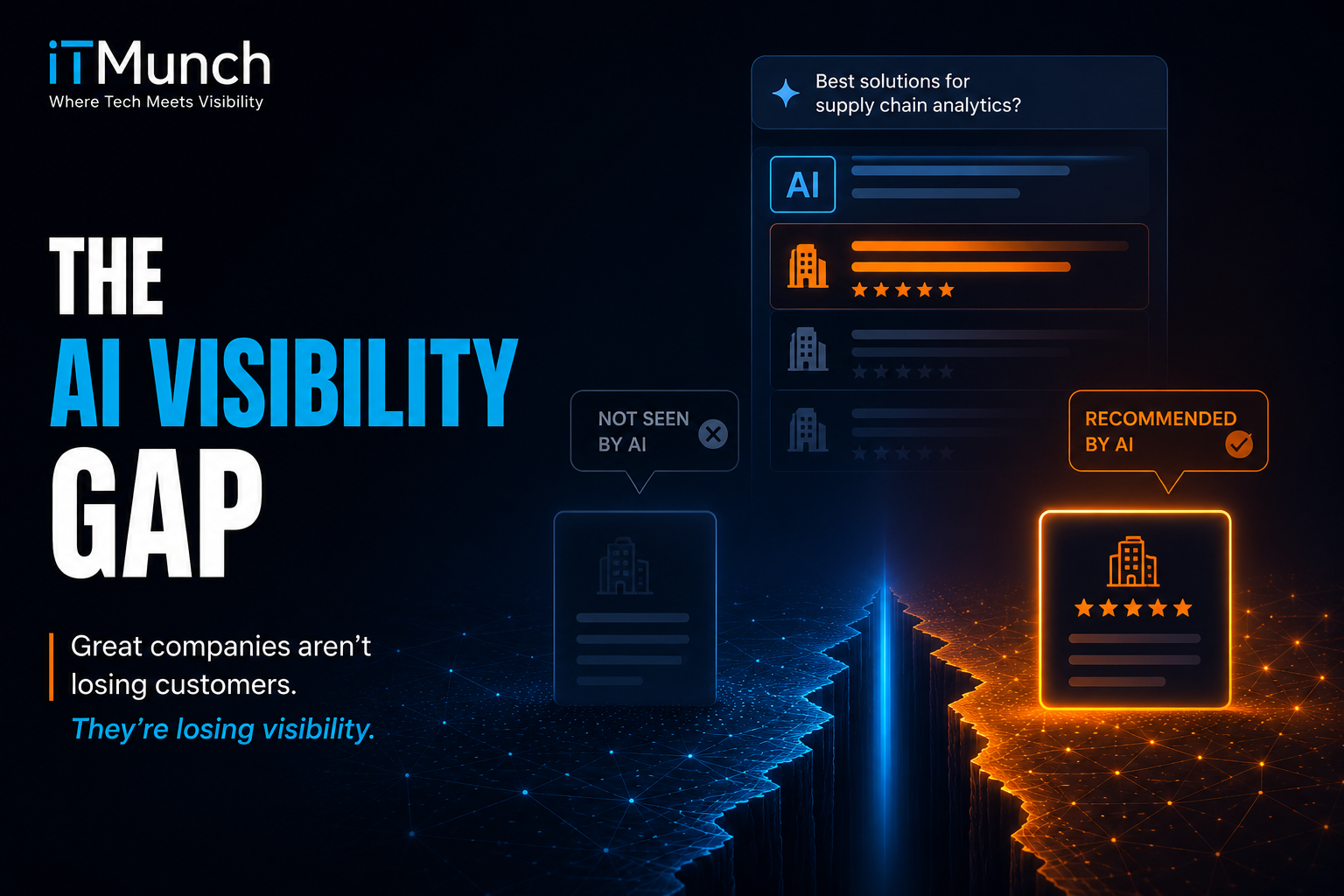
The AI Visibility Gap: Why Great B2B Companies Are Becoming Invisible in 2026
 Vansh Banthia,
4 months ago
5 min read
Vansh Banthia,
4 months ago
5 min read
For years, B2B marketing followed a predictable playbook.
Build a website. Invest in SEO. Publish content. Run campaigns. Generate leads.
The goal was simple: rank higher on search engines and attract potential buyers.
But in 2026, something fundamental has changed.
Increasingly, buyers aren’t clicking through pages of search results. They’re asking AI platforms directly.
Instead of searching:
“Best supply chain analytics software”
they ask:
“Which supply chain analytics platforms are best for manufacturing companies?”
And instead of receiving ten blue links, they get a curated answer generated by AI.
The result?
Many companies that once relied on traditional search visibility are discovering a new challenge:
They’ve become invisible to AI.
This is what industry experts are beginning to call the AI Visibility Gap.
The Shift From Search Engines to Answer Engines
Traditional search engines were designed to help users find websites.
AI search tools are designed to help users find answers.
That’s a massive difference.
In the traditional model:
- Your website ranked.
- The user clicked.
- You had an opportunity to convert.
In the AI model:
- AI gathers information from multiple sources.
- AI creates a summarized response.
- The user often never visits your website.
For B2B companies, this changes the entire visibility equation.
Visibility is no longer measured solely by rankings.
It’s measured by whether AI considers your company relevant enough to include in its answer.
Why Great Companies Are Being Left Out
Many organizations assume that having a strong website is enough.
Unfortunately, AI systems evaluate credibility differently than traditional search engines.
They look beyond your website.
AI models increasingly rely on signals from:
- Industry publications
- Analyst reports
- Marketplace listings
- Review platforms
- Business directories
- Thought leadership content
- News coverage
- Community discussions
A company may have an excellent product and a beautiful website.
But if it lacks visibility across these trusted ecosystems, AI may overlook it entirely.
The result is a growing disconnect between business quality and business discoverability.
The Rise of Distributed Visibility
In previous years, marketers focused heavily on owned media.
Today, visibility is becoming distributed.
Think about how buyers conduct research.
Before making a purchase decision, they often consume information from multiple sources:
- Review websites
- Industry blogs
- Independent analysts
- Online communities
- Vendor comparison platforms
- Marketplaces
AI systems follow a similar pattern.
They aggregate information from across the web to determine which solutions deserve attention.
This means your digital presence can no longer exist in a single location.
Your brand must be visible wherever buying decisions are being influenced.
Why Marketplaces Are Becoming Strategic Assets
One of the biggest changes in B2B marketing is the growing importance of industry marketplaces.
Historically, marketplaces were viewed primarily as lead generation channels.
Today, they serve a much broader purpose.
They help businesses:
Establish Credibility
Being listed in respected marketplaces creates additional trust signals.
Improve Discoverability
Marketplaces often rank highly and attract both buyers and AI systems.
Expand Digital Footprint
Every profile, listing, and business description creates another opportunity for visibility.
Support AI Recognition
Structured information is easier for AI systems to understand and reference.
For many organizations, marketplace presence is becoming an essential component of modern demand generation strategies.
The New Visibility Formula
In 2026, visibility is no longer a single-channel game.
Winning companies are investing in multiple visibility layers.
Layer 1: Website Authority
Your website remains your digital headquarters.
It should provide clear messaging, educational content, and strong technical performance.
Layer 2: Thought Leadership
Publishing insights helps establish expertise and authority.
This includes:
- Blogs
- Research reports
- Webinars
- Podcasts
- Industry commentary
Layer 3: Marketplace Presence
Buyers increasingly compare solutions through marketplace ecosystems.
Being present where evaluations occur is critical.
Layer 4: Third-Party Validation
Reviews, analyst mentions, customer success stories, and media coverage strengthen trust.
Layer 5: AI Readability
Content must be structured, clear, and context-rich so AI systems can easily understand what your company does and who it serves.
Together, these layers create a visibility network that extends far beyond traditional SEO.
How B2B Marketers Should Adapt
The companies gaining visibility in 2026 are not necessarily producing more content.
They’re creating more discoverable content.
That means:
Focus on Buyer Questions
Answer specific questions prospects are asking.
Expand Beyond Your Website
Build presence across industry ecosystems.
Create Structured Content
Use clear headings, definitions, comparisons, and use cases.
Invest in Authority Signals
Thought leadership and third-party mentions matter more than ever.
Measure Visibility Differently
Track:
- Brand mentions
- Marketplace engagement
- AI citations
- Industry references
- Share of voice
Traditional rankings alone no longer tell the full story.
The Hidden Cost of Invisibility
Many organizations won’t notice the AI Visibility Gap immediately.
Traffic may remain stable for a while.
Leads may continue flowing.
But gradually, competitors who are more visible across digital ecosystems begin appearing in AI-generated recommendations.
Those competitors gain awareness.
They gain credibility.
And eventually, they gain market share.
The danger isn’t that your business becomes worse.
The danger is that your business becomes harder to find.\
Final Thoughts
The future of B2B marketing isn’t about ranking for more keywords.
It’s about being present wherever buyers—and AI systems—look for answers.
The companies that thrive in 2026 will be those that embrace a broader definition of visibility.
They’ll build authority beyond their websites.
They’ll strengthen their presence across marketplaces, publications, communities, and industry ecosystems.
Most importantly, they’ll understand that in the age of AI search, discoverability is no longer a marketing advantage.
It’s a business necessity.