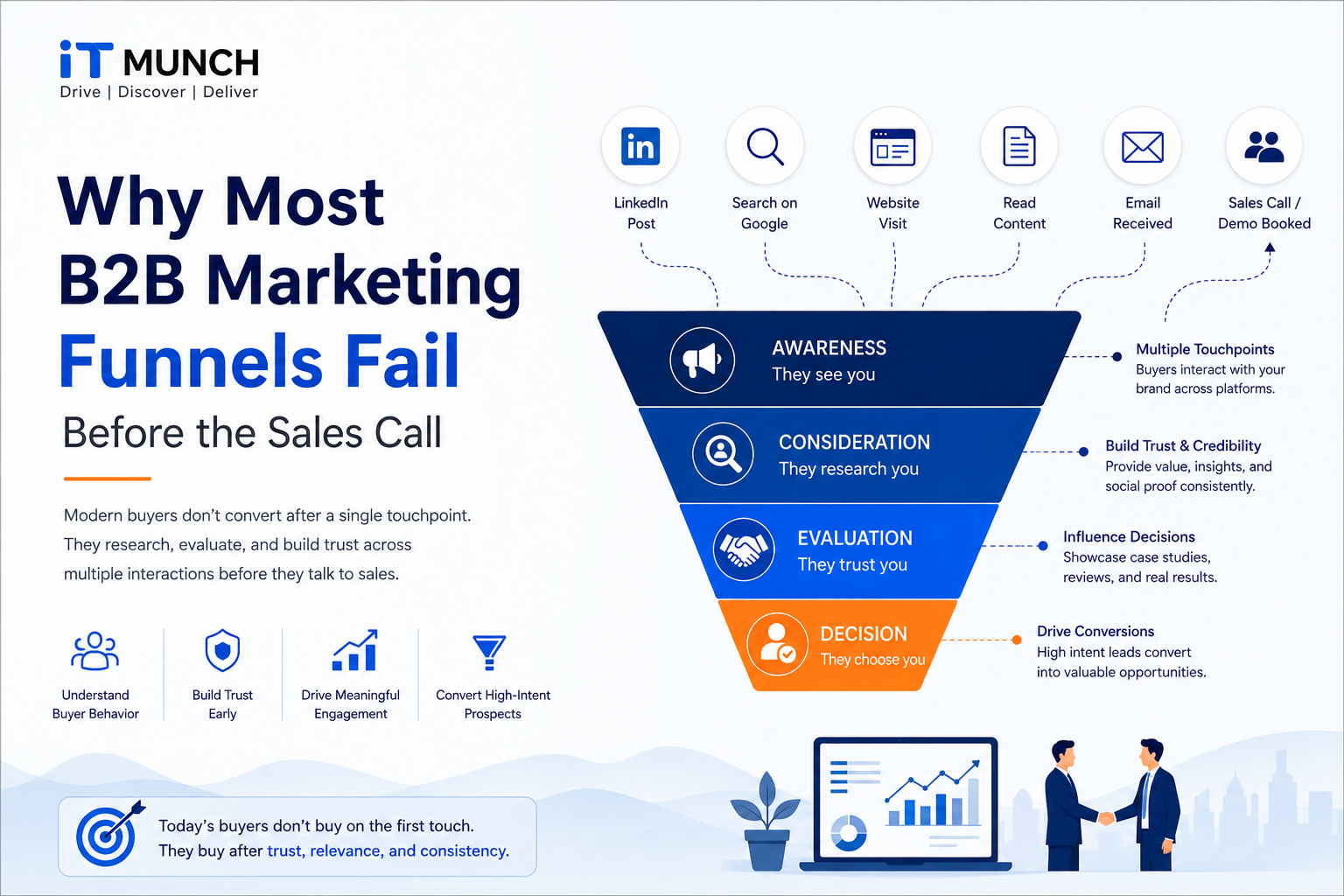
For years, B2B companies believed the biggest challenge in marketing was generating more leads. More traffic, more outreach, more campaigns, more automation — the assumption was simple: volume creates growth.
But in 2026, the problem looks very different.
Many businesses are generating traffic. They are running ads, sending cold emails, posting on LinkedIn, investing in SEO, and launching outbound campaigns consistently. Yet despite all this activity, conversion rates remain low, sales cycles are getting longer, and buyers are harder to engage than ever before.
The reality is that most B2B marketing funnels are not failing at the bottom.
They are failing long before the sales call even happens.
Modern Buyers Don’t Trust Quickly Anymore
Today’s B2B buyers behave very differently compared to a few years ago.
Before replying to an email, booking a demo, or speaking with a sales team, buyers now spend significant time researching independently. They compare vendors, review websites, explore social proof, consume content, and silently evaluate credibility across multiple channels.
Most decision-makers already form opinions about a business before the first conversation even begins.
This shift has fundamentally changed how marketing funnels work.
The traditional funnel assumed that once a lead entered the pipeline, the business controlled the buying journey. But modern buyers are now self-educating long before they formally engage.
That means trust-building starts much earlier than most companies realize.
The Multi-Touch Reality of B2B Marketing
One of the biggest mistakes businesses still make is expecting conversions from isolated touchpoints.
A single cold email rarely creates meaningful pipeline growth anymore. Neither does one LinkedIn post, one ad campaign, or one webinar.
Modern B2B buying journeys are multi-touch by nature.
A prospect may:
- See a LinkedIn post today
- Visit the company website next week
- Notice a retargeting ad later
- Read a case study afterward
- Open a marketing email days later
- Finally book a meeting after repeated exposure
Every interaction contributes to familiarity and trust.
This is why visibility has become one of the most important competitive advantages in B2B marketing.
The companies generating the best results are not necessarily the loudest. They are simply visible more consistently across the buyer journey.
Funnels Fail When Marketing Feels Disconnected
Another major issue is fragmented marketing execution.
Many companies treat each marketing channel separately:
- SEO works independently
- Paid ads operate separately
- LinkedIn content lacks alignment
- Sales outreach feels disconnected from branding
- Website messaging does not match campaigns
From the buyer’s perspective, this creates inconsistency.
Modern buyers expect seamless experiences across channels. If messaging feels disconnected or generic, trust weakens immediately.
Strong B2B funnels now require integrated marketing ecosystems where every touchpoint reinforces the same positioning, value, and credibility.
Consistency creates confidence.
Why Attention Is Harder Than Ever
One reason funnels are struggling is because buyers are overwhelmed with information.
Every company is producing content. Every inbox is crowded. Every platform is saturated with outreach.
As AI-generated marketing becomes more common, generic messaging is becoming easier to ignore.
This has shifted the competitive advantage toward businesses that can:
- Create stronger positioning
- Deliver more relevant messaging
- Build recognizable brand presence
- Provide educational value consistently
- Stay visible without becoming repetitive
The modern challenge is no longer simply generating awareness.
It is earning attention repeatedly enough to become memorable.
The Rise of Buyer-Led Funnels
Traditional funnels were sales-led.
Modern funnels are buyer-led.
Today’s buyers control:
- When they research
- What they consume
- Which businesses they compare
- How they validate credibility
- When they decide to engage
This means businesses must optimize for discoverability, trust, and educational value long before outreach begins.
Content marketing, SEO, social visibility, retargeting, and thought leadership are no longer secondary branding activities. They are core funnel-building mechanisms.
The companies adapting fastest understand that buyers need repeated exposure before conversion becomes possible.
Why High-Intent Leads Matter More Than Lead Volume
Many businesses still focus heavily on lead quantity.
But modern B2B growth increasingly depends on lead quality and intent.
A smaller pipeline of highly relevant, properly nurtured prospects often outperforms large volumes of cold, unqualified leads.
That is why intent-driven marketing strategies are becoming more important in 2026.
Businesses are investing more in:
- Intent data
- Behavioral signals
- Buyer journey tracking
- Personalized outreach
- Multi-touch engagement strategies
The goal is no longer just generating leads.
It is generating the right conversations.
The Future of B2B Funnel Strategy
The most effective B2B marketing funnels today are designed around one core principle:
Trust compounds through visibility.
Businesses that consistently educate, appear across multiple touchpoints, and maintain relevance throughout the buyer journey create significantly stronger conversion environments.
In many ways, the future of B2B marketing is less about aggressive selling and more about strategic presence.
Funnels are no longer linear systems.
They are ecosystems of repeated interactions.
How iTMunch Helps Businesses Build Smarter Funnels
At iTMunch, we help businesses create modern lead generation ecosystems designed for how B2B buyers actually behave today. From intent-based outreach and content-driven visibility to multi-touch marketing strategies, our focus is on generating meaningful conversations instead of vanity metrics.
Because in 2026, the businesses winning the most attention are not necessarily the ones marketing the hardest.
They are the ones buyers remember when it finally becomes time to make a decision.