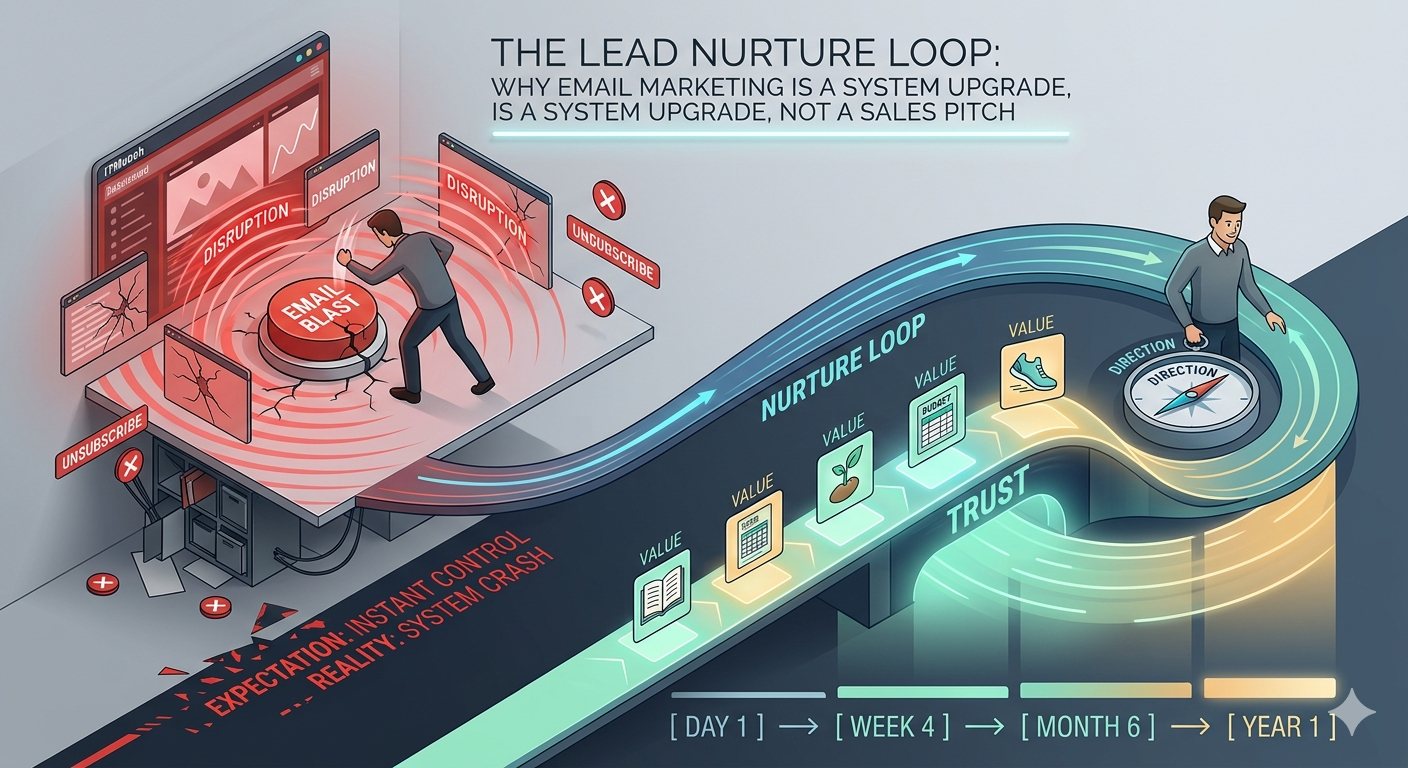
The Lead Nurture Loop: Why Email Marketing is a System Upgrade, Not a Sales Pitch
 Vansh Banthia,
3 days ago
4 min read
Vansh Banthia,
3 days ago
4 min read
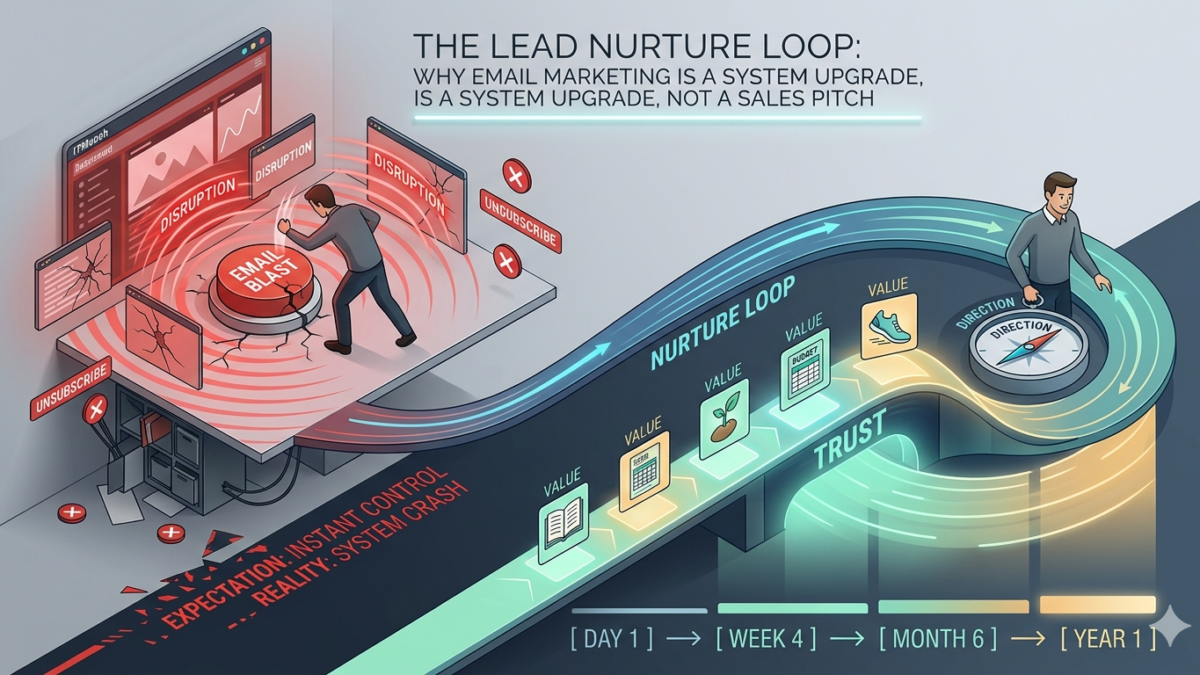
Every CMO and founder has been there. You have a slow quarter, the “Revenue” dashboard is flashing amber, and the immediate instinct is to hit the Blast button. You want instant control over your numbers. You want to send one massive, aggressive email marketing to your entire database and “force” a conversion spike.
But in 2026, the “Email Blast” is the sledgehammer of a bygone era. It disrupts the system, triggers spam filters, and causes a mass exodus of subscribers (the ultimate “System Crash”).
True email marketing success—much like personal growth—rarely appears in bold moments of control. Instead, it shows up quietly through Gradual Direction: the subtle, repeated adjustments of a lead nurture sequence that accumulate trust over time.
1. Learning From “Slow-Release” Systems
Consider the architecture of a high-performing email funnel. It isn’t a single, massive file transfer; it’s a series of “Data Packets” sent at the right latency. Attempting to force immediate control by asking for a $10k contract in the first welcome email often disrupts the user journey rather than improving it.
Effective email marketing mirrors Financial Habits. You wouldn’t expect a single deposit to erase a lifetime of debt; you rely on structured approaches. Similarly, you don’t expect one email to build a lifetime of brand loyalty. You use Segmentation and Behavioral Triggers to organize change step-by-step.
2. The High Latency of Trust
Why does a “Nurture Sequence” feel so uncomfortable for aggressive sales teams? Because we hate latency. We want low-ping, high-speed ROI.
Expecting a subscriber to move from “Awareness” to “Decision” over six weeks sounds reasonable in a strategy doc, but emotionally, it feels like a 404 error. This is where the Psychology of Behavior Change comes in. As noted by the American Psychological Association, habits (and brand preferences) become stable when small actions are repeated in predictable contexts.
Every “Value-Add” email marketing you send is a small, predictable context that rewires how the subscriber perceives your brand. What feels like a “slow” response is actually the user’s internal system reorganizing itself to trust you.
3. Invisible Progress: The “Drip” Effect
The most important shifts in email marketing happen beneath the surface. During the early “Drip” phase, your open rates might be steady, but your “Conversions” feel invisible.
However, internally, the subscriber is forming a mental “Neural Pathway” associated with your expertise. They are experimenting with your free resources and adjusting their internal “Vendor List.” Eventually, when the “Sales” email finally hits, the visible result (the click) appears suddenly—but it is the outcome of many quiet, background attempts.
As the Harvard Health guide to habit formation suggests, consistency and environmental cues (like your email appearing in their inbox every Tuesday) play a larger role than sudden bursts of motivation.
4. Shifting from “Blast” to “Vector”
In physics and email, a Vector is defined by magnitude and direction. To scale your revenue, stop trying to command the magnitude (the number of emails sent) and start guiding the direction (the relevance of the content).
- Control (The Blast): Asking “How do I make them buy right now?”
- Direction (The Sequence): Asking “What small piece of value moves them 1% closer to solving their problem?”
A company fixing its marketing ROI doesn’t start by doubling its ad spend; they start by tracking “Open Rates” for a month, then adjusting “Subject Line” categories, and later exploring Segmented Personalization. Each step is modest, yet together, they reshape the entire marketing OS.
5. The Hidden Advantage of the “Slow Build”
Ironically, gradual email nurturing produces a much more stable “Revenue Stream” than instant promotional blasts ever could.
Rapid, high-pressure sales tactics collapse because they rely on “Overclocking” a user’s temporary FOMO. Gradual shifts, however, reshape the subscriber’s routine. By the time they are ready to buy, the “Underlying Structure” of the relationship is already stress-tested.
Over time, these micro-interactions redefine your Brand Identity. You stop being “that company that emails me deals”; you become “that expert resource I can’t live without.” The purchase becomes a native feature of the relationship.
6. Measuring the “Heartbeat” (Telemetry)
If gradual change is the path, we need to change our “Monitoring Logs.” Don’t just track the “Lagging Indicators” (Sales). Track the “Leading Indicators”:
- Reply Rates: Are they talking back to the system?
- Engagement Velocity: Is the subscriber moving deeper into the funnel?
- Consistency: Is your “System” (your brand) showing up when it promised it would?
The Final “Commit”
The paradox of digital marketing is that giving up the need for instant control actually leads to greater influence over your market. When you accept that trust is a gradual deployment, you start designing better sequences.
What once felt slow begins to reveal itself as steady revenue. What once felt uncertain begins to look like an inevitable partnership.