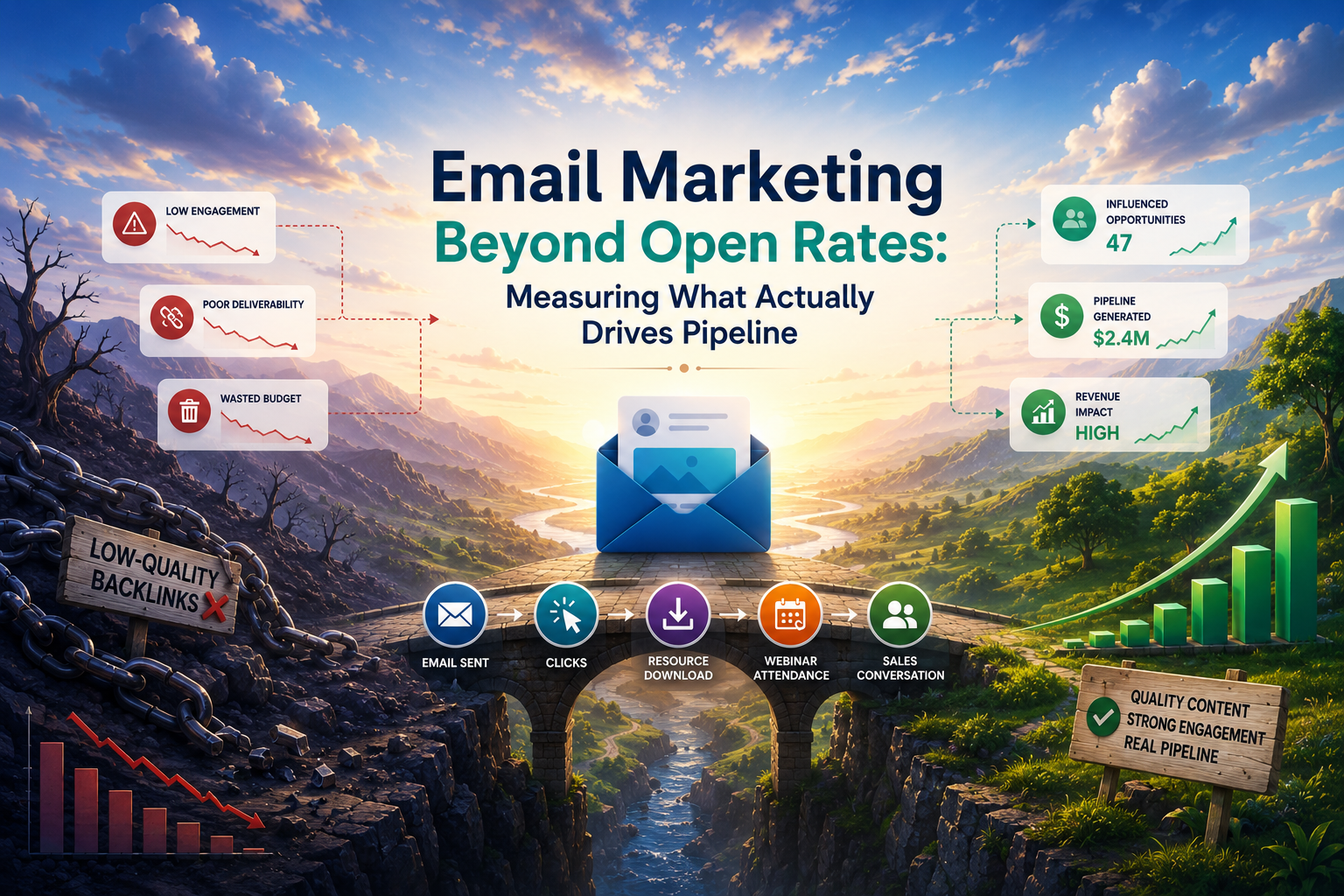
Email Marketing Beyond Open Rates: Measuring What Actually Drives Pipeline
 Purva Wankhade,
3 months ago
4 min read
Purva Wankhade,
3 months ago
4 min read
For years, open rates have been one of the most closely watched metrics in email marketing. Marketing teams tracked every percentage point, compared campaign performance, and used open rates as a quick indicator of audience interest.
But the modern B2B buying journey has become far more complex.
A prospect opening an email does not necessarily mean they are ready to engage. A high open rate does not always translate into meaningful conversations, qualified opportunities, or revenue growth. In an environment where buyers interact with multiple channels before making decisions, measuring email marketing success requires a much deeper understanding of what actually influences pipeline.
In 2026, successful B2B organizations are moving beyond surface-level engagement metrics and focusing on how email contributes to business outcomes.
The question is no longer, “How many people opened our email?”
It is, “Did this email move the right buyers closer to a decision?”
Why Open Rates Are No Longer Enough for B2B Email Marketing
The importance of open rates has declined as the digital ecosystem has evolved. Privacy changes, automated email scanning, and improved inbox protection systems have made open tracking less reliable as a standalone performance indicator.
The introduction of privacy-focused features by major email platforms has encouraged marketers to rethink how they evaluate campaigns. Apple’s Mail Privacy Protection, for example, changed how organizations interpret email engagement by limiting the accuracy of traditional open tracking.
At the same time, B2B buying behavior has shifted. Decision-makers are spending more time researching independently, consuming content across different platforms, and involving multiple stakeholders before contacting vendors.
This means an email campaign’s impact may not always appear through immediate clicks or replies.
A well-designed email created through an email marketing tool can influence a buyer who later visits a website, downloads a resource, attends a webinar, or engages with a sales conversation weeks later. The value of email marketing is often connected to the broader customer journey rather than a single interaction.
For enterprise marketers, this requires a shift from campaign-level reporting to revenue-focused measurement.
The most valuable insights come from understanding how email influences pipeline creation, acceleration, and conversion.
The Future of Email Marketing Measurement Is Connected to Revenue
Modern B2B marketing teams are increasingly connecting email performance with CRM data, buyer intent signals, and customer journey analytics.
Instead of evaluating success only through engagement metrics, businesses are looking at how email contributes to qualified opportunities and long-term relationships.
For example, an email campaign targeting senior technology leaders may generate fewer clicks but influence high-value accounts that later enter a sales conversation. Another campaign may receive strong engagement but fail to attract buyers with actual purchasing intent.
This difference highlights why context matters.
Artificial intelligence is also changing how companies approach email marketing measurement. AI-powered analytics tools are helping marketers identify patterns across campaigns, predict audience behavior, and understand which messages resonate with specific buyer segments.
Generative AI has already transformed email creation by helping teams personalize content, optimize messaging, and improve campaign efficiency. The next evolution is using AI to understand performance at a strategic level identifying which interactions contribute to revenue outcomes.
This approach allows marketing teams to move from reporting activities to explaining business impact.
Instead of showing that a campaign generated thousands of opens, marketers can demonstrate how specific content influenced account engagement, pipeline movement, and customer acquisition.
Building an Email Strategy Around Buyer Intent and Long-Term Relationships
The future of email marketing will not be defined by sending more emails. It will be defined by sending more meaningful communication at the right moments.
B2B buyers expect relevance. They want content that reflects their challenges, industry priorities, and decision-making stage. Generic campaigns designed for broad audiences are becoming less effective as personalization and buyer expectations continue to evolve.
Leading organizations are using a combination of behavioral data, customer insights, and marketing automation to create more connected experiences. They are focusing on delivering value through educational content, industry insights, research, and resources that help buyers make informed decisions.
This shift also aligns with the broader movement toward first-party data strategies. As third-party tracking becomes increasingly limited, businesses are placing more importance on direct relationships with audiences and the data collected through meaningful interactions.
Email marketing remains one of the most valuable channels because it creates a direct connection with prospects and customers. However, its true potential is realized when organizations measure it as part of a larger revenue engine.
The future of B2B email success will not be defined by vanity metrics. It will be defined by influence, engagement quality, and measurable business outcomes.
Companies that understand this shift will move beyond simply tracking email activity and start using email marketing as a strategic tool for building relationships, creating opportunities, and driving sustainable pipeline growth.