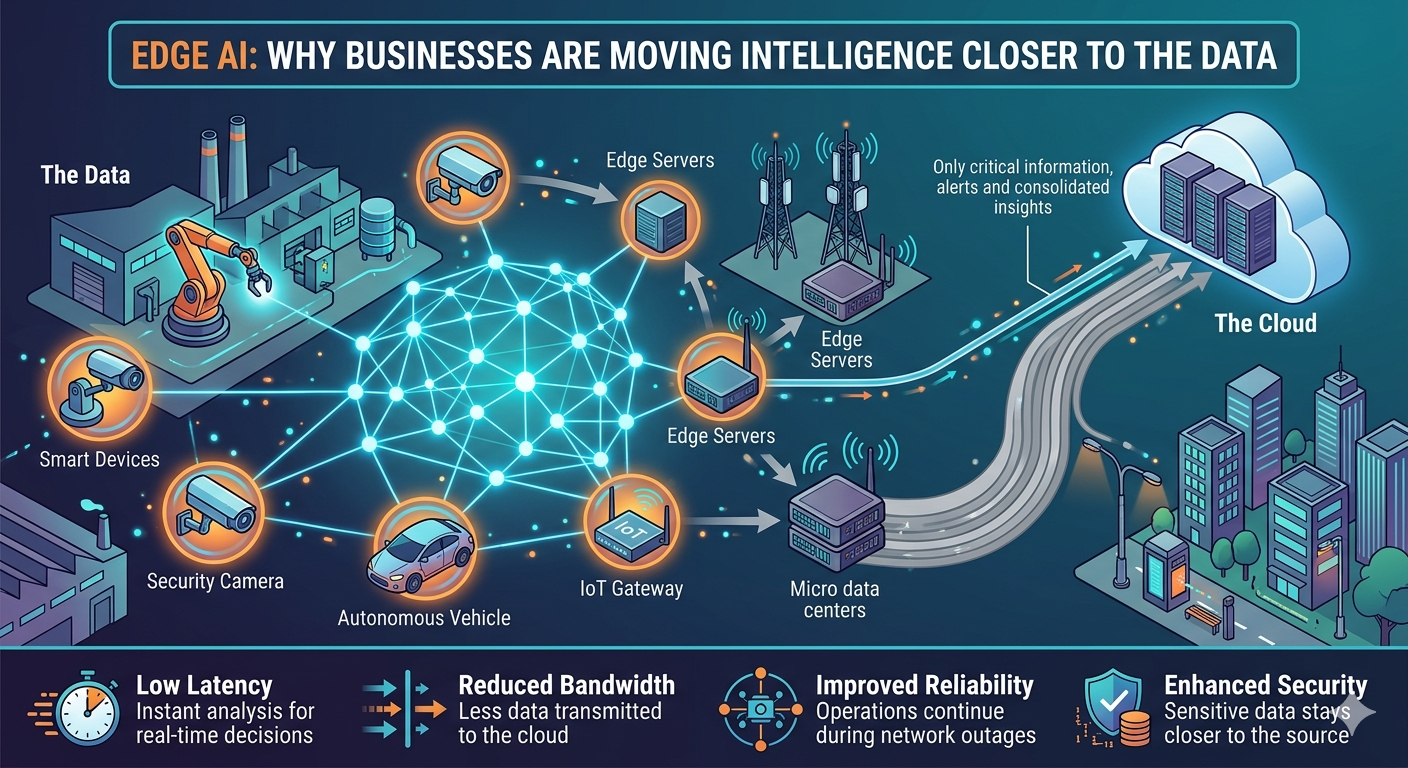
Edge AI: Why Businesses Are Moving Intelligence Closer to the Data
 Vansh Banthia,
2 months ago
7 min read
Vansh Banthia,
2 months ago
7 min read
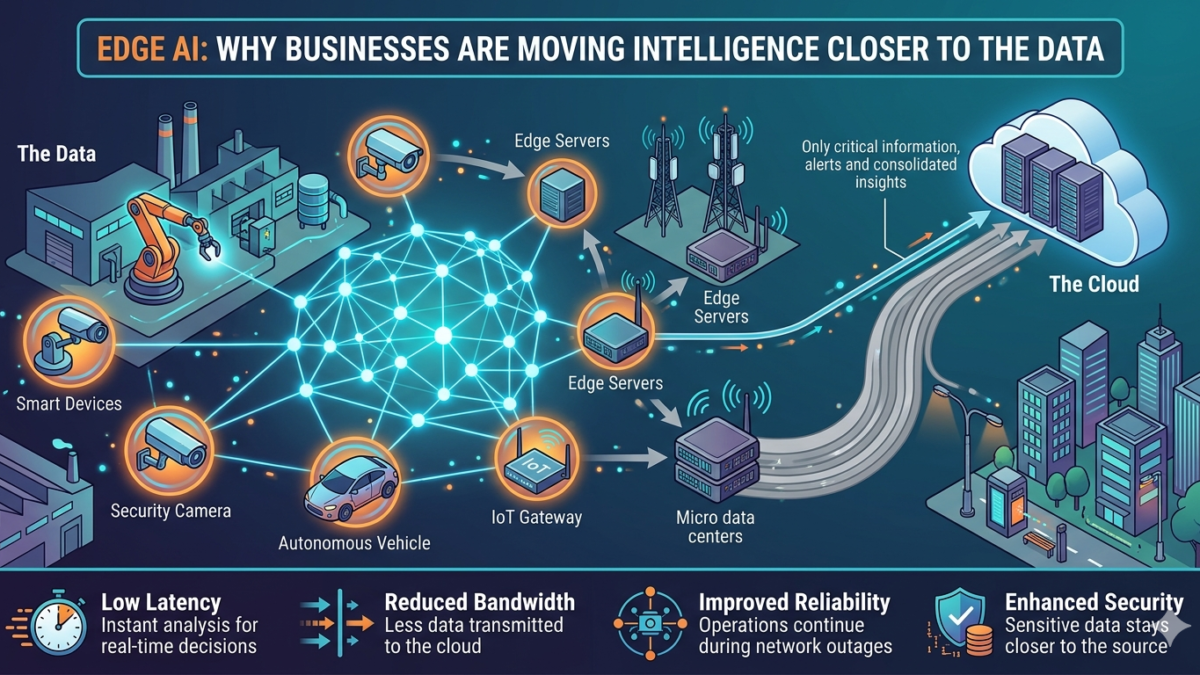
Artificial intelligence has become a central component of modern digital transformation strategies. Traditionally, AI systems relied heavily on cloud computing infrastructure to process data and deliver insights. However, as organizations generate larger volumes of data through connected devices and real-time applications, relying solely on centralized cloud systems can create delays and inefficiencies. The emergence of Edge AI addresses these challenges effectively. By enabling data processing at the edge, businesses can not only enhance their operational efficiency but also gain a competitive advantage in their industries.
This challenge has led to the rise of Edge AI, a technology approach that brings artificial intelligence processing closer to where data is generated. Instead of sending massive amounts of information to cloud servers for analysis, Edge AI enables devices and local systems to process data directly. This localized processing not only minimizes latency but also allows for quicker, more informed decision-making in critical situations, such as in industrial automation or emergency response scenarios.
For businesses operating in industries such as manufacturing, healthcare, logistics, and retail, this shift is helping enable faster decision-making and more efficient operations. For instance, in a manufacturing environment, real-time monitoring of machinery through Edge AI can predict failures before they occur, thus minimizing downtime and maintenance costs. In healthcare, real-time patient monitoring through Edge AI can provide immediate insights, facilitating timely interventions and improving patient outcomes.
Edge AI represents a significant advancement in how businesses leverage artificial intelligence for immediate data processing and decision-making. Its ability to operate in real-time enhances operational capabilities across various sectors, fostering innovation and enabling businesses to adapt swiftly to market changes. Furthermore, as businesses increasingly adopt Edge AI, we can expect to see a transformation in customer experiences, driven by personalized services and improved responsiveness.
What Is Edge AI?
Edge AI refers to the deployment of artificial intelligence algorithms directly on devices or local servers located near the data source. These devices may include sensors, cameras, IoT devices, or embedded computing systems. This architectural shift not only optimizes data processing but also enhances the ability to harness insights that can lead to proactive measures, ultimately driving better business outcomes.
By processing information locally, Edge AI systems can analyze data in real time without relying entirely on cloud infrastructure. This capability is vital in applications such as autonomous vehicles, where immediate decision-making can be a matter of safety. For example, Edge AI allows vehicles to assess their surroundings and react instantly to changing conditions, enhancing overall safety for passengers and pedestrians alike.
This approach allows organizations to handle large volumes of data more efficiently while reducing network congestion and latency. The ability to process data at the edge not only alleviates the burden on network resources but also empowers organizations to operate more independently of internet connectivity. This independence is particularly valuable in remote locations where connectivity may be limited or unreliable.
Why Edge AI Is Gaining Momentum
Several technological and business factors are driving the adoption of Edge AI.
Growing IoT Ecosystems
Organizations are deploying millions of connected devices that continuously generate data. Processing all this information in centralized cloud systems can become inefficient. As the Internet of Things (IoT) continues to expand, the need for Edge AI becomes increasingly apparent. For instance, smart home devices that utilize Edge AI can process commands locally, providing immediate responses to user interactions without the delays associated with cloud processing.
Real-Time Decision Requirements
Applications such as autonomous systems, predictive maintenance, and smart security solutions require immediate data analysis. In industries such as agriculture, Edge AI enables real-time monitoring of crop health using drones equipped with AI algorithms, allowing farmers to make timely decisions about irrigation and pest control, ultimately increasing yields and reducing waste.
Reduced Latency
Edge AI processes information closer to the source, enabling faster response times compared to cloud-based systems. This speed is crucial in scenarios like financial transactions, where instantaneous processing can determine market advantages or mitigate risks effectively.
Data Privacy and Security
Processing sensitive data locally can help organizations reduce exposure to potential data breaches during transmission. This is particularly important for industries handling personal data, such as finance and healthcare, where stringent regulations mandate strict data protection protocols. Edge AI not only enhances security through localized processing but also improves compliance with these regulations.
Key Use Cases Across Industries
Edge AI is being adopted across a wide range of sectors. The versatility of Edge AI allows it to be tailored to specific industry needs, thereby maximizing its impact. For example, in the energy sector, Edge AI can analyze data from smart grids to optimize energy distribution based on real-time consumption patterns, leading to significant cost savings and sustainability improvements.
Smart Manufacturing
Factories use Edge AI to monitor machinery, detect anomalies, and predict equipment failures before they occur. This capability not only enhances operational efficiency but also significantly reduces costs associated with unscheduled downtime. Furthermore, Edge AI can facilitate real-time quality control by analyzing production metrics on the fly, ensuring that only products meeting quality standards reach consumers.
Retail Analytics
Retailers use smart cameras and Edge AI systems to analyze customer behavior, optimize store layouts, and manage inventory. By leveraging real-time analytics, businesses can respond to customer needs dynamically, enhancing the shopping experience while simultaneously improving operational efficiency. For example, stores can adjust staff levels based on real-time foot traffic data, ensuring that customer service remains high during peak times.
Healthcare Monitoring
Edge-enabled medical devices can process patient data instantly, supporting faster clinical decisions. This capability is particularly beneficial in critical care settings, where timely information can lead to life-saving interventions. Moreover, Edge AI can facilitate remote patient monitoring, enabling healthcare providers to track patients’ conditions in real-time and respond promptly to any changes.
Smart Cities
Urban infrastructure systems use Edge AI to manage traffic, monitor public safety, and optimize energy usage. For instance, smart traffic lights can adjust in real-time based on current traffic conditions, reducing congestion and emissions. Additionally, Edge AI can enhance public safety by analyzing data from surveillance cameras to detect suspicious activities and alert law enforcement.
Challenges in Implementing Edge AI
Despite its advantages, organizations face certain challenges when deploying Edge AI solutions. The integration of Edge AI into existing systems can be complex, requiring a thorough understanding of both hardware and software requirements. Organizations must also navigate issues related to interoperability between different devices and platforms, ensuring seamless communication and data exchange.
Developing efficient AI models that can run on smaller edge devices requires specialized optimization techniques. Hardware limitations, power consumption, and system integration can also affect deployment. Furthermore, organizations must invest in training personnel to effectively utilize Edge AI technologies and maintain the systems for ongoing success.
Additionally, companies must ensure secure device management and reliable data synchronization between edge systems and cloud platforms. Establishing robust security protocols is essential to mitigate risks associated with data breaches and to protect sensitive information handled by Edge AI systems.
The Future of Edge Intelligence
As AI models become more efficient and edge computing hardware continues to advance, Edge AI is expected to become an integral part of enterprise technology strategies. The future will see greater collaboration between edge devices and central cloud systems, allowing businesses to leverage the strengths of both architectures for optimal performance.
Businesses are increasingly combining cloud computing, edge computing, and AI to create hybrid architectures that support both large-scale analytics and real-time decision-making. This synergy will empower various sectors to innovate and adapt swiftly in a rapidly changing technological landscape.
In the coming years, Edge AI will likely play a critical role in enabling faster, smarter, and more autonomous digital systems across industries. As businesses increasingly recognize the benefits of leveraging Edge AI, we can expect a significant transformation in how data is processed and utilized, paving the way for unprecedented advancements in automation and intelligence.