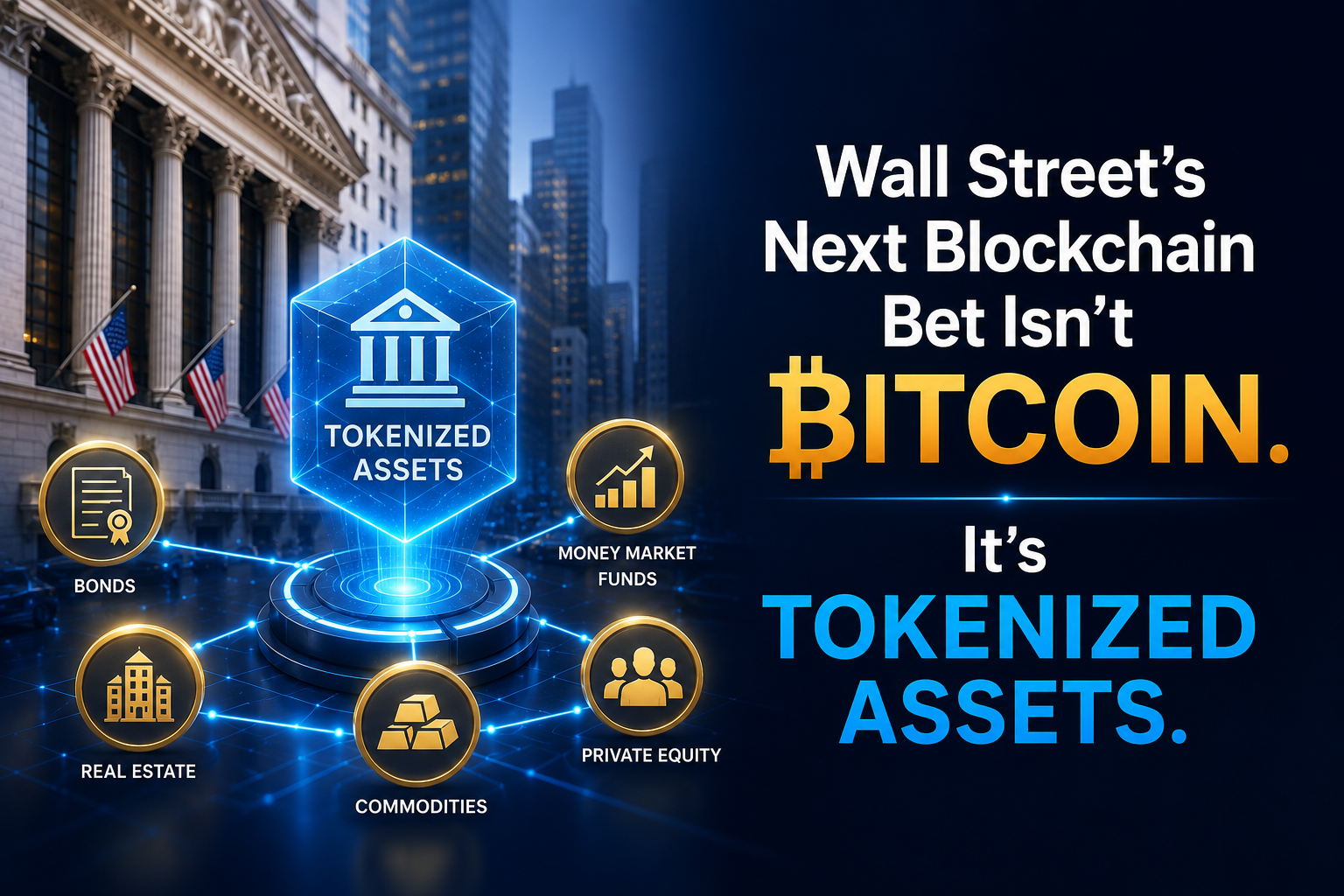
Wall Street’s Next Blockchain Bet Isn’t Bitcoin. It’s Tokenized Assets
 Purva Wankhade,
2 months ago
5 min read
Purva Wankhade,
2 months ago
5 min read
For years, blockchain’s biggest promise to financial markets sounded almost futuristic: assets could move faster, settle continuously, and become programmable. A tokenized asset takes that promise further by bringing traditional financial value onto blockchain-based infrastructure. Wall Street largely watched from the sidelines while crypto markets tested the technology in public.
That is changing.
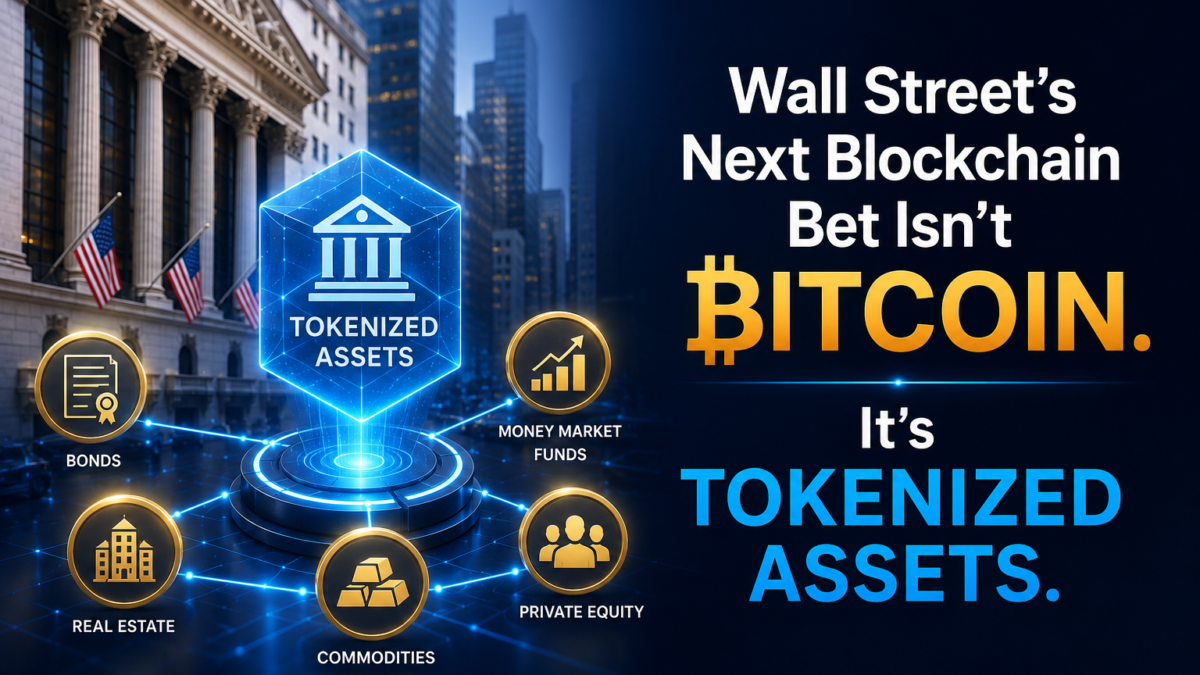
The more interesting blockchain story in 2026 is no longer whether institutions will use the technology. It is what they will put on it. From U.S. Treasuries and money-market funds to equities and private-market instruments, tokenized assets are moving from experimentation toward financial infrastructure.
J.P. Morgan is expanding its Kinexys blockchain infrastructure for tokenized money-market funds, while the Depository Trust & Clearing Corporation (DTCC) is working with major financial institutions on tokenized versions of stocks and Treasuries. NYSE Arca has also moved toward enabling securities to trade in tokenized form.
The message from Wall Street is becoming difficult to ignore: blockchain may have found a more consequential use case than cryptocurrency speculation.
Why Wall Street Is Looking Beyond Bitcoin
The appeal of tokenized assets is not simply that they put traditional investments onto a blockchain. The bigger opportunity is to redesign how those investments are issued, transferred, settled, recorded and integrated with other financial systems.
Consider a conventional security. Ownership records, custodial systems, settlement processes, compliance checks and reconciliation often exist across different institutions and databases. Moving value can therefore involve multiple intermediaries and operational handoffs.
Tokenization introduces a different architecture. A blockchain-based representation can carry ownership information, transfer rules and transaction history within a shared digital environment. In the right structure, settlement can happen closer to real time, transactions can operate outside traditional market hours, and compliance requirements can potentially become part of the transaction logic.
That is particularly attractive for institutions managing enormous volumes of financial assets.
J.P. Morgan’s recent work illustrates the direction. Its Kinexys platform now supports tokenized money-market funds across private and registered fund structures, connecting traditional fund infrastructure with public blockchain technology. The bank has also expanded its blockchain-based payment infrastructure, showing that institutional blockchain strategies are increasingly connecting money movement with asset movement.
This is why the current shift feels different from earlier blockchain experiments. The objective is not necessarily to replace Wall Street. It is to make Wall Street’s existing machinery more programmable.
The Real Breakthrough Could Be 24/7 Capital Markets
The most compelling case for tokenized assets may ultimately be operational rather than ideological.
Traditional markets operate according to schedules. Settlement systems have cut-off times. Different jurisdictions have different operating hours. Cross-border transactions can involve delays, reconciliation and multiple intermediaries.
Blockchain infrastructure does not inherently need to follow those constraints.
A tokenized Treasury, for example, could potentially move between approved participants at any hour, while smart-contract infrastructure could automate parts of settlement and compliance. For global businesses, asset managers and financial institutions, that could translate into more efficient collateral management, faster liquidity movement and fewer operational bottlenecks.
Recent developments suggest the industry is moving toward this model. DTCC is working with firms including J.P. Morgan, BlackRock, Goldman Sachs, Vanguard and the NYSE on a tokenization initiative involving major stocks and exchange-traded funds, with a planned formal launch later in 2026. The significance is not simply that familiar assets are receiving blockchain representations. It is that core market infrastructure is beginning to experiment with making those representations interoperable with existing securities.
There is another important signal: tokenization is spreading across asset classes rather than remaining concentrated in one niche. Treasuries have emerged as an early institutional use case because they already have predictable cash flows, established custody structures and strong demand for liquidity. While Bitcoin code represents the technical foundation behind Bitcoin’s decentralized network, tokenization is extending blockchain technology into money-market funds, private credit and other traditionally less accessible instruments.
But tokenization does not automatically create liquidity. A blockchain can make an asset easier to transfer without creating enough buyers and sellers to support an active market. Recent research into real-world asset markets reinforces this distinction: being tokenized and being liquid are two separate outcomes.
That distinction will become increasingly important as institutions move from pilots to production.
Regulation Could Determine How Fast the Market Scales
The next phase of tokenization will not be decided by technology alone.
Regulation, custody, investor rights, interoperability and legal ownership are becoming just as important as blockchain performance. The U.S. Securities and Exchange Commission has already issued guidance explaining how tokenized securities fit within federal securities laws, while ongoing industry submissions are debating questions around issuer authorization, transfer controls and the treatment of third-party tokenization.
That regulatory evolution matters because institutional investors cannot treat a token as merely a digital version of a traditional asset. They need certainty about what the token legally represents, who controls it, how ownership is recorded, what happens during disputes and whether the asset can move between platforms without breaking its legal or economic characteristics.
This is where the next competitive advantage may emerge.
The winners in institutional tokenization are unlikely to be determined simply by who builds the fastest blockchain. They will be determined by who can connect tokenized asset infrastructure with compliance, custody, identity, settlement, and existing financial-market plumbing.
For business leaders, that changes the strategic question. Instead of asking whether blockchain will disrupt finance, the more useful question is where blockchain can remove friction from finance.
Wall Street appears to be answering that question with tokenized assets.
Bitcoin may have introduced institutional investors to blockchain. Tokenization could be what makes the technology part of their everyday infrastructure.
The transformation will probably not arrive as a dramatic replacement of traditional markets. It is more likely to happen quietly, asset by asset and process by process, until issuing, transferring and settling financial instruments on blockchain becomes less experimental and more ordinary.
That may ultimately be blockchain’s biggest breakthrough: not creating a new financial system from scratch, but quietly rebuilding the one that already exists.