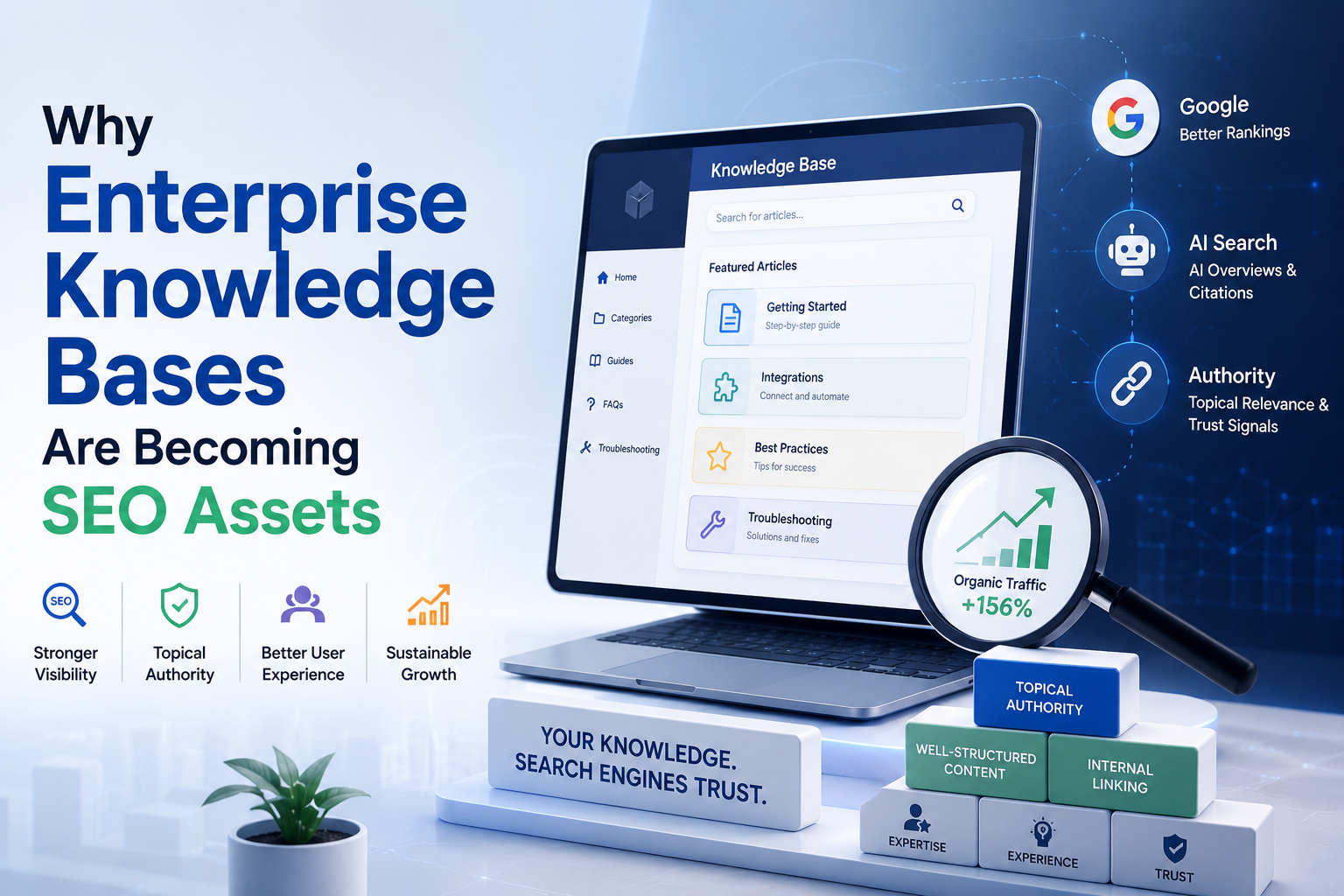
Enterprise knowledge bases have traditionally been viewed as operational resources. They helped customers troubleshoot issues, supported internal teams, and reduced the burden on customer service departments. Their primary purpose was efficiency rather than visibility.
That perception is changing rapidly. In 2026, enterprise knowledge bases are evolving into strategic digital assets that influence search visibility, AI-generated answers, and customer trust. As search engines increasingly prioritize comprehensive, authoritative, and structured information, businesses are discovering that the content hidden within their documentation portals often contains some of their most valuable SEO opportunities.
This shift is closely tied to the evolution of AI-powered search experiences. Google continues expanding AI-driven search capabilities, while AI assistants and enterprise search platforms increasingly rely on trusted sources to answer complex user questions. Instead of simply ranking web pages, modern search systems are identifying organizations that consistently demonstrate expertise across an entire topic.
For B2B decision makers, this represents a significant opportunity. A well-structured knowledge base is no longer just a support resource, it is becoming an essential component of a successful Enterprise SEO strategy.
Search Engines Are Rewarding Structured Expertise
The role of search engines has changed dramatically over the past few years. Traditional SEO often focused on optimizing individual landing pages around specific keywords. Today, search algorithms increasingly evaluate how comprehensively an organization covers an entire subject.
Knowledge bases naturally align with this shift. They organize information into logical categories, answer highly specific questions, define technical concepts, and explain complex workflows in a structured format. This depth of content helps search engines understand not only individual pages but also the broader expertise of a business.
Recent developments in AI-powered search have accelerated this trend. Google’s AI Overviews and other generative search experiences increasingly summarize information from trusted sources rather than directing users to a single webpage. Businesses with well-maintained documentation, technical articles, implementation guides, and frequently updated knowledge resources are better positioned to become part of these AI-generated responses.
For Enterprise SEO, this means success is increasingly determined by topical authority rather than isolated keyword optimization. Whether the content focuses on software automation or other enterprise technologies, organizations that publish interconnected, well-structured knowledge content demonstrate expertise that both search engines and AI systems can recognize.
Another important factor is search intent. Enterprise buyers often begin their research by asking highly specific questions rather than searching for product names. A comprehensive knowledge base helps businesses appear throughout these research journeys, building trust long before a purchasing decision is made.
Enterprise Knowledge Is Becoming a Competitive Advantage
One of the biggest challenges facing enterprise organizations is that valuable expertise often remains trapped inside internal documentation, support tickets, implementation guides, and technical manuals. While this information helps existing customers, it rarely contributes to brand visibility.
Forward-thinking businesses are changing that approach. They are transforming internal knowledge into public educational resources that answer industry questions, explain emerging technologies, and provide practical guidance for enterprise buyers.
This strategy benefits both customer experience and Enterprise SEO. Existing customers gain faster access to reliable information, while prospective buyers discover valuable resources through search engines and AI-powered discovery platforms.
Recent industry trends also show growing investment in knowledge management systems integrated with artificial intelligence. Organizations are using AI to organize documentation, identify content gaps, improve semantic relationships between articles, and surface the most relevant information more efficiently. This creates richer content ecosystems that benefit both users and search engines.
As enterprise software becomes increasingly complex, buyers expect vendors to demonstrate expertise before initiating conversations with sales teams. Comprehensive knowledge resources establish credibility by educating audiences without immediately attempting to sell.
This educational approach aligns closely with how modern B2B purchasing decisions are made. Decision makers prefer organizations that consistently provide useful insights rather than promotional messaging, making knowledge content a valuable long-term asset for brand authority.
The Future of Enterprise SEO Is Built on Knowledge Ecosystems
The next phase of Enterprise SEO will be defined less by individual webpages and more by interconnected knowledge ecosystems. Search engines are becoming better at understanding relationships between topics, entities, and user intent, rewarding businesses that provide complete, trustworthy information across an entire subject area.
Enterprise knowledge bases are uniquely positioned to support this evolution because they naturally contain detailed explanations, technical accuracy, structured information, and ongoing updates. Unlike static marketing pages, knowledge articles continue growing alongside products, services, and customer needs, making them valuable long after publication.
This also aligns with the rapid adoption of AI assistants within enterprise environments. As organizations increasingly rely on AI to answer questions, summarize documentation, and assist decision-making, structured knowledge becomes even more valuable. Businesses that maintain accurate, accessible, and authoritative documentation improve not only search visibility but also their ability to be understood by intelligent systems.
Another emerging trend is the growing importance of semantic search. Instead of matching exact keywords, search engines now evaluate context, relationships, and meaning. A well-connected knowledge base helps search systems understand how concepts relate to one another, strengthening topical authority and improving visibility across a wider range of search queries.
The organizations that succeed in the coming years will not simply publish more content. They will build living knowledge ecosystems that educate customers, support AI-powered search, and reinforce industry expertise.
For B2B decision makers, the message is becoming increasingly clear. Knowledge is no longer confined to support portals or documentation libraries. It is becoming one of the most valuable digital assets an organization can create. Businesses that invest in structured, authoritative knowledge today will strengthen their Enterprise SEO performance, improve customer trust, and position themselves for greater visibility in an AI-driven search landscape.