From More Impressions to More Influence: The New Era of Programmatic Advertising
 Vansh Banthia,
2 months ago
6 min read
Vansh Banthia,
2 months ago
6 min read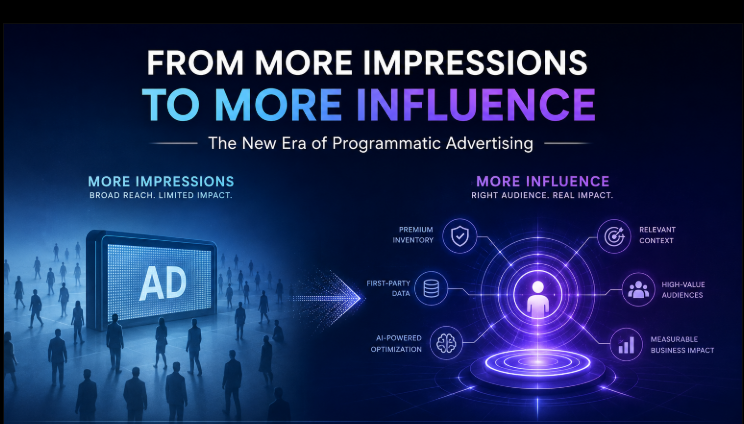
For years, the success of programmatic advertising was defined by numbers. More impressions, lower CPMs, higher click volumes, and broader reach were considered the hallmarks of a successful campaign. The assumption was simple: the more people who saw an advertisement, the greater the likelihood of driving business results.
That equation no longer holds true.
The digital advertising landscape has matured dramatically over the past few years. B2B buyers have become more selective, privacy expectations have reshaped audience targeting, and artificial intelligence has transformed both content creation and media buying. At the same time, marketing leaders are under increasing pressure to demonstrate measurable business impact rather than campaign-level performance.
As a result, programmatic advertising is undergoing a strategic evolution. The focus is shifting away from maximizing impressions and toward maximizing influence ,reaching the right decision-makers in environments that build trust, strengthen brand perception, and ultimately contribute to revenue.
The Shift from Scale to Significance
Understanding Programmatic Advertising’s Impact on Modern Marketing
The internet has never offered more advertising inventory than it does today. New websites, streaming platforms, connected TV channels, digital publications, and AI-generated content are expanding the available advertising ecosystem at an unprecedented pace. While this creates more opportunities to reach audiences, it also introduces a new challenge: not every impression delivers equal value.
An advertisement displayed on a trusted industry publication carries significantly more weight than one placed alongside low-quality or irrelevant content. Similarly, reaching a procurement leader actively researching enterprise software is far more valuable than generating thousands of impressions among audiences with little purchasing influence.
For B2B organizations, where buying decisions often involve multiple stakeholders and extended sales cycles, success is increasingly determined by the quality of audience engagement rather than the quantity of impressions served. Marketing teams are beginning to recognize that meaningful influence is built through relevance, context, and credibility—not simply through scale.
Why Media Quality Has Become a Competitive Advantage
One of the most notable developments shaping programmatic advertising is the growing emphasis on media quality. As generative AI accelerates content production, the internet is experiencing a surge in low-value websites, duplicated content, and made-for-advertising (MFA) properties designed primarily to monetize ad inventory rather than provide genuine value to readers.
This changing landscape has prompted advertisers to become far more selective about where their campaigns appear. Brand safety, inventory transparency, and publisher credibility have moved from operational considerations to strategic priorities.
Rather than pursuing the largest possible inventory pools, many organizations are investing in curated marketplaces, premium publisher relationships, and supply path optimization strategies that prioritize trusted environments. The objective is not simply to avoid wasted advertising spend but to ensure that every brand interaction reinforces credibility among prospective customers.
In this new environment, fewer impressions delivered in high-quality contexts often generate stronger business outcomes than millions of low-value exposures.
AI Is Changing Execution, Not Strategy
Artificial intelligence has become deeply embedded within modern programmatic advertising platforms. Advanced bidding algorithms, predictive audience modeling, dynamic budget allocation, and automated campaign optimization have significantly improved operational efficiency. Many repetitive tasks that once required constant manual oversight are now managed in real time by machine learning systems.
Yet despite these technological advances, strategy remains firmly in human hands.
AI can determine the optimal bid for an impression or identify behavioral patterns across vast datasets, but it cannot define a company’s positioning, understand nuanced customer motivations, or craft a compelling brand narrative. Those responsibilities continue to belong to marketers.
The organizations achieving the strongest results are not relying solely on automation. Instead, they are combining intelligent technology with thoughtful planning, ensuring that every automated decision aligns with broader business objectives. In many ways, AI is making strategic thinking even more valuable by allowing marketing teams to focus less on campaign mechanics and more on creating meaningful customer experiences.
Precision Is Replacing Broad Targeting
The modern B2B buying journey rarely follows a predictable path. Decision-makers conduct independent research, compare multiple vendors, consume information across different channels, and involve colleagues from finance, procurement, operations, and executive leadership before making purchasing decisions. In this fragmented environment, relying solely on owned channels is no longer enough. Content syndication enables businesses to extend the reach of their expertise by placing valuable content in front of relevant audiences across industry publications, professional communities, and trusted content networks. By meeting buyers where they already consume information, organizations can increase brand visibility, nurture demand, and influence purchasing decisions long before a prospect fills out a contact form.
This complexity has fundamentally changed how audiences are targeted.
Rather than prioritizing maximum reach, marketers are increasingly combining first-party data, contextual intelligence, firmographic insights, and buying intent signals to identify accounts that demonstrate genuine purchase potential. Programmatic advertising is becoming an extension of broader account-based marketing strategies, enabling brands to engage decision-makers throughout the entire buying journey instead of only at the point of conversion.
The emphasis is shifting from reaching more people to reaching the right people with greater consistency and relevance.
Success Can No Longer Be Measured by Clicks Alone
Traditional performance metrics continue to provide useful insights, but they tell only a fraction of the story. A click may indicate momentary interest, yet many high-value B2B purchasing decisions unfold over several months and involve numerous interactions before a prospect ever completes a form or requests a product demonstration.
As a result, marketing leaders are broadening the way they evaluate campaign performance. Greater attention is being given to pipeline influence, qualified account engagement, brand recall, view-through conversions, and revenue contribution. These metrics acknowledge that programmatic advertising often plays an influential role long before measurable demand materializes.
This evolution reflects a broader understanding of marketing’s purpose. Rather than optimizing campaigns solely for immediate actions, organizations are increasingly investing in strategies that shape perception, establish authority, and remain visible throughout extended buying cycles.
The Future of Programmatic Advertising Is Built on Influence
The next chapter of programmatic advertising will not be defined by who serves the highest number of impressions or achieves the lowest acquisition costs. It will belong to organizations that recognize advertising as an opportunity to create meaningful business influence rather than simply generate digital visibility.
As privacy standards continue to evolve, AI reshapes media buying, and buyers become increasingly discerning about the content they engage with, quality will naturally outweigh quantity. Trusted publishers, intelligent targeting, premium inventory, and strategic creativity will become the foundations of successful campaigns.
For B2B decision-makers, this represents more than a tactical adjustment – it marks a fundamental shift in how advertising creates value. The brands that succeed in this new era will be those that understand influence cannot be bought through scale alone. It is earned through relevance, credibility, and consistently meaningful interactions with the audiences that matter most.
In an increasingly automated digital ecosystem, the most valuable impression is no longer the one that reaches the most people. It is the one that reaches the right decision-maker, at the right moment, in the right environment and leaves a lasting impression long after the advertisement has disappeared.