Search Is Quietly Changing
For nearly two decades, businesses understood how online visibility worked.
You ranked on Google, generated traffic, optimized landing pages, and converted visitors through SEO. Entire industries were built around understanding search engine algorithms, keyword rankings, backlinks, and organic traffic growth.
But in 2026, something much bigger is happening beneath the surface of the internet.
Understanding the dynamics between SEO vs GEO is crucial for adapting to these changes.
People are no longer searching the same way they used to.
Instead of typing short search phrases into Google, users are increasingly asking complete questions directly to AI systems. Rather than searching:
“Best project management software”
People now ask:
“What’s the best project management tool for a remote startup team with under 20 employees?”
That difference may seem subtle, but it completely changes how discovery works online.
The internet is slowly shifting from search engines toward answer engines.
And that shift is creating a new conversation marketers can no longer ignore:
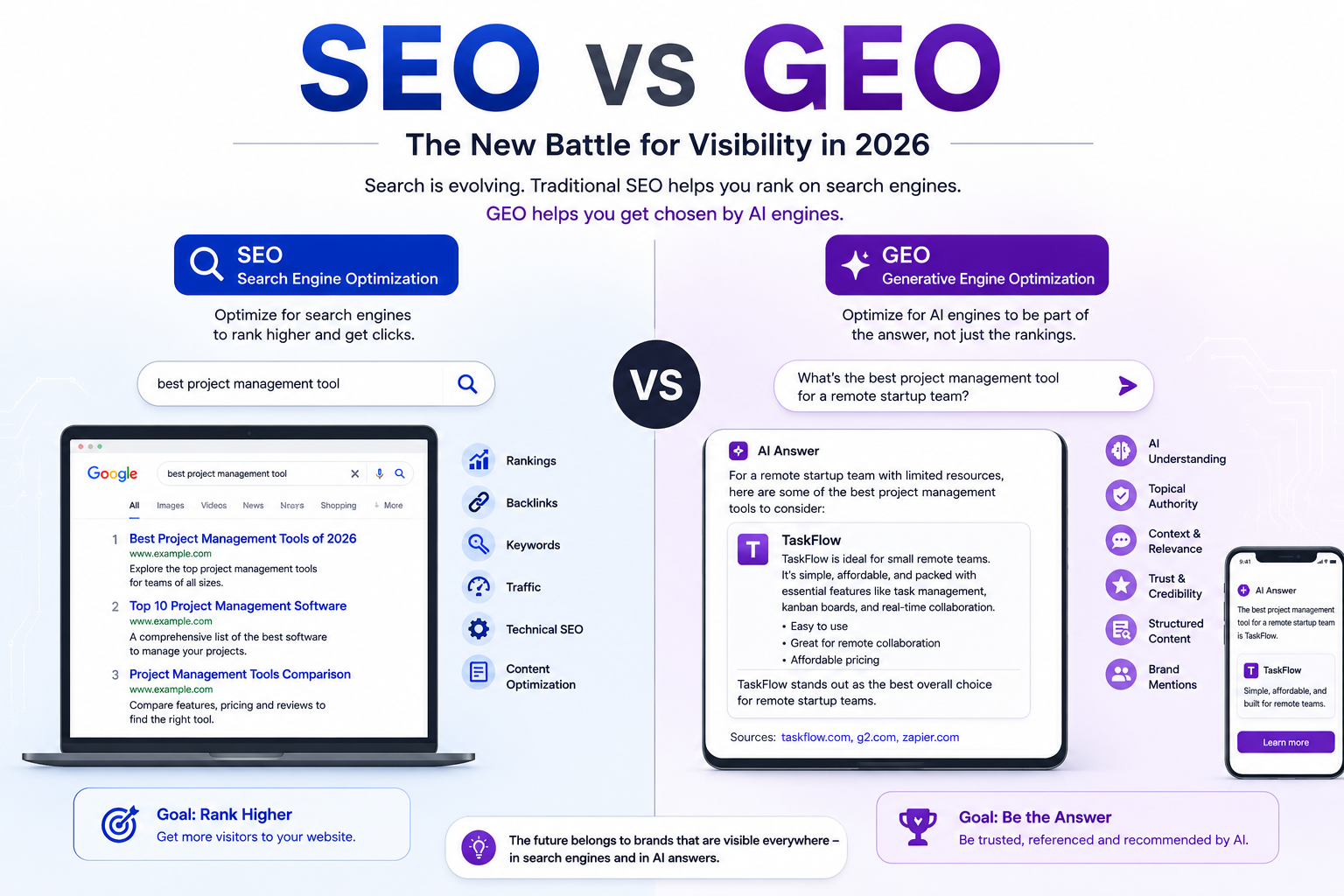
SEO vs GEO.
What GEO Actually Means
When we consider SEO vs GEO, we see two distinct approaches to visibility.
GEO stands for Generative Engine Optimization.
While SEO focuses on helping websites rank on traditional search engines, GEO focuses on helping brands appear inside AI-generated responses from platforms like ChatGPT, Perplexity, Gemini, Claude, and Google’s AI-powered search experiences.
In the discussion of SEO vs GEO, it’s important to note the different strategies involved.
Businesses now face the challenge of integrating SEO vs GEO into their marketing strategies.
As we analyze SEO vs GEO, the differences in user engagement become evident.
This changes visibility dramatically.
Traditional search engines usually give users a list of websites to explore. AI systems increasingly skip that process entirely by generating direct answers conversationally.
Ultimately, the debate of SEO vs GEO will shape the future of digital marketing.
That means businesses are no longer competing only for clicks.
They are competing to become part of the answer itself.
The need for clear strategies in SEO vs GEO cannot be overstated.
And that is a very different internet from the one marketers were optimizing for just a few years ago.
Why Traditional SEO Content Is Struggling
One of the biggest reasons GEO is becoming important is because the internet became overloaded with content written primarily for algorithms instead of humans.
For years, businesses produced:
- Keyword-heavy blogs
- Repetitive listicles
- SEO-first content structures
- Articles designed mainly to rank
As AI-generated writing exploded, this problem became even worse. The internet is now flooded with polished but interchangeable content.
Users are noticing it.
And AI systems are starting to notice it too.
Modern AI search systems prioritize something different:
clarity, relevance, authority, and usefulness.
In this evolving landscape, SEO vs GEO establishes a new standard.
This means shallow content written only to capture traffic is becoming easier to ignore.
Ironically, AI may end up rewarding genuinely helpful content more than the traditional SEO era ever did.
GEO Is Changing What “Authority” Means
In the old SEO world, authority was often heavily tied to backlinks, domain strength, and technical optimization.
Those things still matter.
But GEO introduces another layer entirely:
contextual trust.
AI systems attempt to understand:
- Whether your content feels credible
- Whether your brand appears consistently across the web
- Whether your information is useful enough to reference
- Whether your expertise feels reliable in context
This means businesses can no longer rely only on technical SEO tactics.
They now need stronger positioning, clearer expertise, and content that actually contributes meaningful insights.
Because in AI-driven search, generic information loses value very quickly.
The concept of authority is shifting as we weigh SEO vs GEO.
To remain competitive, understanding SEO vs GEO is essential for businesses.
Why Businesses Shouldn’t Panic About SEO
The interplay between SEO vs GEO is crucial for future strategies.
There’s a growing misconception that SEO is “dying.”
That’s not really true.
Google still drives massive global traffic, and traditional search behavior will continue to matter for a long time. Businesses still need strong websites, search visibility, technical optimization, and organic discoverability.
But SEO alone is no longer the full visibility strategy.
The internet is becoming hybrid.
Some users will continue using traditional search engines. Others will increasingly rely on conversational AI tools to summarize information, recommend products, compare services, and answer questions instantly.
The businesses that adapt fastest will likely be the ones optimizing for both environments simultaneously.
The Real Shift Is Behavioral
The biggest change here is not technological.
It’s behavioral.
Modern users are becoming less patient with traditional browsing behavior. They no longer want to open ten tabs, scan multiple blogs, and compare endless search results manually.
They want clarity quickly.
AI systems are succeeding because they reduce friction dramatically. They compress discovery into direct conversation.
And once user behavior changes at scale, marketing strategies eventually have to change with it.
As we progress, the implications of SEO vs GEO will become clearer.
That is exactly what is beginning to happen now.
The Future of Visibility
For years, businesses focused on becoming searchable.
Now they also need to become answerable.
Embracing the strategies of SEO vs GEO will determine success in digital marketing.
That means creating content that is not only optimized for rankings, but also structured around expertise, relevance, clarity, and contextual trust.
Because in the next phase of the internet, visibility will not belong only to the websites ranking highest.
It will belong to the brands AI systems trust enough to mention in the first place.