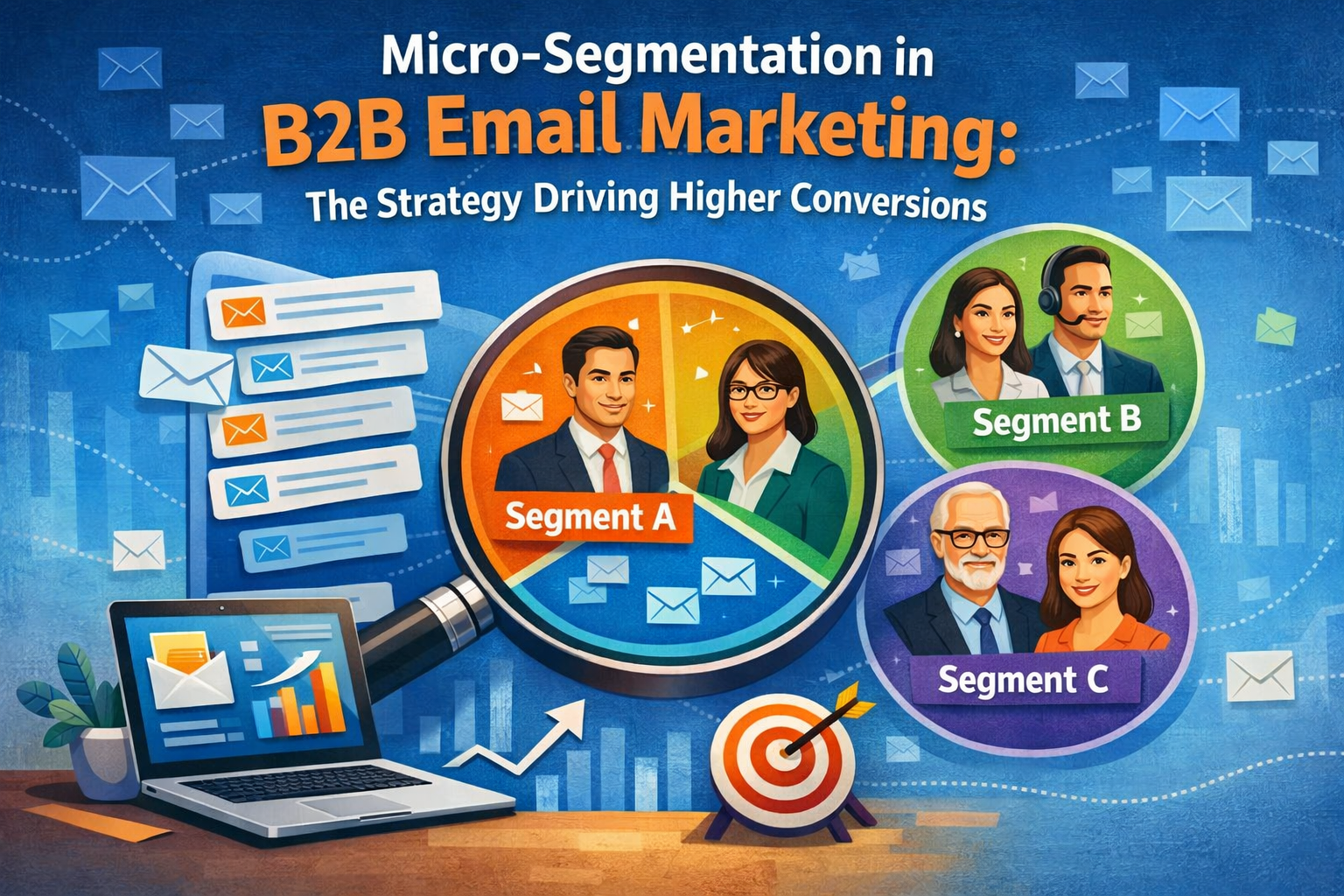
Micro-Segmentation in B2B Email Marketing: The Strategy Driving Higher Conversions
 Vansh Banthia,
6 days ago
3 min read
Vansh Banthia,
6 days ago
3 min read
B2B email marketing remains one of the most effective channels for demand generation and customer engagement. However, many organizations still rely on broad audience lists and generic messaging that fails to resonate with different buyer personas.
Modern B2B buyers expect communication that is relevant to their specific role, industry, and stage in the buying journey. This expectation has led marketers to adopt micro-segmentation, a strategy that divides audiences into smaller, highly targeted groups.
By using micro-segmentation in email campaigns, B2B marketers can deliver more personalized and relevant messages, significantly improving engagement and conversion rates.
What Is Micro-Segmentation in B2B Email Marketing?
Micro-segmentation is the process of dividing email audiences into highly specific groups based on detailed data points.
Unlike traditional segmentation, which may only categorize contacts by industry or company size, micro-segmentation uses multiple attributes to create more refined audience segments.
These attributes can include:
- Job roles and decision-making authority
- Industry and company size
- Past content engagement
- Website behavior and page visits
- Stage in the buying journey
This approach allows marketers to send messages tailored to the precise interests and needs of each audience segment.
Why Traditional Email Segmentation Is No Longer Enough
Traditional segmentation often groups thousands of contacts into broad categories such as “technology companies” or “enterprise clients.”
While this approach simplifies campaign management, it often results in emails that feel too generic. Prospects receive messages that may not directly address their challenges or priorities.
Micro-segmentation solves this problem by enabling marketers to craft highly targeted campaigns that speak directly to specific audiences.
How Micro-Segmentation Improves Email Performance
B2B organizations are increasingly seeing measurable improvements when they implement micro-segmentation strategies.
Higher Open Rates
Emails that are tailored to specific roles or industries are more likely to capture attention.
Improved Click-Through Rates
When content is relevant to a recipient’s needs, they are more likely to engage with links, resources, and offers.
Stronger Lead Qualification
Micro-segmentation helps marketing teams identify high-intent prospects and prioritize outreach.
Better Customer Experience
Personalized messaging creates more meaningful interactions between brands and potential buyers.
Technologies Enabling Micro-Segmentation
Advances in marketing technology have made micro-segmentation more accessible for B2B organizations.
Marketing Automation Platforms
Modern platforms allow marketers to create dynamic segments based on behavioral and demographic data.
CRM Integration
Customer relationship management systems provide detailed insights into contacts, accounts, and engagement history.
Data Analytics Tools
Analytics tools help marketers track engagement patterns and refine segmentation strategies.
Challenges in Implementing Micro-Segmentation
Despite its benefits, micro-segmentation requires a strong data infrastructure.
Organizations must ensure that their contact databases are accurate and regularly updated. Incomplete or outdated data can lead to ineffective segmentation and irrelevant messaging.
Additionally, creating highly personalized campaigns may require more content variations and careful campaign planning.
The Future of B2B Email Marketing
As B2B buyers continue to expect personalized communication, micro-segmentation will become a key component of email marketing strategies.
Rather than sending the same message to thousands of contacts, organizations will focus on delivering targeted insights and solutions tailored to specific audience segments.
Companies that adopt micro-segmentation will be better positioned to build stronger relationships, improve engagement, and drive more effective B2B marketing outcomes.