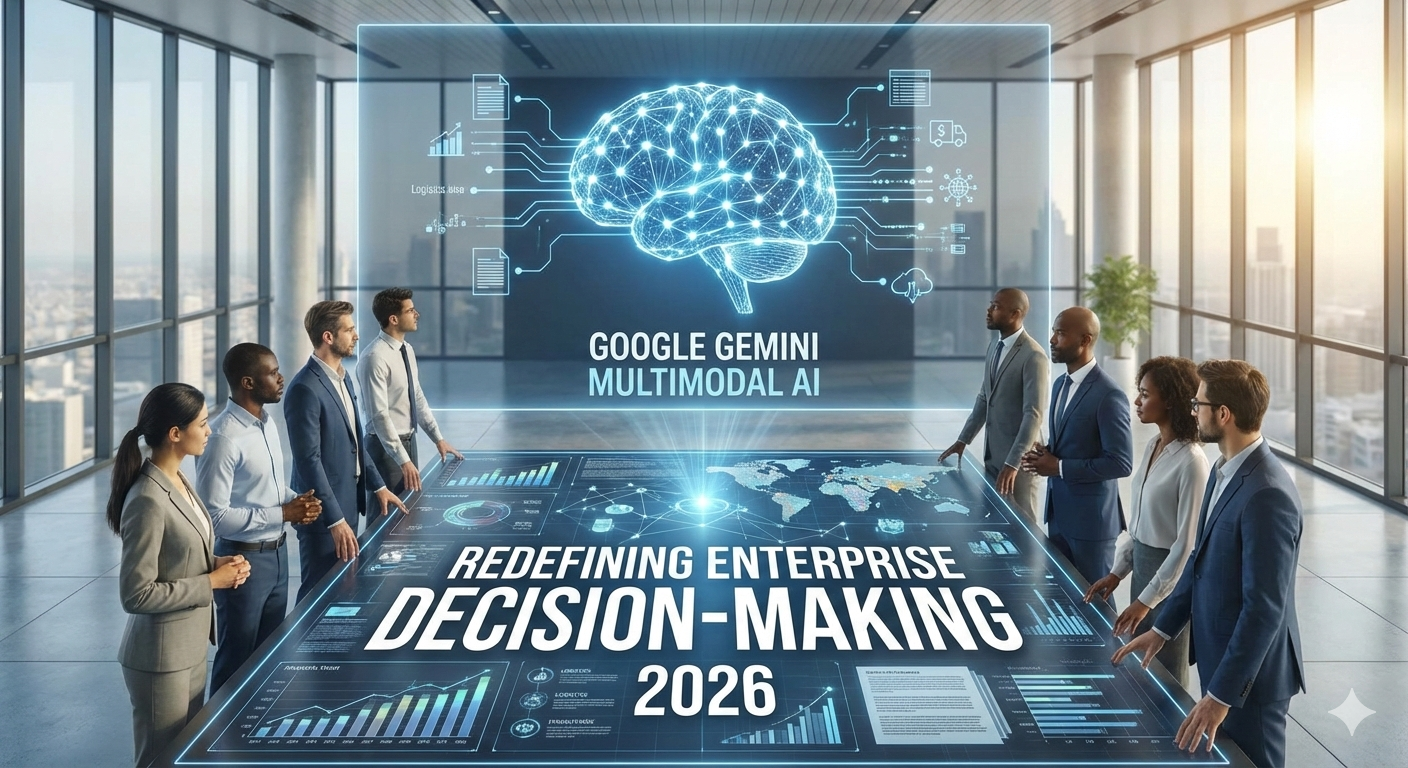
Google Gemini: How Multimodal AI Is Redefining Enterprise Decision-Making in 2026
 Vansh Banthia,
2 months ago
4 min read
Vansh Banthia,
2 months ago
4 min read
Artificial intelligence is no longer about isolated tools or single-task automation. In 2026, the competitive edge belongs to enterprises that can reason across data types, contexts, and workflows in real time. At the center of this shift is Google Gemini—Google’s most advanced multimodal AI model, designed to unify text, code, images, audio, and video into a single intelligent system.
For B2B organizations, Gemini represents more than another AI model. It signals a structural change in how decisions are made, how teams collaborate, and how intelligence flows across the enterprise.
This blog explores what Gemini is, why it matters, and how B2B teams can prepare for its impact.
What Is Google Gemini?
Google Gemini is a multimodal AI model built to understand, reason, and generate insights across multiple data formats simultaneously. Unlike traditional AI systems that operate in silos—text-only or image-only—Gemini is designed to connect signals across formats in one unified model.
In practical terms, this means Gemini can:
- Analyze documents, spreadsheets, and emails together
- Interpret charts, dashboards, and visuals alongside written data
- Understand code, business logic, and natural language in the same workflow
- Move seamlessly between research, execution, and optimization
For enterprises, this opens the door to context-aware intelligence at scale.
Why Gemini Matters for B2B Enterprises
B2B organizations operate in environments where decisions depend on fragmented data—CRM records, analytics dashboards, customer conversations, campaign performance, and market research.
Historically, connecting these signals required manual analysis or multiple disconnected tools.
Gemini changes this by enabling AI to reason holistically, not sequentially.
Key enterprise implications include:
- Faster decision cycles
- Reduced reliance on manual reporting
- Better alignment between marketing, sales, and operations
- More accurate forecasting and strategy modeling
Instead of asking teams to interpret data, Gemini helps systems interpret it for them.
Gemini and the Future of B2B Marketing
Marketing is one of the first functions to feel Gemini’s impact.
1. Multimodal Campaign Intelligence
Gemini can analyze campaign copy, performance metrics, creative assets, and audience behavior together—helping marketers understand why something works, not just what works.
2. Content Strategy at Scale
By understanding long-form content, audience intent, and distribution performance simultaneously, Gemini enables smarter content planning, optimization, and repurposing.
3. Predictive Buyer Insights
Instead of reactive reporting, Gemini supports predictive modeling—identifying patterns in buyer behavior before conversion signals appear.
For B2B demand generation platforms like iTMunch, this aligns perfectly with the shift toward intent-led, data-driven growth.
Gemini’s Impact on Sales and Revenue Teams
Sales teams rely on context—yet often operate with incomplete information.
Gemini enhances sales intelligence by:
- Analyzing deal history, communication patterns, and buyer behavior together
- Identifying risks and opportunities within pipelines
- Supporting account-level insights across multiple stakeholders
Rather than replacing sales teams, Gemini acts as an intelligence layer that improves timing, relevance, and decision quality.
Gemini and Enterprise Automation
Automation in 2026 is no longer rule-based—it’s reason-based.
Gemini enables:
- Dynamic workflows that adapt to real-time signals
- Cross-functional automation spanning marketing, sales, and customer success
- Reduced dependency on rigid process design
This marks a transition from task automation to decision automation—where systems recommend or execute actions based on understanding, not triggers.
Trust, Governance, and Enterprise Readiness
With greater intelligence comes greater responsibility.
Enterprise adoption of Gemini requires:
- Strong data governance frameworks
- Transparency in AI-driven decision logic
- Clear boundaries between human judgment and machine recommendations
Google’s focus on enterprise-grade security and compliance positions Gemini as a scalable solution—but success depends on organizational readiness, not just technology.
What B2B Leaders Should Do Now
Gemini is not a plug-and-play solution—it’s a strategic capability.
B2B leaders should:
- Audit data quality and integration readiness
- Identify workflows that rely heavily on manual interpretation
- Invest in AI-compatible content and data strategies
- Align teams around intelligence-driven decision models
Platforms like iTMunch, which combine content intelligence, demand generation, and performance insights, are well-positioned to leverage Gemini-driven ecosystems.
The Bigger Picture: From Tools to Intelligence Systems
Gemini signals a broader shift in enterprise technology—from isolated tools to connected intelligence systems.
In this future:
- AI doesn’t just assist—it reasons
- Data doesn’t just report—it informs
- Decisions don’t lag—they adapt
For B2B organizations, the question is no longer whether AI will shape operations, but how intelligently it will be implemented.
Final Thoughts
Google Gemini is not just an evolution of AI—it’s a redefinition of how enterprises think, decide, and act.
For B2B brands navigating complex markets, rising competition, and data overload, Gemini offers a path toward clarity—provided it’s paired with the right platforms, strategies, and governance.
At iTMunch, the focus remains on helping modern B2B teams turn intelligence into impact—because in the age of multimodal AI, insight is the new growth engine.