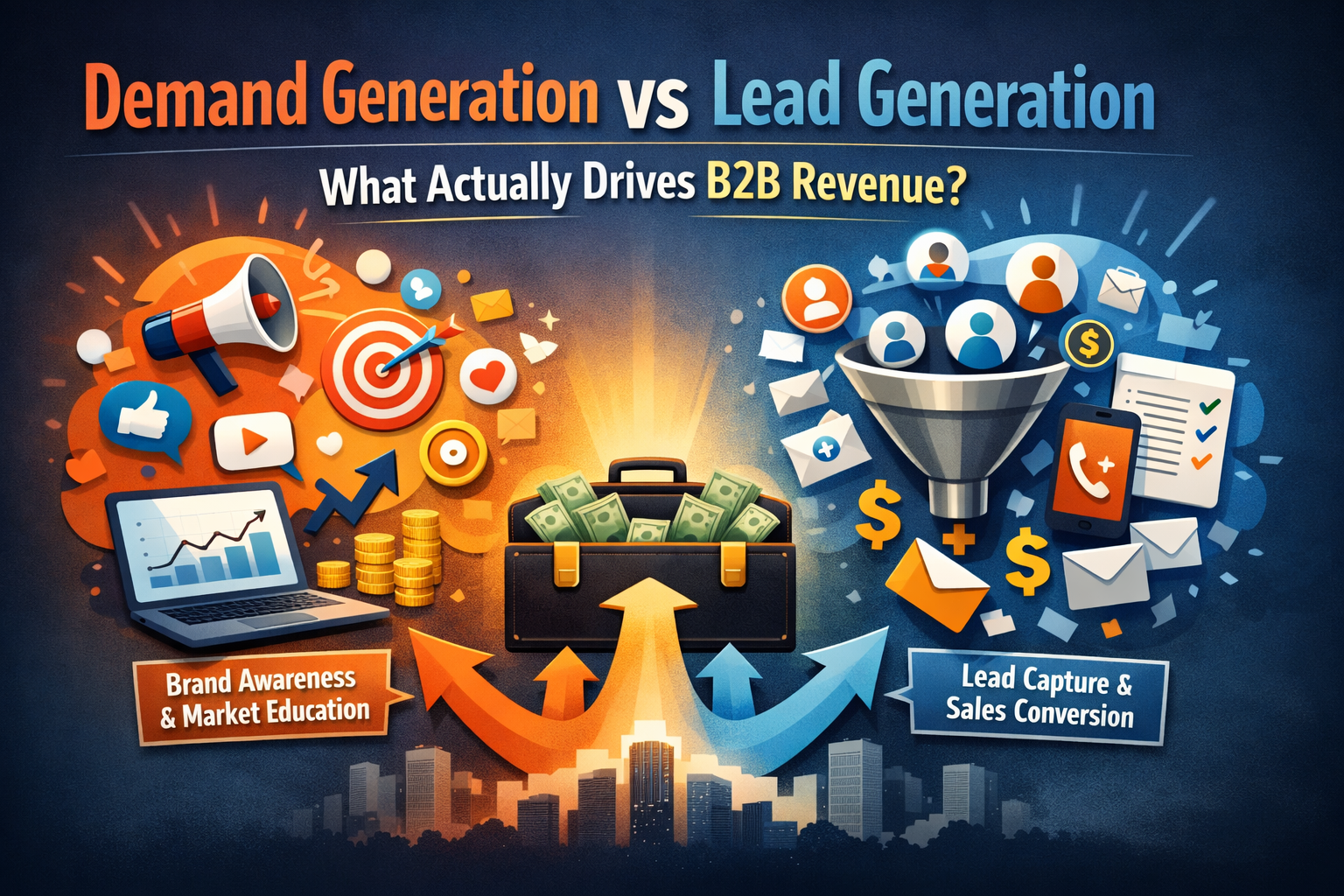
Demand Generation vs Lead Generation: What Actually Drives B2B Revenue?
 Vansh Banthia,
5 days ago
4 min read
Vansh Banthia,
5 days ago
4 min read

For many B2B companies, lead generation has long been the primary marketing goal. The logic was simple: generate as many leads as possible, pass them to the sales team, and convert them into customers.
However, modern B2B buying behavior has changed dramatically. Buyers now conduct extensive independent research before interacting with vendors, often completing most of their decision-making journey online.
Because of this shift, companies are increasingly focusing on demand generation alongside lead generation. While both strategies are related, they serve different purposes in the B2B marketing ecosystem.
Understanding the difference between these two approaches can help marketing teams build stronger pipelines and drive sustainable revenue growth.
What is Lead Generation?
Lead generation focuses on capturing contact information from potential customers who show interest in a company’s product or service.
This typically happens through gated marketing assets such as:
- Whitepapers
- Research reports
- Webinars
- Case studies
- Product demos
- Newsletter sign-ups
Once a prospect submits their information, they enter the company’s marketing or sales funnel as a lead.
Lead generation strategies are designed to convert website visitors into identifiable prospects that sales teams can engage with.
What is Demand Generation?
Demand generation focuses on creating awareness and interest in a product, service, or solution before capturing leads.
Instead of immediately pushing prospects to fill out forms, demand generation aims to educate the market and build trust.
Common demand generation tactics include:
- Educational blog content
- Industry research insights
- Social media thought leadership
- Podcasts and webinars
- Video explainers
- Community engagement
The primary goal is to build credibility and influence buyer perception long before a purchase decision is made.
Why Demand Generation is Becoming Essential
Modern B2B buyers prefer to research independently. Studies consistently show that many decision-makers complete a large portion of their evaluation process before contacting vendors.
This means companies that focus only on lead generation may miss opportunities to influence buyers earlier in the journey.
Demand generation helps companies:
- Build brand awareness
- Educate potential buyers
- Establish industry authority
- Stay top-of-mind during research phases
By the time a prospect becomes a lead, they may already trust the brand due to previous exposure through demand generation activities.
Key Differences Between Demand Generation and Lead Generation
Objective
Demand generation focuses on creating market interest, while lead generation focuses on capturing contact information.
Funnel Position
Demand generation operates mostly at the top and middle of the marketing funnel, whereas lead generation primarily targets prospects ready to move deeper into the funnel.
Content Strategy
Demand generation relies heavily on ungated content such as blogs, social media posts, and videos. Lead generation typically uses gated assets that require users to submit information.
Measurement Metrics
Demand generation success is often measured through metrics such as:
- Brand awareness
- Website traffic
- Content engagement
- Social reach
Lead generation success is measured through:
- Number of leads generated
- Conversion rates
- Cost per lead
- Sales pipeline contribution
Why B2B Companies Need Both
Demand generation and lead generation are not competing strategies—they work best when integrated.
Demand generation builds market awareness and trust, while lead generation converts interested prospects into identifiable contacts.
Without demand generation, companies may struggle to attract enough prospects to fill the funnel. Without lead generation, marketing teams cannot capture and nurture those prospects effectively.
A balanced strategy allows companies to both create interest and convert that interest into revenue opportunities.
Building an Effective Demand + Lead Generation Strategy
To maximize marketing impact, companies should combine both approaches.
Invest in Educational Content
Blogs, industry insights, and expert articles help build authority and attract organic traffic.
This content forms the foundation of demand generation.
Use Gated Assets Strategically
Once prospects engage with your content, offer deeper resources such as whitepapers, research reports, or webinars in exchange for contact information.
This converts engaged readers into leads.
Distribute Content Through Multiple Channels
Content distribution through industry platforms, social media, and content syndication networks can significantly expand reach and attract qualified prospects.
Align Sales and Marketing Teams
When demand generation and lead generation strategies are aligned, sales teams receive better-informed prospects who already understand the company’s value proposition.
This shortens the sales cycle and improves conversion rates.
The Future of B2B Marketing
As digital research continues to shape buyer behavior, companies must rethink traditional lead generation strategies.
The most successful B2B marketers will focus not only on collecting leads but also on creating meaningful demand within their target markets.
Demand generation ensures your brand becomes part of the buyer’s research journey, while lead generation turns that interest into tangible opportunities.
In today’s competitive B2B environment, the companies that master both strategies will be the ones that consistently build stronger pipelines and drive long-term revenue growth.