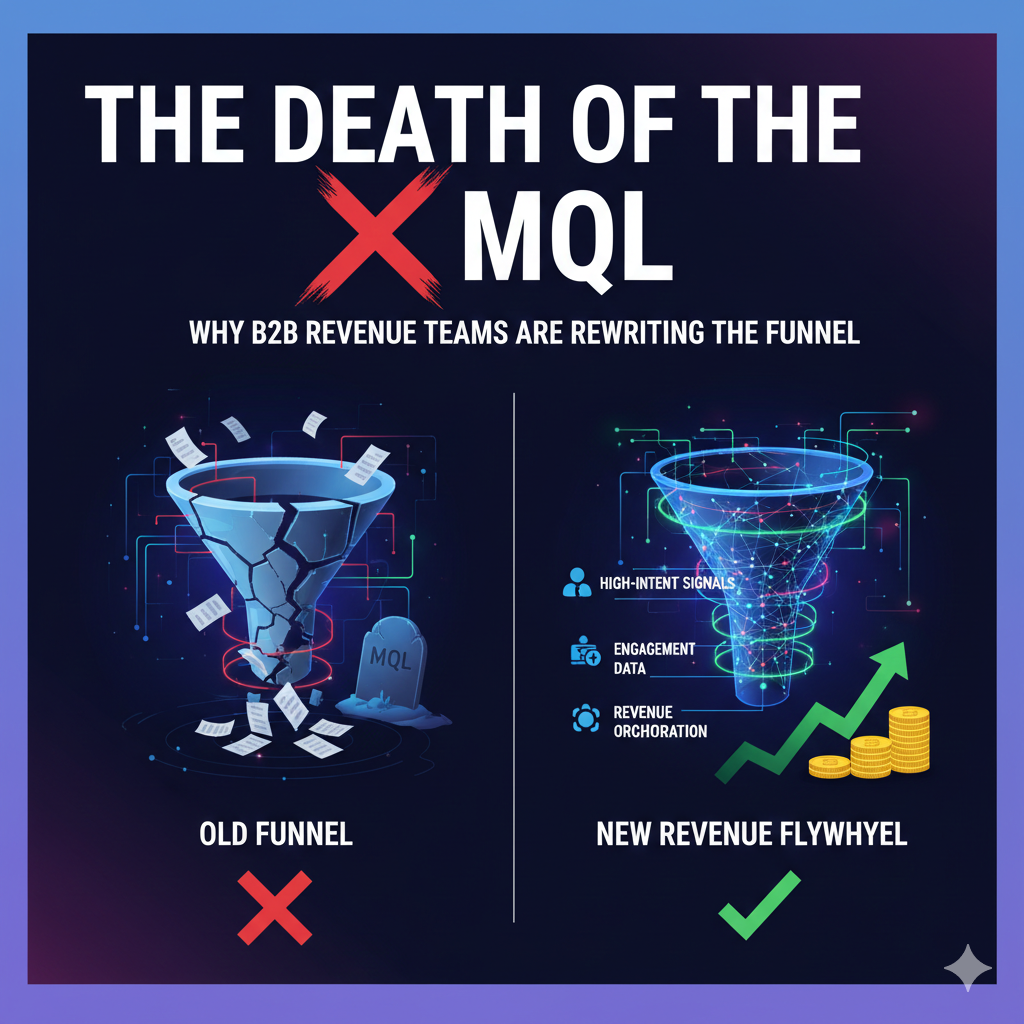
The Death of the MQL: Why B2B Revenue Teams Are Rewriting the Funnel
 Vansh Banthia,
2 months ago
4 min read
Vansh Banthia,
2 months ago
4 min read
For over a decade, the Marketing Qualified Lead (MQL) has been the backbone of B2B growth strategies. Dashboards revolved around it. Teams were structured around it. Budgets were justified by it.
And yet—most B2B revenue teams today quietly admit the same thing:
MQLs don’t translate into revenue anymore.
This isn’t a failure of execution. It’s a failure of the model itself.
As buyer behavior evolves, the traditional funnel—built around gated content, lead scoring, and linear progression—is breaking down. In its place, a new revenue framework is emerging—one that prioritizes buyer readiness, intent, and context over arbitrary lead thresholds.
Why the MQL Model Is No Longer Fit for Purpose
The MQL was designed for a simpler buying journey.
Back then:
- Buyers filled forms early
- Sales controlled most product knowledge
- Content access was limited
- Attribution was relatively linear
Today’s reality looks very different.
Modern B2B buyers:
- Self-educate across multiple third-party platforms
- Involve more stakeholders than ever
- Delay direct sales engagement
- Move non-linearly across touchpoints
The result? A lead can meet every MQL scoring rule and still have zero buying intent—while a serious buyer remains completely invisible.
The Hidden Cost of Chasing MQLs
Revenue teams pay a real price for outdated lead models.
Sales Fatigue
Sales teams burn time following up on leads that downloaded a single asset months ago—without urgency or authority.
Marketing-Sales Friction
When MQLs don’t convert, trust erodes. Marketing defends volume. Sales questions quality.
Missed Buying Windows
By the time a buyer becomes an MQL, the decision may already be made—just not with you.
The MQL doesn’t fail because teams execute it poorly. It fails because it measures activity, not intent.
The Funnel Isn’t Linear Anymore — It’s Fragmented
B2B funnels used to move cleanly:
Awareness → Consideration → Decision
Now, buyers jump:
- From peer reviews to demos
- From industry content to vendor comparisons
- From anonymous research to closed deals
This fragmentation means success depends less on “moving leads down the funnel” and more on identifying when genuine demand exists.
What’s Replacing the MQL?
High-performing B2B teams are shifting toward intent-qualified engagement models.
Instead of asking:
“Did this contact meet our MQL criteria?”
They ask:
“Is this account showing buying intent right now?”
This shift focuses on:
- Engagement depth (not just clicks)
- Content relevance (not downloads alone)
- Buyer context (role, industry, problem stage)
- Timing signals (recency and frequency)
Intent becomes the qualification—not the form fill.
Demand Recognition vs Demand Generation
The future of B2B growth isn’t about generating demand—it’s about recognizing it early.
Demand already exists. Buyers are already researching. The competitive advantage lies in:
- Detecting interest before competitors
- Understanding what buyers care about
- Engaging with relevance instead of volume
This is where content-driven intent discovery becomes critical.
Why Content Is the Strongest Intent Signal
Content consumption reveals more than contact data ever could.
What a buyer reads tells you:
- What problem they’re trying to solve
- How urgent that problem is
- How informed they already are
- Where they are in the decision cycle
But this only works when content is distributed in trusted, research-driven environments—not just behind brand-owned gates.
How iTMunch Enables Intent-First Revenue Strategies
iTMunch is built for teams moving beyond MQLs.
By distributing content across high-authority, industry-relevant platforms, iTMunch helps brands:
- Reach buyers during genuine research moments
- Capture engagement tied to real purchase intent
- Align content with buyer readiness stages
- Deliver sales-ready context—not just contact lists
Instead of pushing buyers into funnels, iTMunch allows revenue teams to meet buyers where intent naturally forms.
What Revenue Teams Gain by Letting Go of MQLs
Organizations that move beyond MQLs consistently report:
- Higher sales acceptance rates
- Shorter deal cycles
- Better pipeline predictability
- Stronger sales-marketing alignment
Most importantly, teams stop optimizing for vanity metrics—and start optimizing for revenue outcomes.
The New Funnel Is Buyer-Controlled
The future funnel isn’t owned by marketing or sales.
It’s owned by the buyer.
Winning brands will be the ones that:
- Listen more than they push
- Interpret intent instead of forcing actions
- Value relevance over reach
The death of the MQL isn’t a loss—it’s an opportunity to build a smarter, more buyer-aligned growth engine.
Final Thought
MQLs were useful when buyers were predictable.
They aren’t anymore.
In a world where buyers move silently, research independently, and decide faster than ever, the question isn’t how many leads you generate—it’s how well you recognize intent when it appears.
With intent-driven platforms like iTMunch, B2B teams can stop chasing outdated metrics and start building pipelines that actually convert.