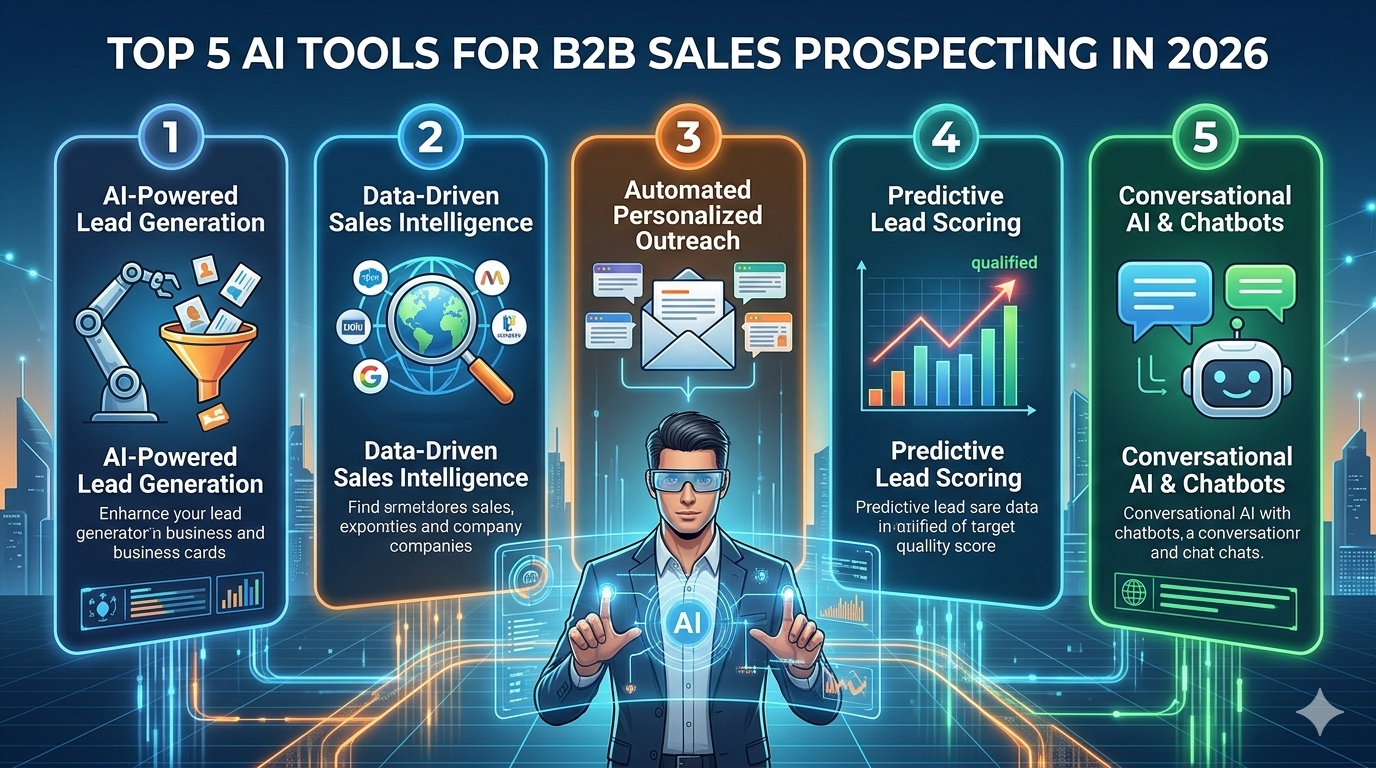
B2B sales prospecting has entered a different phase. Volume alone no longer creates a pipeline. Buyers filter aggressively, technical stakeholders influence earlier, and outreach fatigue has made generic automation ineffective. In this environment, AI is no longer a “nice-to-have” layer; it is the operating system behind modern outbound.
The most effective AI tools for B2B sales prospecting do not simply automate emails. They connect signal detection, account intelligence, sequencing, and deliverability into coordinated workflows. They help teams identify the right accounts, surface the right stakeholders, and engage at the right moment.
At a Glance: Top AI Tools for B2B Sales Prospecting
- Onfire: Signal-driven account intelligence for complex B2B sales
- Salesloft: Structured enterprise sales engagement workflows
- Dealfront: Intent data and European account visibility
- Cognism: Verified contact data for outbound teams
- ReachInbox: Cold email infrastructure and deliverability control
Why AI Is Reshaping B2B Sales Prospecting
Outbound prospecting used to begin with lists. Sales teams purchased databases, segmented by firmographics, and launched campaigns at scale. The assumption was simple: more activity equals more opportunity. That assumption no longer holds.
Buying committees now include engineering, security, finance, and operations. Technical validation often happens before procurement is involved. Meanwhile, inbox saturation has reduced tolerance for generic messaging. AI changes this dynamic in three important ways:
- It identifies accounts showing early signals of interest or technical evaluation.
- It surfaces stakeholders influencing decisions beyond traditional titles.
- It coordinates execution across channels without losing timing precision.
The Top AI Tools for B2B Sales Prospecting
1. Onfire – Best Overall AI Platform for Signal-Driven Prospecting
Onfire approaches prospecting as an intelligence challenge rather than an outreach problem. Instead of starting with contact lists, it begins with signals, identifying accounts that are actively engaging with relevant technologies and surfacing the engineers and technical stakeholders influencing decisions.
At the center of Onfire is its Account Intelligence Graph, which connects CRM context with large-scale external technical signals. This enables sales teams to detect early-stage evaluation activity, particularly in engineering-led buying environments where traditional firmographic targeting falls short.
For B2B SaaS companies selling into DevOps, security, infrastructure, or technical teams, this level of visibility changes timing entirely. Instead of reaching out after procurement conversations begin, teams can engage during technical validation phases, when influence is still fluid.
Rather than automating more emails, Onfire improves who you contact, when you contact them, and why the outreach is relevant.
Key Features
- Account Intelligence Graph linking companies, technologies, and stakeholders
- AI-driven detection of active technical buying signals
- Discovery of hidden engineers and platform decision-makers
- Signal-based account prioritization
- Integration into outbound and CRM workflows
2. Salesloft – For Structured Enterprise Sales Engagement
Salesloft operates at the engagement layer of prospecting. It focuses on cadence orchestration, workflow standardization, and performance visibility for revenue teams managing complex sales motions.
For enterprise organizations with large SDR teams, Salesloft provides structured multichannel sequences across email, phone, and LinkedIn. Its AI capabilities recommend next actions and help managers monitor activity patterns and conversion metrics.
Salesloft does not primarily function as a signal detection engine. Instead, it excels at coordinating execution once target accounts and contacts are defined. In structured enterprise environments where discipline and forecasting alignment matter, this operational layer is critical.
It is particularly valuable for teams seeking to unify activity tracking and ensure consistency across reps.
Key Features
- Multichannel cadence orchestration
- AI-driven activity recommendations
- Revenue performance analytics
- Call and email tracking
- CRM integration for pipeline alignment
3. Dealfront – For European Market Intelligence and Intent Signals
Dealfront combines account intelligence with intent data, with particular strength in European market coverage. For B2B companies operating across EU regions, localized visibility can significantly improve targeting accuracy.
The platform surfaces website visitor data, intent signals, and account-level insights that help sales teams identify companies researching relevant solutions. This timing component enhances outbound prioritization.
While Dealfront provides useful intelligence, its focus is broader account visibility rather than deep stakeholder-level signal mapping. It supports segmentation and intent-based targeting, particularly for mid-market and regional sales strategies.
For organizations with strong European GTM presence, Dealfront can function as an effective intelligence layer.
Key Features
- Intent signal monitoring
- Website visitor identification
- Account intelligence dashboards
- Data enrichment capabilities
- CRM and outbound integrations
4. Cognism – For Verified Contact Data in Outbound Teams
Cognism strengthens the contact data foundation of outbound prospecting. It is particularly known for phone-verified mobile numbers and compliance-focused data sourcing.
In sales environments where calling remains central to pipeline creation, connect rates matter. Cognism’s verified contact information reduces time wasted dialing inaccurate numbers and improves SDR efficiency.
Beyond phone data, the platform offers global contact coverage and CRM enrichment. Its strength lies in accuracy and reliability rather than signal detection or advanced workflow orchestration.
For teams focused on outbound calling or multi-threaded enterprise engagement, Cognism supports execution with dependable data quality.
Key Features
- Phone-verified mobile numbers
- Global B2B contact database
- Compliance-first data sourcing
- CRM enrichment capabilities
- Integration with sales engagement platforms
5. ReachInbox – For Cold Email Infrastructure and Deliverability
ReachInbox focuses on cold email execution and deliverability management. As outbound email volume increases, sender reputation becomes fragile. Platforms that manage warmup, inbox rotation, and sending behavior are essential for maintaining performance.
ReachInbox provides structured email automation workflows with built-in warmup systems and deliverability monitoring. For teams running high-volume outbound programs, protecting domain health is foundational.
Unlike intelligence-driven platforms, ReachInbox concentrates on infrastructure. It ensures campaigns reach inboxes reliably, supporting scalable execution.
For growth teams prioritizing cold email as a primary channel, infrastructure stability can significantly impact reply rates and overall campaign ROI.
Key Features
- Automated inbox warmup
- Cold email sequence automation
- Deliverability monitoring
- Campaign performance analytics
- Multi-inbox management
Where Most B2B Prospecting Breaks Down
Even with AI tools available, many organizations struggle because they automate weak processes.
Common breakdown points include:
- Over-reliance on static contact databases
- Poor visibility into buying signals
- Generic personalization variables
- Disconnected engagement tools
- Neglected deliverability infrastructure
When prospecting is treated purely as outreach execution, results plateau quickly. Without signal context, automation simply accelerates irrelevance. The most successful AI-driven prospecting systems begin with intelligence and layer execution on top.
How High-Performing Prospecting Systems Combine Intelligence and Execution
The strongest revenue teams do not rely on a single category of tool. They build layered systems.
A modern prospecting architecture typically includes:
- Intelligence layer: Identifying accounts showing active signals
- Engagement layer: Coordinating multichannel outreach
- Data layer: Ensuring contact accuracy
- Infrastructure layer: Protecting deliverability
When these layers operate in isolation, performance suffers. When they are integrated under RevOps governance, prospecting becomes predictable. The key shift is moving from list-based automation to signal-first execution.
Which AI Prospecting Tool Is Right for Your GTM Motion?
The answer depends on your sales model.
- Enterprise organizations may prioritize engagement orchestration.
- EU-focused companies may value regional intent visibility.
- Call-heavy outbound teams require accurate contact data.
- High-volume email strategies depend on deliverability control.
- Technical B2B vendors benefit from early signal detection and stakeholder mapping.
Choosing the right platform requires identifying your bottleneck: targeting, execution, data accuracy, or infrastructure.
FAQs
What makes an AI tool effective for B2B sales prospecting?
An effective AI prospecting tool improves targeting precision and execution timing. The best platforms connect account intelligence, stakeholder discovery, and workflow automation into a coordinated system. Instead of sending more emails, they help teams identify accounts showing real signals and engage them with context, improving reply rates and pipeline conversion efficiency.
How do AI tools improve outbound response rates?
AI tools improve response rates by increasing relevance and timing. Signal-driven platforms identify accounts actively researching solutions, while personalization engines tailor messaging at scale. Combined with deliverability controls and multichannel orchestration, AI reduces generic outreach and aligns communication with buyer context, resulting in higher engagement and meeting conversion.
Are technographic signals more valuable than contact databases?
Technographic signals often provide earlier buying insight than contact databases alone. While verified contact information supports execution, signals reveal when and why accounts may be evaluating solutions. The most effective prospecting strategies combine both layers, using signal intelligence to prioritize accounts and accurate data to execute outreach efficiently.
Can AI replace SDRs in B2B prospecting?
AI does not replace SDRs; it enhances their effectiveness. By automating research, signal detection, and workflow management, AI reduces manual operational tasks. This allows SDRs to focus on conversations, qualification, and relationship building. The result is higher productivity and stronger pipeline creation without increasing headcount.
How should companies evaluate AI prospecting platforms?
Companies should evaluate AI prospecting platforms based on signal quality, workflow integration, data accuracy, and scalability. The right choice depends on GTM maturity and the complexity of the sales motion. Teams selling into technical markets may prioritize intelligence depth, while high-volume outbound models may emphasize deliverability infrastructure and execution consistency.
For deeper insights into modern sales prospecting strategies and AI-driven sales tools, explore: