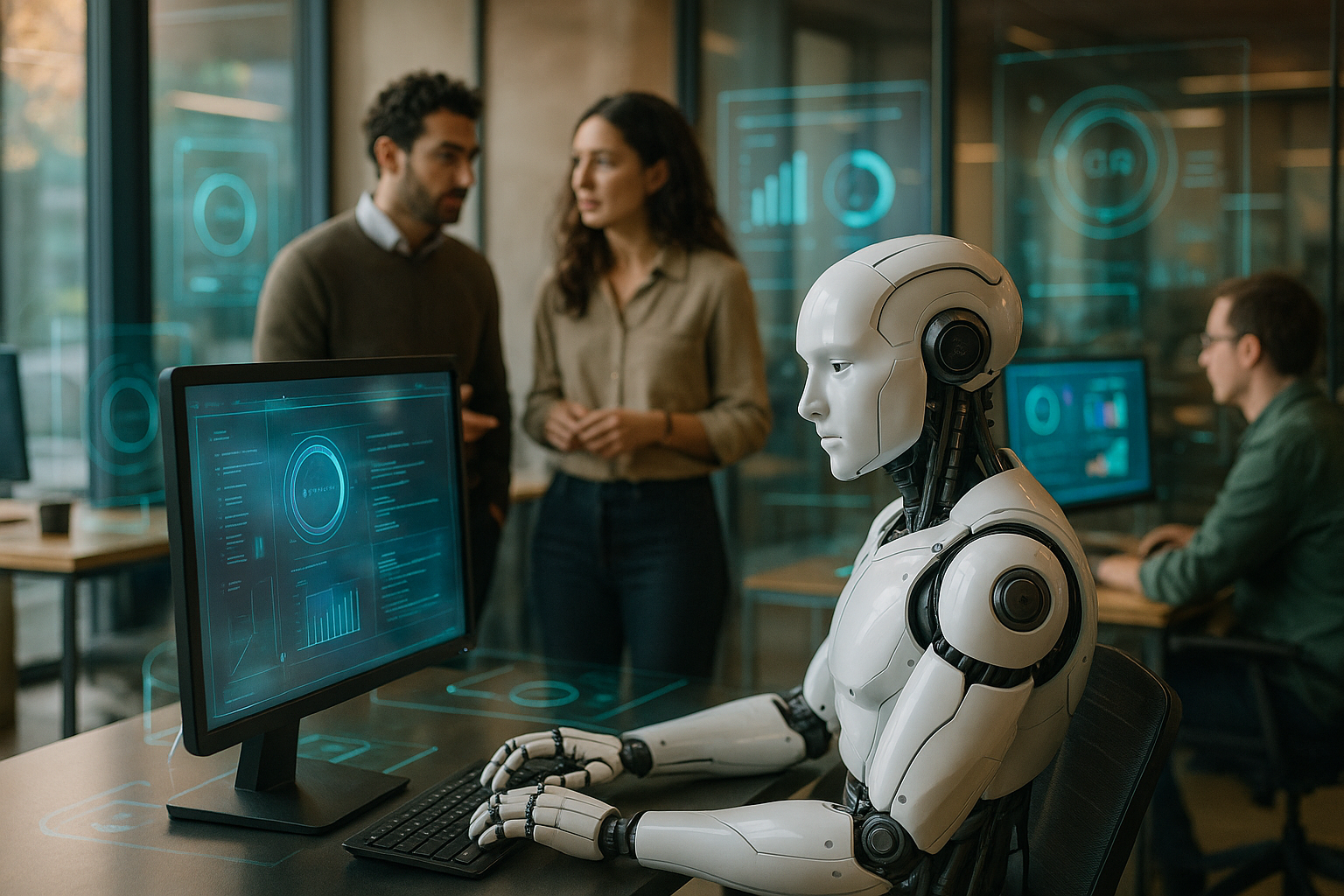
AI Agents in the Workplace: Are Autonomous Employees the Future of Productivity?
 Gaurav Uttamchandani,
9 months ago
3 min read
Gaurav Uttamchandani,
9 months ago
3 min read
Table of Contents
Introduction
The workplace is evolving faster than ever, and the biggest game-changer of 2025 might just be something that never needs a lunch break—AI agents. These autonomous, software-based systems are now being deployed across industries to handle everything from customer support to complex project management. But can AI agents truly act as coworkers? And if so, what does that mean for the modern workforce?
Let’s explore how AI agents are reshaping productivity, redefining job roles, and offering a glimpse into the next generation of work.
What Are AI Agents?
AI agents are autonomous software programs capable of making decisions, learning from feedback, and taking actions without constant human oversight. Think of them as digital coworkers programmed to handle tasks, make suggestions, and even interact with human colleagues in real time.
Popular examples include:
- Auto-GPT and AgentGPT: Self-prompting AI agents that autonomously complete multi-step tasks
- Devin (by Cognition AI): An AI software engineer that can write and deploy code independently
- Claude, ChatGPT, and Gemini: When integrated with tools, these LLMs act as semi-autonomous support agents
Real-World Use Cases
Artificial Intelligence agents are already being deployed across various industries:
Customer Support Automation
Companies are replacing Tier-1 support roles with AI agents that:
- Answer FAQs with near-human accuracy
- Escalate only complex queries
- Integrate with CRM systems to resolve tickets automatically
Sales & Lead Qualification
AI agents are:
- Engaging leads via chat or email
- Scoring and qualifying prospects
- Booking meetings directly into human reps’ calendars
Coding & Development
Autonomous developers like Devin can:
- Generate functional code
- Debug and test applications
- Push updates to GitHub with minimal input
Additionally Read: How AI Agents Are Revolutionizing Customer Support in 2025
Marketing & Content Creation
AI agents write blogs, generate SEO strategies, schedule posts, and analyze performance metrics—all while adapting to brand tone.
The Pros:
- 24/7 Productivity: No fatigue, no breaks, and minimal downtime.
- Scalability: Run multiple agents in parallel to handle high-volume tasks.
- Consistency: Repeatable results with minimal errors.
- Cost Efficiency: Reduce hiring needs for repetitive tasks.
The Cons: What Are the Risks?
- Accountability: Who is responsible when an AI agent makes a mistake?
- Job Displacement: Entry-level roles are at highest risk of automation.
- Bias & Ethics: AI agents can unintentionally reinforce systemic bias if poorly trained.
- Overreliance: Relying too heavily on AI can lead to skill atrophy among human workers.
The Human-AI Collaboration Model
The future isn’t human vs. AI. It’s human + AI.
Forward-thinking companies are adopting hybrid models, where:
- AI agents handle 80% of routine tasks
- Human employees focus on creativity, strategy, and emotional intelligence
This model not only increases productivity but also improves employee satisfaction by eliminating repetitive work.
Preparing for an AI-Integrated Workforce
To stay competitive in this new era:
- Upskill continuously in AI literacy and digital collaboration tools
- Redesign job roles to emphasize tasks only humans can perform
- Establish AI governance policies for transparency and control
- Monitor AI outputs to ensure alignment with business ethics and goals
Final Thoughts
AI agents aren’t science fiction—they’re rapidly becoming business as usual. As they move from experimental to essential, companies that embrace and integrate autonomous agents strategically will enjoy faster growth, higher efficiency, and a more dynamic workplace.
The question is no longer if AI agents will join your team—but how ready you are to manage them.
Explore more future-of-work trends and emerging technologies at iTMunch.com