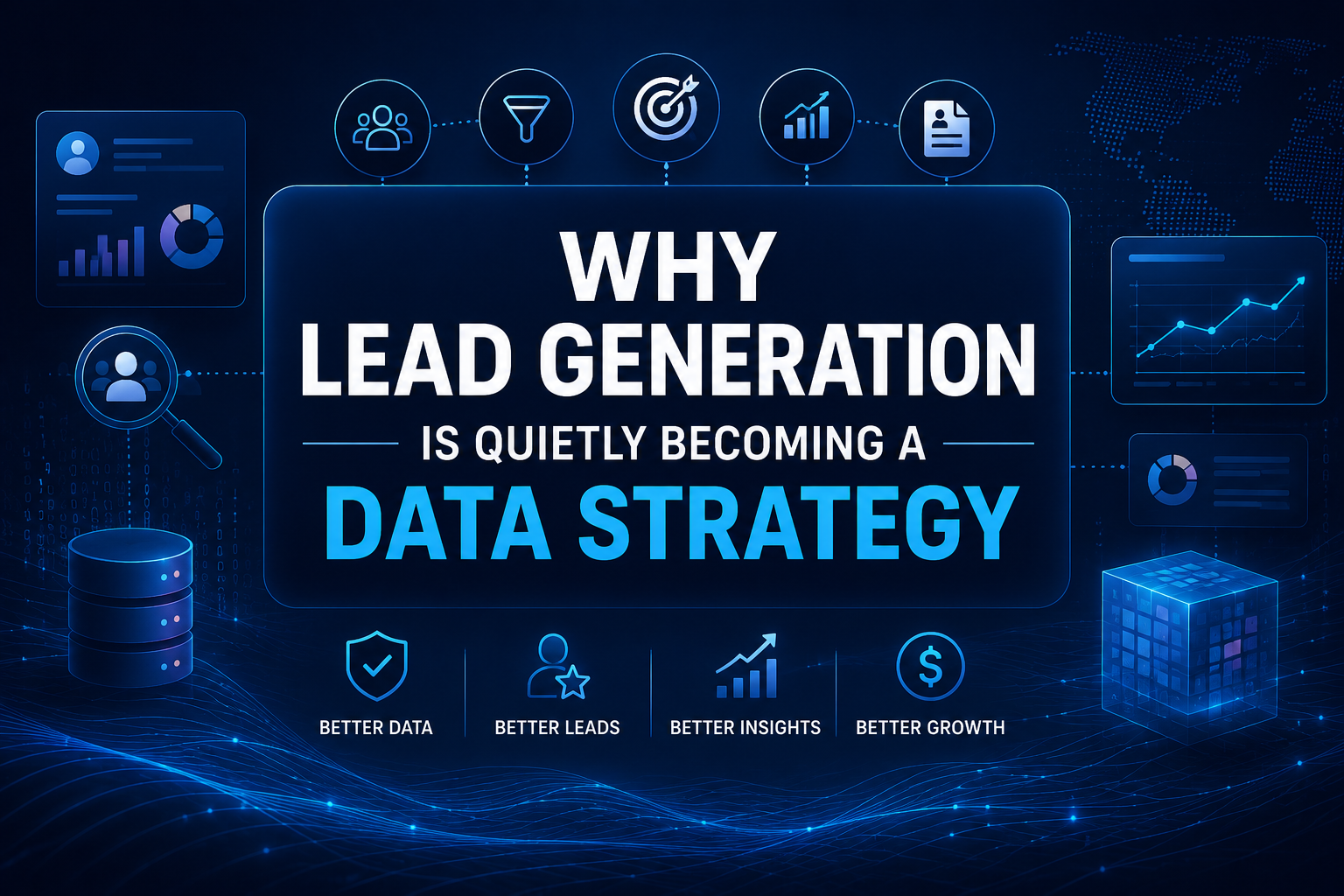
For years, B2B marketing teams measured success by the number of leads entering the sales pipeline. More downloads, more form submissions, and more marketing-qualified leads often signaled a healthy demand generation engine. Yet as enterprise buying journeys become increasingly digital and AI reshapes how organizations evaluate vendors, the definition of lead generation is undergoing a profound transformation.
In 2026, the most valuable outcome of B2B lead generation is no longer simply acquiring contact information. It is collecting meaningful data that reveals buying intent, customer behavior, and market opportunities. Every interaction from website visits and webinar attendance to content consumption and product research creates signals that help organizations understand when, why, and how prospects are moving toward a purchasing decision.
Recent advancements in AI-powered analytics, predictive modeling, and privacy-first marketing have accelerated this shift. Businesses are discovering that the organizations with the strongest competitive advantage are not necessarily those generating the highest number of leads, but those building the richest datasets to guide future decisions.
For B2B decision makers, lead generation is evolving from a marketing activity into a strategic business intelligence function.
Every Buyer Interaction Is Becoming a Data Signal
The traditional lead funnel assumed that a completed form represented the beginning of the customer journey. Today, enterprise buyers often conduct extensive research before identifying themselves. AI-powered search, industry communities, analyst reports, peer recommendations, and vendor documentation enable decision makers to evaluate solutions anonymously for weeks or even months.
As a result, successful B2B lead generation strategies increasingly focus on capturing behavioral intelligence rather than waiting for explicit conversions.
Modern marketing platforms collect insights from website engagement, content consumption, search behavior, webinar participation, email interactions, CRM activity, and first-party customer data. Individually, these signals may appear insignificant. Together, they create a detailed picture of purchasing intent.
Artificial intelligence is making these insights even more valuable. AI models can identify patterns that human teams might overlook, helping businesses recognize high-intent prospects earlier, forecast buying behavior more accurately, and prioritize outreach based on real engagement rather than assumptions.
Recent industry trends also reinforce the growing importance of first-party data as privacy regulations continue reducing dependence on third-party cookies. Organizations that build their own data ecosystems are becoming less reliant on external targeting while improving marketing precision.
This evolution changes the purpose of lead generation. Instead of simply collecting names, businesses are building continuously expanding intelligence systems that improve every future marketing decision.
Better Data Creates Better Revenue Decisions
One of the biggest misconceptions surrounding B2B lead generation is that success depends primarily on generating higher lead volumes. In reality, poor-quality data often creates more challenges than opportunities.
Sales teams spend valuable time pursuing contacts with little purchasing intent, marketing budgets become less efficient, and forecasting accuracy declines when organizations rely on incomplete or outdated information.
Businesses are responding by investing more heavily in unified customer data platforms, AI-powered lead scoring, intent data providers, and predictive analytics. These technologies transform isolated customer interactions into meaningful business intelligence that supports both marketing and sales.
Instead of asking whether someone downloaded a whitepaper, organizations now analyze how prospects move across multiple digital touchpoints. They evaluate engagement depth, revisit frequency, content preferences, buying committee activity, and historical purchasing patterns to determine readiness.
This richer understanding improves decision-making across the organization. Marketing teams create more relevant campaigns. Sales representatives engage prospects at more appropriate moments. Revenue leaders gain more reliable forecasting. Product teams uncover emerging customer needs before competitors recognize them.
The result is a business strategy informed by data rather than intuition.
The Future of B2B Lead Generation Is Intelligence, Not Collection
As artificial intelligence continues reshaping enterprise marketing, the next evolution of B2B lead generation will focus less on collecting information and more on interpreting it.
Recent developments across enterprise technology show growing investment in AI-powered revenue intelligence platforms capable of connecting CRM systems, marketing automation, customer engagement platforms, and analytics tools into unified decision-making environments. Instead of viewing each lead as an isolated opportunity, organizations are beginning to understand customer behavior as an ongoing stream of connected data.
Another important trend is the rise of buying committee analysis. Enterprise purchases rarely involve a single decision maker. Multiple stakeholders often research independently across different channels before collectively evaluating vendors. Data-driven lead generation helps organizations identify these broader engagement patterns, allowing marketing and sales teams to influence entire buying groups rather than individual contacts.
Predictive analytics is also becoming increasingly central to enterprise growth strategies. Rather than reacting to completed forms, businesses are using AI to anticipate purchasing behavior, identify expansion opportunities, and uncover emerging market demand before competitors do.
The future belongs to organizations that treat every interaction as an opportunity to learn. Every search query, content view, webinar registration, product comparison, and customer conversation contributes to a growing knowledge base that strengthens future decisions.
For B2B decision makers, this represents a significant strategic shift. B2B lead generation is no longer just about filling the sales pipeline. It is becoming the foundation of a broader data strategy that connects marketing, sales, customer success, and executive leadership through shared intelligence.
The businesses that thrive in the years ahead will not simply generate more leads. They will generate better insights. In a marketplace where competitive advantage increasingly depends on understanding customer behavior before anyone else, data is becoming the most valuable outcome of every lead generation effort.