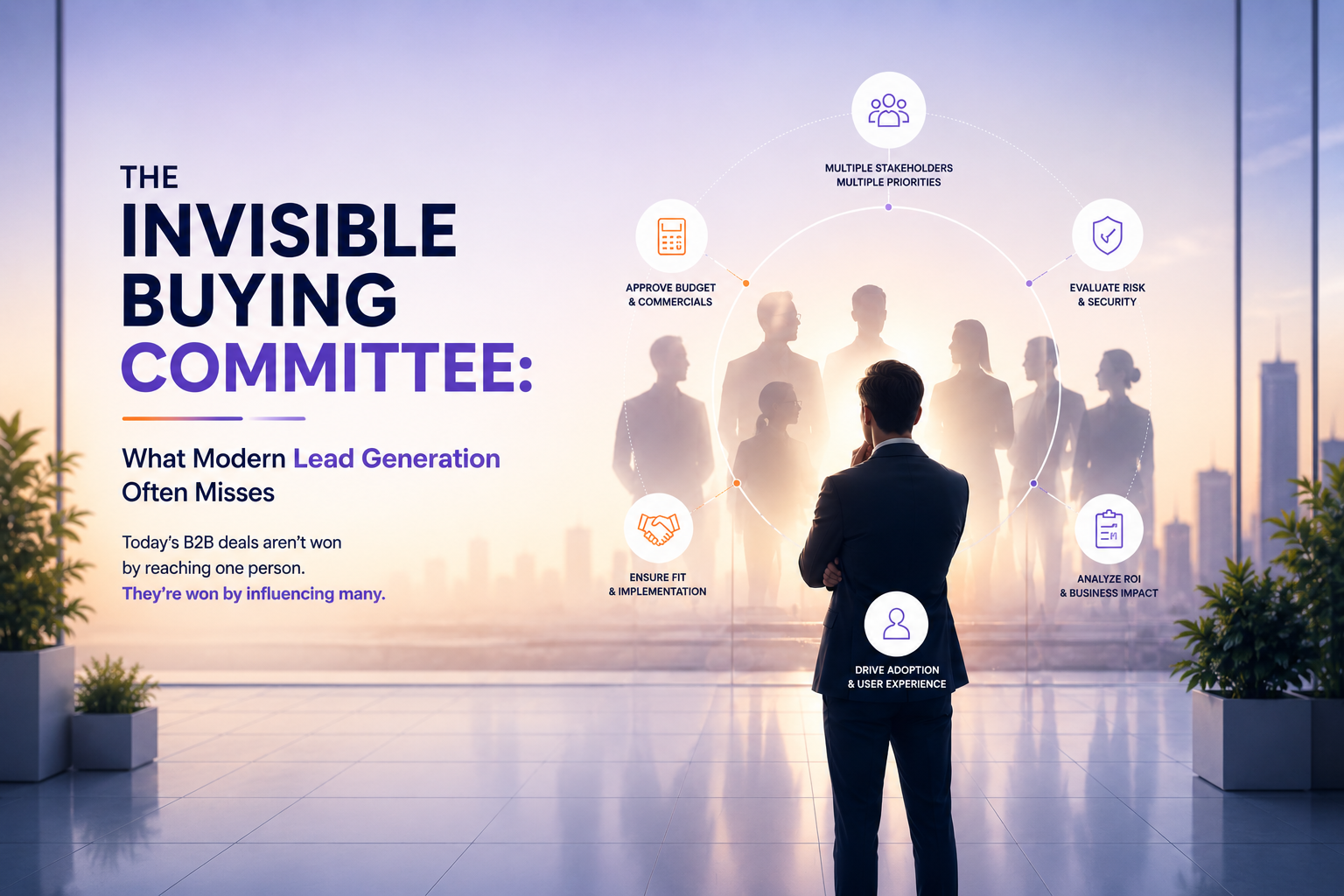
The Invisible Buying Committee: What Modern Lead Generation Often Misses
 Purva Wankhade,
4 months ago
6 min read
Purva Wankhade,
4 months ago
6 min read
For years, B2B lead generation followed a familiar formula. Identify a decision-maker, capture their information through gated content or a demo request, nurture the relationship, and pass the opportunity to sales. Success was measured by marketing-qualified leads, conversion rates, and pipeline volume.
That approach no longer reflects how enterprise buying decisions are made.
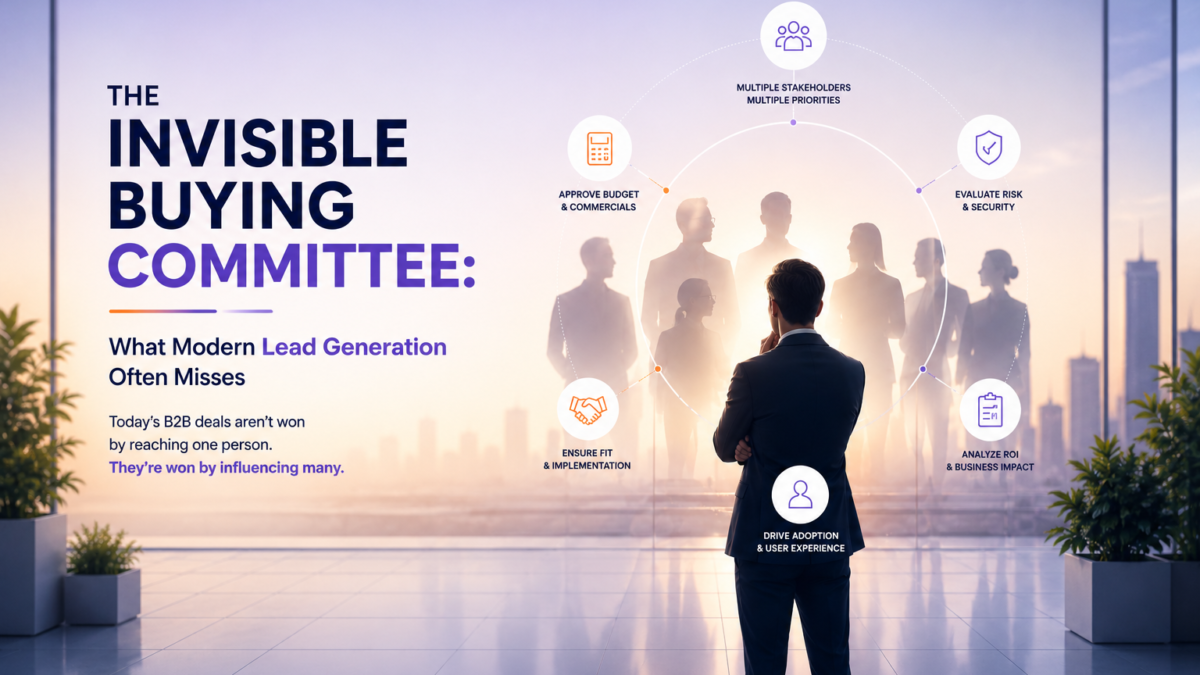
Today’s B2B purchases rarely depend on a single executive. Whether an organization is investing in AI platforms, cybersecurity, cloud infrastructure, marketing technology, or finance software, decisions are increasingly shaped by groups of stakeholders with different priorities, responsibilities, and concerns. Procurement evaluates commercial risk, IT reviews security and integration, finance analyzes long-term costs, operations considers implementation, and end users determine practical adoption.
The challenge is that most of these stakeholders never fill out a form, attend a webinar, or speak with sales during the early stages of the buying journey. They remain largely invisible, yet they often determine whether a deal moves forward. For B2B decision-makers, recognizing this invisible buying committee is becoming one of the biggest competitive advantages in modern lead generation.
Why Traditional Lead Generation Is Missing the Bigger Picture
The buying journey itself has fundamentally changed. Generative AI, AI-powered search experiences, industry communities, analyst research, professional networks, and peer recommendations now enable buyers to answer many of their questions independently. Recent changes in search behavior, including AI-generated summaries and conversational search experiences, have reduced reliance on traditional website visits for early-stage research. Buyers often compare vendors, evaluate solutions, and validate claims long before they engage with a sales representative.
As a result, many organizations are generating leads without fully understanding who else is influencing the purchase behind the scenes.
This shift exposes one of the biggest weaknesses in traditional lead generation strategies. Marketing teams frequently optimize campaigns around the individual who completes a form while overlooking the broader network of stakeholders who ultimately shape the buying decision. The person downloading a whitepaper may simply be gathering information for a department head. A product manager requesting a demo may still need approval from finance, security, procurement, legal, and executive leadership before any purchase is made.
Winning the initial lead is no longer the same as winning the opportunity.
How AI Is Reshaping Enterprise Buying Journeys
Artificial intelligence is making these buying journeys even more dynamic. AI assistants are helping professionals summarize research, compare vendors, generate requirement documents, and evaluate potential solutions before internal discussions even begin. Instead of searching multiple websites, buyers increasingly rely on AI tools to accelerate decision-making and narrow vendor shortlists.
This evolution means lead generation can no longer focus solely on attracting website traffic or increasing form submissions. Organizations must ensure their expertise, customer success stories, product capabilities, and educational content are discoverable wherever buyers conduct research, whether through AI-powered search, partner ecosystems, analyst reports, professional communities, or industry publications.
The Rise of Multi-Stakeholder Decision Making
Another emerging trend is the growing complexity of buying groups themselves. Enterprise organizations are placing greater emphasis on governance, compliance, cybersecurity, sustainability, and return on investment. Each additional priority introduces new stakeholders into purchasing decisions. A single technology investment may require alignment across marketing, IT, finance, legal, operations, customer success, and procurement before contracts are finalized.
This growing complexity explains why many marketing teams report strong lead volume but inconsistent pipeline performance. The issue often isn’t the quality of the individual lead. It’s the inability to influence the broader buying committee.
From Individual Leads to Buying Group Engagement
Forward-thinking organizations are responding by shifting their lead generation strategies from individual acquisition to collective buyer enablement. Instead of creating content exclusively for one decision-maker, they develop resources tailored to multiple stakeholders throughout the buying process. Executive summaries address business outcomes for leadership teams. Technical documentation supports IT evaluations. ROI calculators help finance justify investment. Customer implementation stories reassure operations teams. Compliance resources build confidence among security and legal stakeholders.
Every piece of content serves a different participant in the buying committee.
At the same time, first-party data is becoming increasingly valuable. As privacy regulations continue to evolve and third-party tracking becomes less reliable, organizations are investing in behavioral insights generated through their own digital properties. Rather than relying exclusively on demographic information, marketers are analyzing engagement patterns across content consumption, webinar participation, account activity, and buying intent signals to understand how entire organizations progress through the purchasing journey. Combined with modern B2B AI tools, these insights enable businesses to identify high-intent accounts, predict buyer behavior, and deliver more personalized engagement throughout the sales cycle.
This is where modern lead generation intersects with account-based marketing. Instead of celebrating a single converted lead, revenue teams evaluate engagement across multiple contacts within the same account. They identify consensus, monitor buying signals from different departments, and coordinate personalized outreach that reflects the interests of various stakeholders.
The objective shifts from generating more leads to building organizational confidence.
Building Trust Across the Entire Buying Committee
Partnerships are also playing a larger role in influencing invisible buying committees. Technology vendors increasingly collaborate with implementation partners, consultants, cloud providers, system integrators, and industry specialists to create integrated solutions that inspire greater buyer confidence. Enterprise customers often place equal value on the strength of a vendor’s ecosystem as they do on the product itself because successful implementation depends on trusted collaboration long after the contract is signed.
Perhaps the biggest misconception surrounding lead generation today is the belief that more leads automatically produce more revenue. In reality, sustainable growth depends on helping buying committees reach informed decisions faster. Marketing teams that educate multiple stakeholders, anticipate objections early, and deliver relevant information throughout the buying journey create significantly stronger opportunities than those focused solely on lead volume.
The most successful B2B organizations are already redefining how they measure success. Pipeline influence, account engagement, buying group coverage, sales velocity, opportunity progression, and revenue contribution are becoming more meaningful indicators than marketing-qualified leads alone. These metrics better reflect the collaborative nature of modern enterprise purchasing and provide a clearer understanding of marketing’s impact on business growth. As a result, B2B lead generation services are increasingly being aligned with revenue-focused strategies that prioritize account engagement, buying committee influence, and long-term pipeline growth over lead volume alone.
The Future of Lead Generation is Buying Committee Enablement
The future of lead generation will not belong to organizations that capture the most contact information. It will belong to those that understand how enterprise decisions are actually made.
The invisible buying committee may never attend your webinar, request a product demo, or subscribe to your newsletter. Yet every article they read, every analyst report they reference, every AI-generated summary they review, and every conversation they have with internal stakeholders influences whether your business earns their trust.
For B2B leaders, that is the new reality of lead generation. Success is no longer about finding a single decision-maker. It is about equipping an entire buying committee with the confidence to choose your solution.