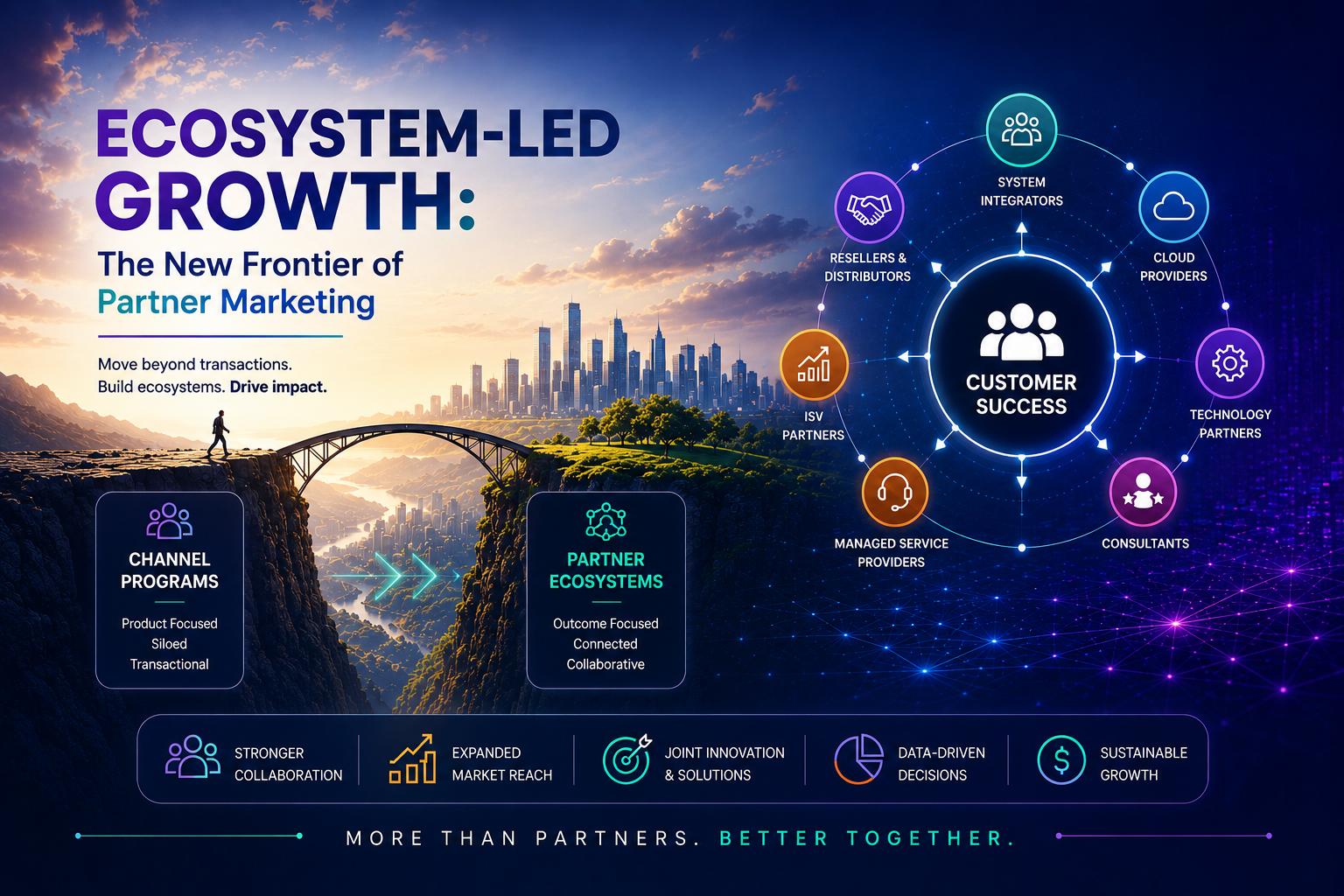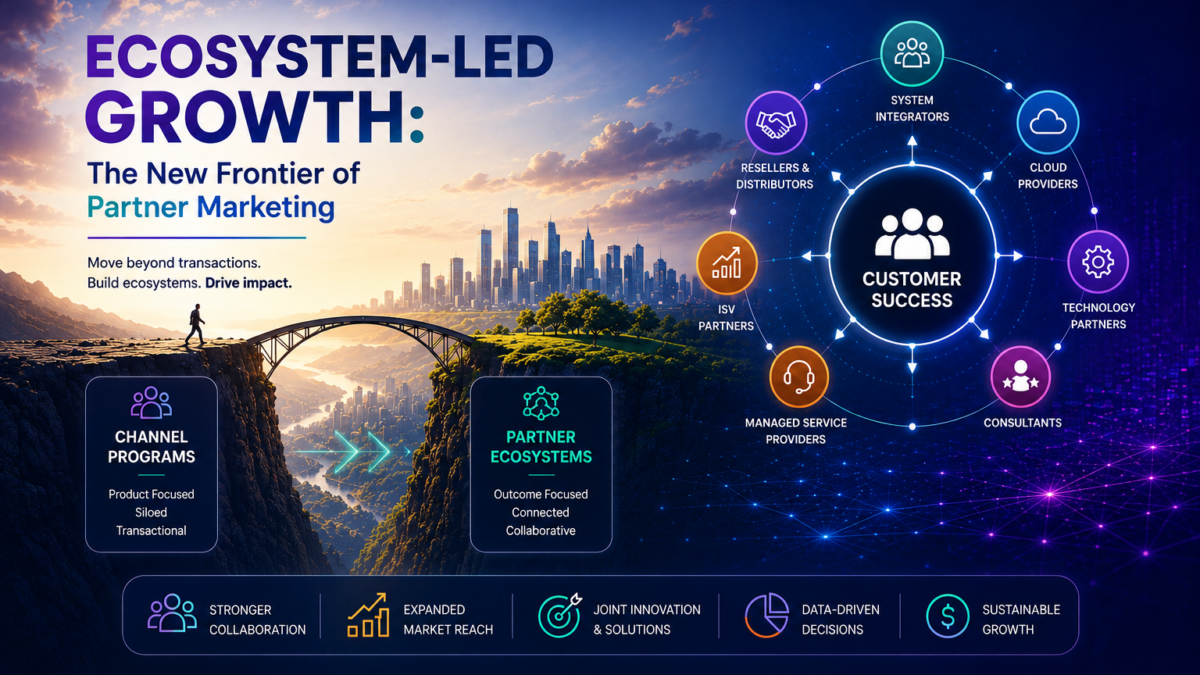
For years, partner marketing was largely synonymous with channel marketing. Vendors recruited resellers, distributors, and solution providers, offered marketing development funds (MDF), shared campaign assets, and measured success by partner registrations or product sales. While this model fueled business growth for decades, it no longer reflects how enterprise buying decisions are made.
Today’s B2B customers rarely rely on a single vendor to solve complex business challenges. Digital transformation, cloud adoption, cybersecurity, artificial intelligence, and industry-specific solutions require multiple technology providers, consultants, system integrators, managed service providers, and independent software vendors to work together. As buying journeys become increasingly interconnected, partner marketing is evolving from managing channel programs to orchestrating entire business ecosystems.
For B2B decision-makers, this shift represents more than a marketing trend. It is becoming a strategic growth model.
How Partner Marketing Is Evolving Beyond Traditional Channel Programs
The rise of ecosystem-led growth is changing how organizations approach go-to-market strategies. Instead of asking, “How can we enable more partners?” leading businesses are asking, “How can we create greater value together?” This subtle change in mindset is redefining partner relationships across industries. Rather than viewing partners as independent sales channels, organizations are building collaborative ecosystems where multiple partners contribute expertise, technology, services, and customer success throughout the buying lifecycle. Industry analysts increasingly describe this transition as partner-led growth, where ecosystems influence a growing share of enterprise purchasing decisions.
Artificial intelligence is accelerating this transformation. AI-powered business platforms are making it easier to identify complementary partners, personalize co-marketing campaigns, predict partner performance, automate campaign execution, and deliver relevant content to buyers across multiple touchpoints. More importantly, AI is allowing organizations to move beyond manual partner management toward intelligent ecosystem orchestration.
However, the conversation around AI has also matured. Throughout recent industry events, business leaders have emphasized that organizations are moving away from experimenting with AI for its own sake and are instead focusing on measurable business outcomes. In partner marketing, this means using AI to strengthen collaboration, improve partner experiences, and increase revenue rather than simply automating repetitive tasks.
This evolution is changing what businesses expect from partner marketing services. Traditional partner marketing often revolved around distributing co-branded collateral, funding campaigns, and managing event participation. Modern partner marketing is far more strategic. It involves identifying high-value ecosystem partners, aligning messaging across organizations, coordinating integrated campaigns, leveraging AI content syndication to deliver personalized content to the right audiences, sharing market intelligence, and measuring contribution across increasingly complex buyer journeys.
The importance of specialization is also becoming more apparent. Enterprise customers are no longer evaluating products in isolation. They want complete business outcomes. Whether implementing AI solutions, modernizing cloud infrastructure, or improving cybersecurity, buyers expect technology vendors, consultants, implementation partners, and service providers to work together seamlessly. As a result, successful partner marketing focuses less on promoting individual products and more on communicating joint value propositions that address real business challenges.
Why Connected Ecosystems Are the Future of Partner Marketing
Another noticeable shift is the growing investment in partner marketing technology. Organizations are adopting dedicated partner marketing automation platforms to simplify campaign management, improve partner engagement, and generate measurable pipeline. According to recent industry research, investment in partner marketing automation continues to rise as businesses recognize that ecosystem marketing requires scalable processes rather than manual coordination.
The structure of partner programs is changing as well. Many technology vendors are redesigning incentive models to reward business outcomes instead of transactional sales. Competencies, customer success, industry expertise, consulting capabilities, and long-term value creation are becoming stronger indicators of partner success than simple resale volume. This reflects a broader industry movement away from quantity-driven partner recruitment toward building smaller, more capable ecosystems that can deliver measurable customer outcomes.
Recent announcements across the technology industry reinforce this direction. Companies are expanding investments in partner enablement, AI-focused ecosystems, co-selling initiatives, and specialized partner networks designed to help organizations address increasingly sophisticated customer requirements. Rather than competing for larger partner lists, vendors are investing in deeper collaboration with partners that bring complementary expertise and industry knowledge.
At the same time, buyer expectations are reshaping partner marketing priorities. Enterprise decision-makers conduct extensive independent research before engaging with sales teams. They seek trusted recommendations, integrated solutions, customer success stories, and validation from multiple sources. This means partner marketing is no longer limited to supporting sales channels; it has become a key mechanism for building credibility across the broader buying ecosystem.
The most successful organizations recognize that every partner interaction influences the customer experience. Marketing, sales, customer success, implementation, consulting, and support teams increasingly work together across organizational boundaries to deliver consistent messaging and seamless engagement. As a result, partner marketing services are evolving beyond campaign execution to enable connected customer journeys, strengthen ecosystem collaboration, and deliver consistent value across every stage of the buying lifecycle.
For marketing leaders, this requires a different approach to measurement. Instead of focusing solely on leads generated through partner campaigns, organizations are increasingly tracking ecosystem influence, shared pipeline, joint customer acquisition, partner-sourced revenue, co-selling effectiveness, and customer lifetime value. These metrics provide a more accurate picture of how ecosystem collaboration contributes to sustainable business growth.
The future of partner marketing will not be defined by larger partner databases or more campaign templates. It will be defined by intelligent collaboration. Organizations that invest in ecosystem thinking, AI-enabled partner engagement, shared customer success, and measurable business outcomes will be better positioned to navigate increasingly complex markets.
As enterprise technology continues to evolve, competitive advantage will depend less on what a company can deliver alone and more on the strength of the ecosystem it builds around its customers. Partner marketing services are no longer supporting functions—they are becoming strategic enablers of ecosystem-led growth. For B2B organizations looking to accelerate revenue, expand market reach, and deliver greater customer value, the future belongs not to individual channel programs but to connected partner ecosystems.