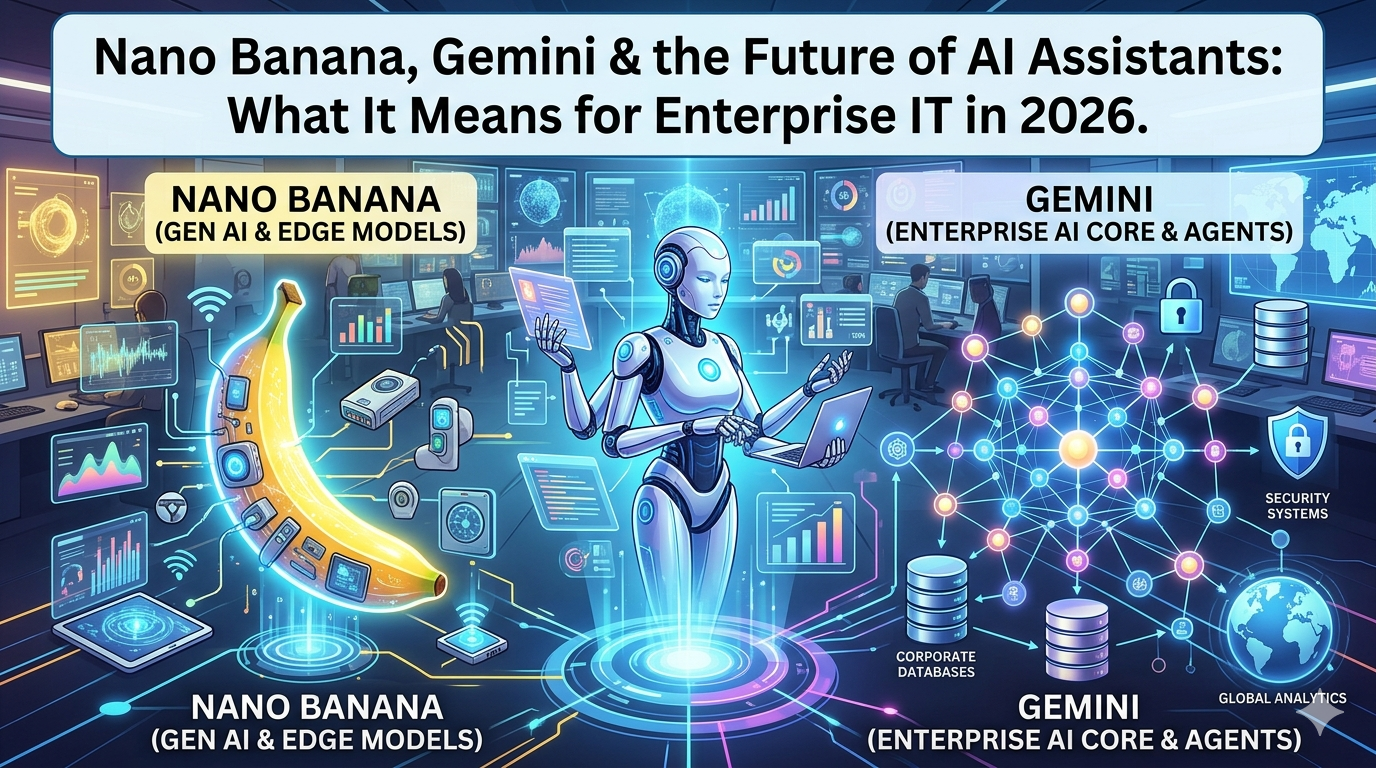
Nano Banana, Gemini & the Future of AI Assistants: What It Means for Enterprise IT in 2026
 Vansh Banthia,
7 months ago
3 min read
Vansh Banthia,
7 months ago
3 min read
The AI race is no longer just about bigger models — it’s about smarter, faster, and more usable systems.
With innovations like Nano Banana and continuous upgrades to Gemini, the focus is shifting toward lightweight intelligence, multimodal capabilities, and real-time enterprise applications.
In 2026, AI is no longer confined to cloud-based tools — it’s becoming embedded, efficient, and everywhere.
What Is “Nano Banana” — And Why It Matters
While still emerging, Nano Banana represents a new class of ultra-lightweight AI models designed for:
- On-device processing
- Low latency performance
- Reduced compute costs
- Real-time decision-making
Unlike traditional large models, these systems are optimized to run closer to the user, enabling faster responses and improved privacy.
Think of it as the shift from “centralized AI” to distributed intelligence.
The Evolution of Gemini
Google Gemini has rapidly evolved into one of the most powerful AI ecosystems, with capabilities extending far beyond simple text generation.
In 2026, Gemini is focusing on:
1. Multimodal Intelligence
Gemini can process and understand:
- Text
- Images
- Video
- Audio
This allows enterprises to build richer, more interactive applications.
2. Context-Aware Assistance
Unlike earlier AI tools, Gemini can maintain context across tasks, enabling:
- Smarter workflows
- Better decision-making
- Continuous task execution
This makes it more of an AI collaborator than just a tool.
3. Integration Across Ecosystems
Gemini is deeply integrated into enterprise environments, connecting with:
- Productivity tools
- Cloud platforms
- Business applications
This allows AI to operate seamlessly across workflows instead of in silos.
From Cloud AI to Edge AI
The combination of Nano Banana-like models and Gemini advancements is driving a major shift:
From cloud-dependent AI → to edge and hybrid AI systems
This shift enables:
✔ Faster processing (no latency from cloud calls)
✔ Improved data privacy
✔ Offline capabilities
✔ Reduced infrastructure costs
For enterprises, this opens up new possibilities in:
- Field operations
- Healthcare devices
- Manufacturing systems
- Real-time analytics
Enterprise Use Cases Emerging in 2026
Smart Operations
Lightweight AI models can run directly on devices, enabling real-time monitoring and automation without relying on cloud connectivity.
Intelligent Workflows
Gemini-powered assistants can:
- Draft reports
- Analyze data
- Automate repetitive tasks
- Provide contextual recommendations
Security & Compliance
On-device AI reduces data exposure, making it easier for organizations to meet strict compliance requirements.
Real-Time Decision Making
With faster processing and contextual understanding, businesses can act on insights instantly rather than waiting for batch analysis.
Why This Shift Matters for IT Leaders
For enterprise IT teams, this evolution introduces both opportunities and challenges.
Opportunities
- Greater efficiency and automation
- Enhanced user experiences
- Reduced dependency on centralized infrastructure
Challenges
- Managing distributed AI systems
- Ensuring governance and control
- Integrating new AI capabilities with legacy systems
IT leaders must rethink their architecture to support a hybrid AI future.
The Role of AI Strategy in 2026
Adopting tools like Gemini or lightweight models isn’t enough.
Organizations need a clear strategy that includes:
- Data readiness
- AI governance frameworks
- Integration planning
- Continuous optimization
The goal is not just to implement AI — but to operationalize it at scale.
What’s Next for AI Assistants?
AI assistants are evolving into:
- Proactive agents that anticipate needs
- Embedded systems within everyday tools
- Collaborative partners in decision-making
The combination of powerful models like Gemini and efficient systems like Nano Banana is accelerating this transformation.
Conclusion
The future of AI isn’t just bigger — it’s smarter, faster, and more distributed.
With innovations like Nano Banana and the continued evolution of Google Gemini, enterprises are entering a new era where AI is:
- Always available
- Deeply integrated
- Highly efficient
For businesses, the message is clear:
The next competitive advantage won’t come from having AI — but from how effectively you deploy it across your ecosystem.