The 2026 B2B Demand Gen Duel: Content Syndication vs. Paid Ads
 Anuvinder Singh,
7 months ago
8 min read
Anuvinder Singh,
7 months ago
8 min read
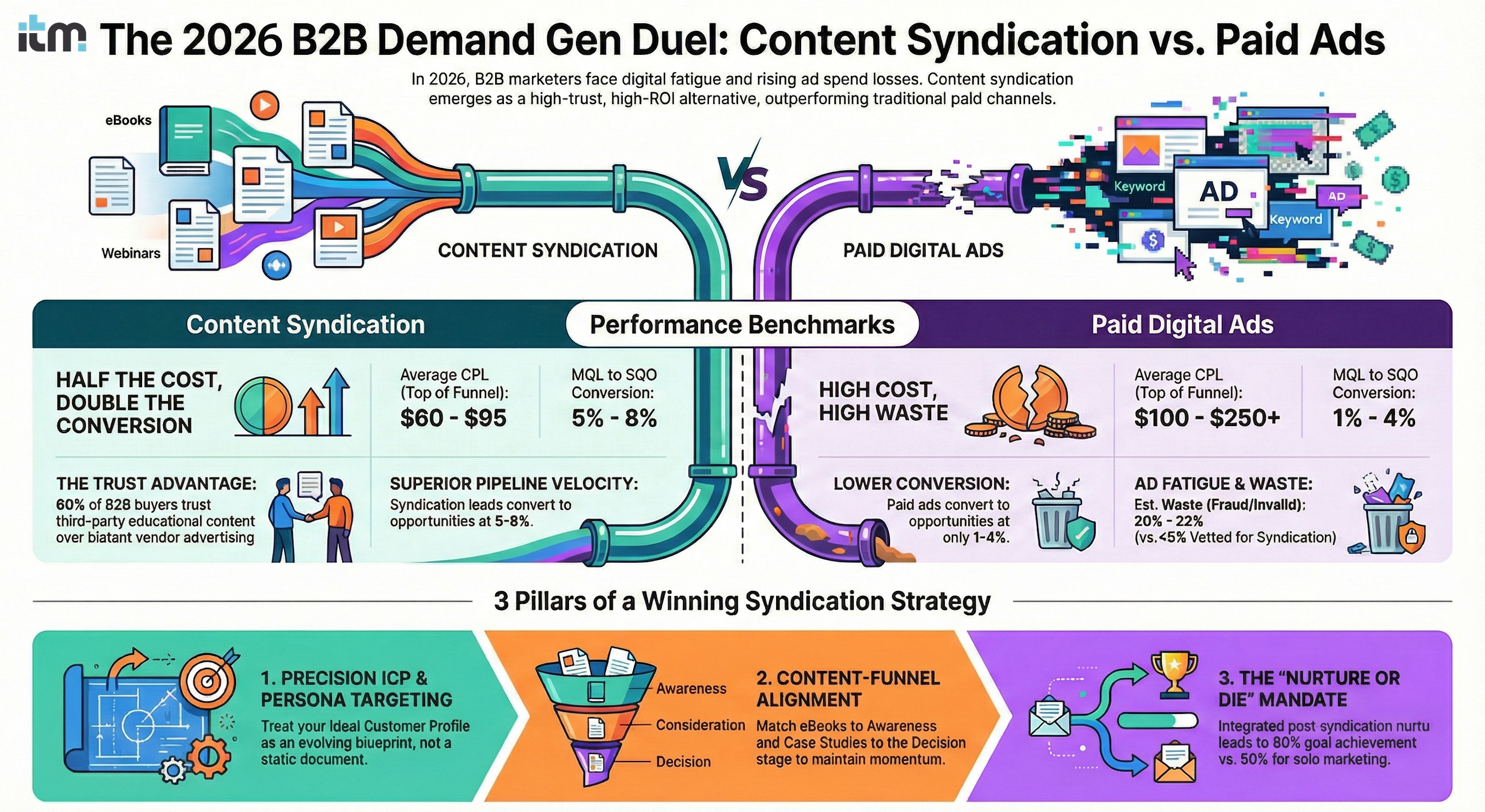
In 2026, B2B marketers face a critical crossroads: digital fatigue is rising, ad spend losses are mounting, and traditional paid advertising channels are delivering diminishing returns. Meanwhile, content syndication has emerged as a high-trust, high-ROI alternative that’s fundamentally reshaping how B2B companies generate demand and acquire customers.
This comprehensive analysis breaks down the performance benchmarks, cost differentials, and strategic frameworks that explain why content syndication is outperforming paid digital ads—and how B2B marketers can capitalize on this shift.
The Performance Gap: By The Numbers
Content Syndication: Half The Cost, Double The Conversion
The economics of content syndication are compelling:
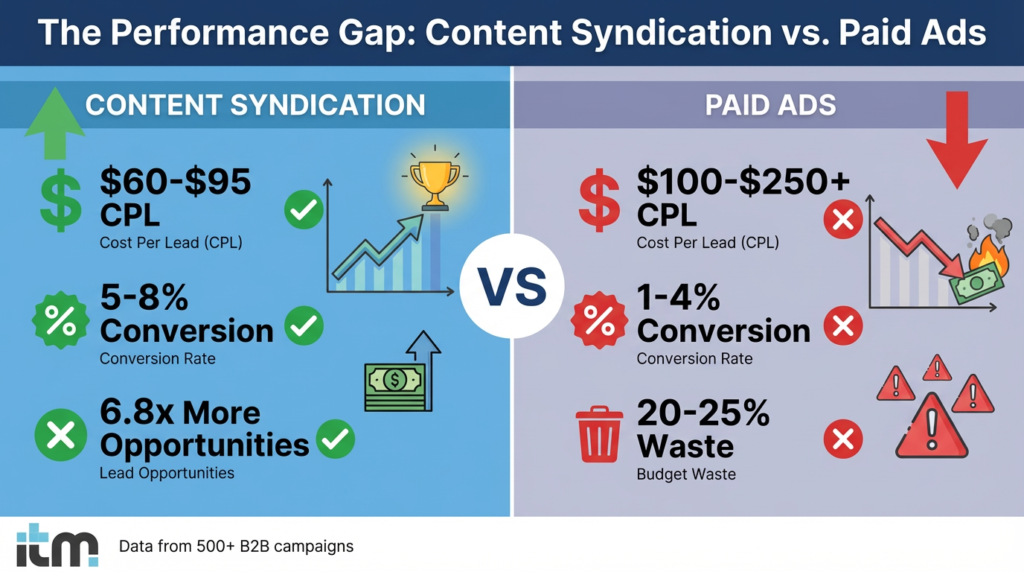
- Average CPL (Cost Per Lead): $60 – $95 per funnel
- MQL to SQO Conversion: 5% – 8%
- Superior Pipeline Velocity: Syndication leads convert to opportunities at 5-8%
Compare this to the sobering reality of paid digital advertising:
- Average CPL: $100 – $250+
- MQL to SQO Conversion: 1% – 4%
- Lower Conversion: Paid ads convert to opportunities at only 1-4%
- Ad Fatigue & Waste: Estimated waste from fraud/invalid clicks: 20% – 25% (vs. <5% vetted for syndication)
The bottom line: Content syndication delivers leads at roughly half the cost while converting at double the rate of traditional paid advertising.
Why Content Syndication Outperforms Paid Ads
1. The Trust Advantage
The foundation of content syndication’s success is trust. 60% of B2B buyers trust third-party educational content over blatant vendor advertising.
When your white paper, case study, or webinar is distributed through respected industry publications, review sites, and educational platforms, it carries implicit endorsement. Buyers don’t feel “sold to”—they feel informed.
Paid ads, by contrast, trigger immediate skepticism. B2B decision-makers have developed banner blindness and ad fatigue after years of aggressive retargeting and intrusive campaigns.
2. Superior Pipeline Velocity
Content syndication doesn’t just generate cheaper leads—it generates better leads.
Syndication leads convert to opportunities at 5-8%, compared to just 1-4% for paid ads. Why? Because syndication captures buyers in the research phase, when they’re actively seeking solutions. These are self-educated, high-intent prospects who have already consumed your thought leadership before entering your funnel.
Paid ads interrupt buyers during unrelated activities. Even when they click, they’re often in exploratory mode—not evaluation mode.
3. The Ad Waste Crisis
The dirty secret of paid digital advertising: 20-25% of your budget disappears to fraud and invalid traffic.
According to industry research, click fraud, bot traffic, accidental clicks, and low-quality placements waste billions in B2B ad spend annually. Content syndication, with its vetted publisher networks and performance-based pricing, keeps waste under 5%.
The 3 Pillars of a Winning Syndication Strategy
Based on analysis of high-performing B2B campaigns, successful content syndication strategies rest on three pillars:
Pillar 1: Precision ICP & Persona Targeting
Treat your Ideal Customer Profile as an evolving blueprint, not a static document.
The most effective syndication campaigns start with laser-focused targeting:
- Firmographics (company size, revenue, industry, technology stack)
- Job titles and seniority levels (decision-makers and influencers)
- Pain points and buying triggers
- Engagement signals (content consumption patterns, intent data)
Pro Tip: Refine your ICP quarterly based on which syndicated leads convert fastest. Double down on high-converting segments.
Pillar 2: Content-Funnel Alignment
Match eBooks and Awareness content to Top-of-Funnel, and Case Studies to Decision stage to maintain momentum.
Content syndication fails when marketers distribute the wrong content at the wrong stage:
- Top-of-Funnel (Awareness): Industry reports, trend analysis, educational eBooks, “how-to” guides
- Mid-Funnel (Consideration): Solution comparison guides, ROI calculators, webinars, expert Q&As
- Bottom-of-Funnel (Decision): Case studies, customer testimonials, product demos, free trials
Misalignment kills conversion. A product datasheet won’t work for awareness. A thought leadership eBook won’t close deals.
Pillar 3: The “Nurture or Die” Mandate
Integrated email/SMS nurture leads to 80% goal achievement vs. 50% without marketing.
Content syndication generates volume—but volume without nurture is wasted opportunity.
High-performing teams implement:
- Immediate engagement: Automated welcome email within 15 minutes of download
- Multi-touch sequences: 7-10 touchpoints over 30-45 days
- Personalized content: Dynamic emails based on downloaded asset and firmographics
- Sales alerts: Notify reps when leads hit engagement thresholds
- Multi-channel approach: Email + LinkedIn + phone + SMS for high-value accounts
Without structured nurture, even high-quality syndicated leads go cold. With it, conversion rates increase by 60%.
Why Paid Ads Still Have a Place (But Not Where You Think)
Content syndication’s dominance doesn’t mean paid advertising is obsolete—it means its role has changed.
Where Paid Ads Still Work:
- Retargeting Warm Audiences
Use paid ads to retarget visitors who consumed syndicated content but didn’t convert. This combines syndication’s trust-building with ads’ persistence. - Account-Based Marketing (ABM)
Hyper-targeted LinkedIn ads to specific accounts identified through syndication can accelerate pipeline velocity. - Event Promotion
Paid ads excel at driving registrations for webinars and virtual events—which then become syndicated content assets. - Brand Awareness (Top 1%)
If you have budget to burn, paid ads can build brand recognition among target accounts—but only at scale.
Where Paid Ads Fail:
- Cold lead generation: CPL is prohibitively expensive ($150-$300+)
- Direct conversion: 1-4% conversion rates don’t justify the cost
- ROI justification: Hard to prove attribution in long B2B sales cycles
- Fraud exposure: 20-25% waste erodes already-thin margins
The Financial Reality: A Side-by-Side Comparison
Let’s run the numbers on a $50,000 quarterly demand gen budget:
Scenario A: Paid Digital Ads
- Average CPL: $150
- Total Leads: 333 leads
- Fraud/Invalid Traffic Waste: -25% = 250 valid leads
- MQL to SQO Conversion: 2.5%
- Sales Opportunities: 6 opportunities
- Cost Per Opportunity: $8,333
Scenario B: Content Syndication
- Average CPL: $75
- Total Leads: 667 leads
- Fraud/Invalid Traffic Waste: -5% = 634 valid leads
- MQL to SQO Conversion: 6.5%
- Sales Opportunities: 41 opportunities
- Cost Per Opportunity: $1,220
The verdict: Content syndication delivers 6.8x more opportunities at 1/7th the cost per opportunity.
For B2B companies with limited budgets and aggressive pipeline targets, the math is unambiguous.
Case Study: How ITMunch Helps B2B Companies Win With Syndication
At ITMunch, we’ve helped 90+ B2B tech companies achieve results like these:
SaaS Company Case Study:
- Challenge: High CAC ($850), long sales cycles (120 days), low demo-to-close rate
- Solution: 3-pillar syndication strategy across 1,500+ platforms
- Results:
- 340% increase in qualified leads
- $850 → $280 CAC
- 120 → 85-day sales cycle
- 180 sales-ready opportunities in 90 days
Cybersecurity Vendor Case Study:
- Challenge: Paid ads delivering low-quality leads, 1.2% conversion rate
- Solution: ICP-targeted content syndication + nurture automation
- Results:
- $220 → $68 CPL
- 1.2% → 7.8% conversion rate
- 31x ROI in year one
How To Get Started With Content Syndication
Step 1: Audit Your Content Assets
Inventory your existing content:
- White papers and eBooks
- Case studies and testimonials
- Webinar recordings
- Industry reports and research
- Product guides and comparison sheets
Identify gaps in your funnel and create new assets where needed.
Step 2: Define Your ICP With Precision
Go beyond basic firmographics. Define:
- Job titles that influence purchase decisions
- Company size and revenue ranges
- Technology stack and integration needs
- Pain points and buying triggers
- Content consumption preferences
Step 3: Select Syndication Partners Strategically
Not all syndication networks are equal. Evaluate partners on:
- Audience quality: Do they reach your ICP?
- Vetting process: How do they validate leads?
- Performance guarantees: Do they offer CPL caps or performance-based pricing?
- Fraud prevention: What measures prevent bot traffic?
- Reporting transparency: Can you see lead-level data?
Pro Tip: Work with a partner like ITMunch that manages 1,500+ syndication relationships so you don’t have to vet platforms individually.
Step 4: Build Your Nurture Engine
Before launching syndication campaigns, ensure you have:
- Marketing automation platform (HubSpot, Marketo, Pardot)
- Segmented nurture sequences by persona and funnel stage
- Lead scoring model to prioritize sales follow-up
- CRM integration for seamless handoff
- Multi-channel touchpoints (email, LinkedIn, phone)
Step 5: Measure, Optimize, Scale
Track these KPIs:
- Cost per lead (CPL)
- MQL to SQO conversion rate
- Opportunity creation rate
- Sales cycle length
- Customer acquisition cost (CAC)
- ROI and payback period
Double down on high-performing platforms and content. Cut underperformers ruthlessly.
The 2026 Reality: Adapt or Get Left Behind
B2B buyers have evolved. They research independently, distrust advertising, and value third-party content over vendor messaging. Digital ad costs continue rising while performance declines.
Content syndication isn’t a trend—it’s the new foundation of B2B demand generation. Companies that recognize this shift early will capture market share from competitors still burning budget on inefficient paid ads.
The Choice Is Clear:
- Pay $150+ per lead with 1-4% conversion, or
- Pay $60-$95 per lead with 5-8% conversion
- Waste 20-25% on fraud, or
- Waste <5% with vetted networks
- Interrupt skeptical buyers with ads, or
- Educate engaged buyers with content
The 2026 B2B Demand Gen Duel isn’t really a competition—it’s a reckoning. And content syndication is winning decisively.
Ready to Shift Your Strategy?
If you’re still relying heavily on paid digital ads and watching your CAC climb while conversion rates fall, it’s time to explore content syndication.
At ITMunch, we specialize in three core services:
- B2B Content Syndication — Distribution across 1,500+ vetted platforms with 1M+ monthly reach
- Tools Publishing — Get listed on high-intent comparison sites (G2, Capterra, TrustRadius) where buyers research
- Precision Media Buying — AI-optimized campaigns focused on lead quality, not just volume
Our track record:
- 500+ successful campaigns
- 90+ global B2B brands
- 1M+ monthly decision-maker reach
- Proven ROI (clients average 8-15x return)
Get Your Free Content Syndication Audit
We’ll analyze your current demand gen performance and show you exactly how much you could save (and how many more opportunities you could generate) with strategic content syndication.
👉 Visit itmunch.com/b2b-content-syndication-services to learn more.

Content Syndication vs. Paid Ads: The Clear Winner for B2B in 2026The Bottom Line
In 2026, B2B marketing isn’t about who spends the most—it’s about who spends the smartest. Content syndication delivers half the cost, double the conversion, and 5-8x more opportunities than paid digital ads.
The question isn’t whether to adopt content syndication. It’s whether you’ll do it before your competitors do.
What’s your biggest B2B lead generation challenge right now? Share with us on contact@itmunch.com.
#B2BMarketing #ContentSyndication #DemandGeneration #LeadGeneration #MarketingROI #B2BTech #PaidAds #MarketingStrategy #ITMunch